

Oil Prices Rise to Two-Week High as Iran Deal Unravels and Shipping Risks Resurface
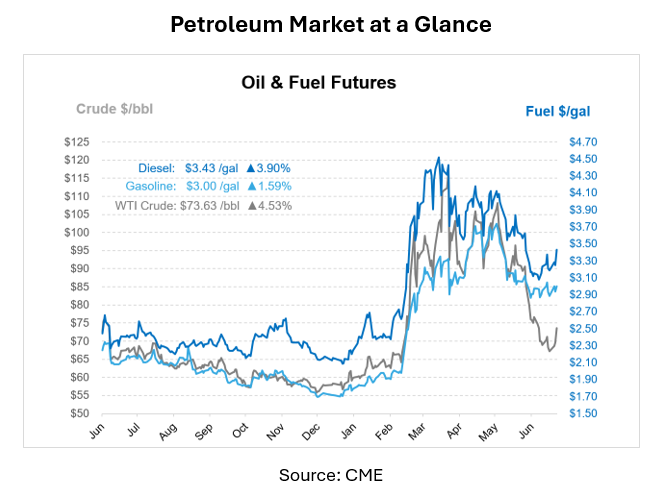
Oil prices moved higher this week after renewed conflict in the Middle East brought supply concerns back into focus. Prompt crude futures were up more than $3 per barrel this morning, extending gains from the previous day, when prices closed roughly $2 per barrel higher. Brent crude climbed more than 4% to around $77 per barrel, while WTI rose more than 4% to about $73 per barrel, with both benchmarks reaching their highest levels since June 22.
The latest move came after President Trump said the interim agreement with Iran was “over,” adding fresh uncertainty around efforts to turn the temporary ceasefire into a longer-term peace deal. The agreement, signed on June 17, helped calm markets by creating a 60-day window for negotiations. However, the situation changed quickly after new attacks on commercial vessels near the Strait of Hormuz and retaliatory U.S. strikes against Iranian targets.
The Strait of Hormuz remains one of the biggest concerns for energy markets because of the volume of crude, refined products, and LNG that normally moves through the waterway. Before the war began in late February, the strait carried about one-fifth of global energy supply.
At least four oil and gas tankers returned from attempting to transit the Strait of Hormuz after renewed vessel attacks raised safety concerns. Three Qatari LNG tankers changed course while heading toward Ras Laffan to load cargoes, and an Indian-flagged VLCC carrying 2 million barrels of Kuwaiti crude also made a U-turn near the strait. At the same time, some stranded crude tankers were able to exit, showing that flows have not stopped completely but remain vulnerable to disruption.
The U.S. also revoked a sanctions waiver that had allowed global sales of Iranian oil under the interim peace agreement. That move added another layer of uncertainty because it directly affects Iran’s ability to sell crude and petroleum products. Under the previous authorization, sales of Iranian-origin crude and petroleum products had been permitted through August 21, but the revocation now gives parties until July 17 to wind down transactions.
Beyond the immediate geopolitical risk, the market is also trying to understand how quickly Gulf exports can normalize. After the June 17 ceasefire, crude flows from the Middle East began recovering, and the return of barrels that had been delayed or stranded helped push prices back toward pre-war levels. Total Middle East crude exports rose to 12.35 million barrels per day in June, up from less than 8 million barrels per day in May, and July exports are expected to reach 12.5 million barrels per day. However, those levels are still well below the pre-war average of around 18 million barrels per day.
Fuel markets are also playing an important role. Refiners have been benefiting from strong demand for gasoline, diesel, and jet fuel while crude prices have recently weakened. The benchmark U.S. 3-2-1 crack spread climbed above $60 per barrel, a record high, while refining margins in Asia and Europe also increased. Gasoline margins in the U.S. have risen more than 60% since early June to more than $56 per barrel, supported by low inventories during peak summer driving season.
Diesel markets remain tight as well. European diesel refining margins climbed above $50 per barrel, and global inventories have fallen in recent months. Ukrainian attacks on Russian energy infrastructure have also contributed to tighter diesel supply by reducing Russian diesel exports. Ukraine said it attacked eight small Russian fuel tankers overnight in the Sea of Azov, targeting gasoline supplies to occupied Crimea.
Inventory expectations in the U.S. are another factor to watch. The API forecasted a 0.4 million-barrel crude inventory draw for the week ended July 3, including a 0.1 million-barrel draw at Cushing. Reuters expected a larger crude draw of 2.4 million barrels. For products, API expected gasoline inventories to fall by 2.9 million barrels and distillate inventories to decline by 1.8 million barrels.
Meanwhile, China is easing some pressure on refined fuel markets by lifting export restrictions for the rest of July. Refiners are planning to export roughly 3 million metric tons of gasoline, diesel, and jet fuel this month, similar to last year’s average export volume. Gasoline exports could rise to more than 400,000 metric tons, diesel exports could reach 600,000 to 700,000 metric tons, and jet fuel exports may rise to about 1.9 million metric tons.
The return of more Gulf barrels and increased refined fuel exports from China could help ease supply concerns, but renewed conflict around the Strait of Hormuz has put geopolitical risk back into the oil prices. Until shipping confidence improves and the path for U.S.-Iran negotiations becomes clearer, oil prices are likely to remain sensitive to any headlines involving Middle East supply routes, tanker movement, and regional security.
This article is part of Daily Market News & Insights


MARKET CONDITION REPORT - DISCLAIMER
The information contained herein is derived from sources believed to be reliable; however, this information is not guaranteed as to its accuracy or completeness. Furthermore, no responsibility is assumed for use of this material and no express or implied warranties or guarantees are made. This material and any view or comment expressed herein are provided for informational purposes only and should not be construed in any way as an inducement or recommendation to buy or sell products, commodity futures or options contracts.