

How America’s Energy Markets Have Evolved Over Time
A recent overview from the U.S. Energy Information Administration (EIA) shows how much the country’s energy mix has changed over time, but it also makes something else clear: today’s energy market is not built around one single fuel source. It is a larger, more complex system where petroleum, natural gas, renewables, coal, nuclear power, and electricity demand all play important roles.
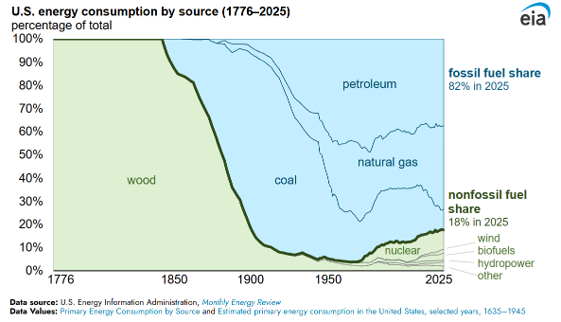
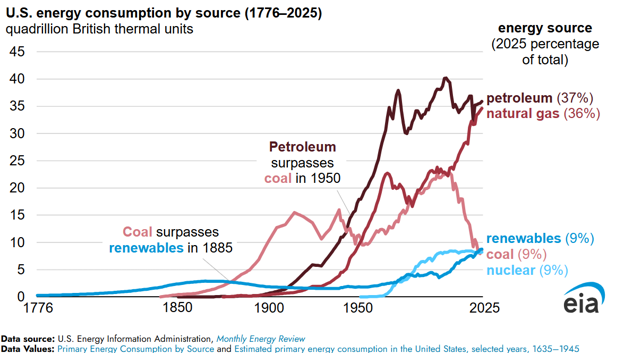
In 2025, total energy used in the United States reached 96 quadrillion British thermal units, up 2% from 2024 but still below the record of 99 quadrillion British thermal units set in 2007. Petroleum was the most-used energy source, followed closely by natural gas. Renewable energy, coal, and nuclear power each accounted for about 9% of total U.S. energy use. Even with the growth of newer energy sources, fossil fuels still accounted for 82% of energy consumed in the United States.
Petroleum remains the largest part of the U.S. energy mix, largely because of transportation. That role developed over time as cars, trucks, boats, and airplanes became central to how people and goods move across the country. According to the EIA, petroleum surpassed coal as the most-used U.S. energy source in 1950, and it remains the top source today. However, petroleum use in 2025 was still below pre-pandemic levels, showing that even the country’s largest energy source continues to shift with changes in travel, demand, and the broader economy.
Natural gas has become one of the most important parts of the modern energy market. The EIA notes that shale gas became more widely available and cheaper in the 2000s because of horizontal drilling and hydraulic fracturing. That changed the power sector in a major way. Between 2011 and 2020, more than 100 coal-fired power plants were replaced with or converted to natural gas. By 2025, natural gas generated more electricity than any other individual energy source and was also the most common home heating source in the United States.
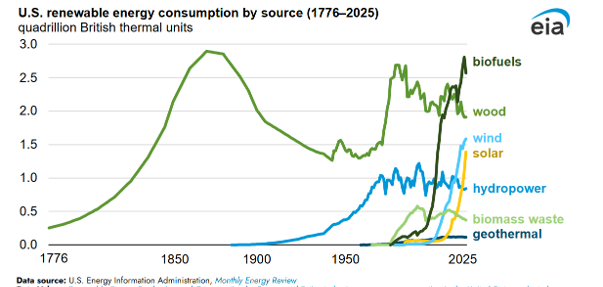
Renewable energy is also playing a larger role. In 2022, U.S. energy consumption from renewables surpassed nuclear for the first time since 1984. In 2023, renewables surpassed coal use for the first time since the 1880s. By 2025, wind and solar accounted for more energy use than hydropower, showing how quickly the renewable mix itself has changed. Biofuels have also become an important part of the renewable category, becoming the most-used U.S. renewable energy source in 2016. Common biofuels include ethanol, biodiesel, and renewable diesel.
Coal is no longer the dominant energy source it once was, but it remains part of the U.S. energy system. Coal helped power industrial growth, railroads, and electricity generation for much of the country’s history, and it surpassed wood as the largest U.S. energy source around 1885. Today, its role has declined as natural gas and renewables have grown, but coal still accounted for about 9% of total U.S. energy use in 2025.
Nuclear power also continues to be an important source of U.S. energy, especially for electricity generation. The country’s first full-scale commercial nuclear power plant came online in Pennsylvania in 1957. The U.S. nuclear fleet later peaked at 112 operable units, with 94 operating in 2025. Like coal and renewables, nuclear power accounted for about 9% of total U.S. energy use in 2025.
Electricity demand may be one of the most important parts of the energy story going forward. The EIA points to data centers, cryptocurrency mining, and electric vehicles as recent drivers of higher energy use. U.S. electricity demand is expected to grow faster through the end of 2027 than at any time since 2000, mostly because of data centers. Electric vehicle demand is also growing, with nearly 6 million EVs on U.S. roads in 2024, almost six times more than in 2018. U.S. light-duty EV electricity consumption reached 24 billion kilowatt-hours in 2025, nearly 15 times higher than in 2018.
The EIA’s overview shows that the U.S. energy market has never stood still. The country moved from wood to coal, then from coal to petroleum, and later toward a broader mix that includes natural gas, nuclear power, renewables, and growing electricity demand. Today, the energy transition is not about one source replacing all others overnight. It is about balancing a wider mix of energy sources while meeting the needs of transportation, homes, businesses, power generation, and new technologies.
This article is part of Daily Market News & Insights


MARKET CONDITION REPORT - DISCLAIMER
The information contained herein is derived from sources believed to be reliable; however, this information is not guaranteed as to its accuracy or completeness. Furthermore, no responsibility is assumed for use of this material and no express or implied warranties or guarantees are made. This material and any view or comment expressed herein are provided for informational purposes only and should not be construed in any way as an inducement or recommendation to buy or sell products, commodity futures or options contracts.