
IEA: Strong Oil and Gas Demand Continues. No Peak on the Horizon
The International Energy Agency’s newest World Energy Outlook shows that global oil use is expected to keep growing for many years. In its “current policies scenario,” oil demand is projected to reach 113 million barrels per day by 2050, and use is expected to rise to 5.6 trillion cubic meters. Electric-vehicle sales are growing quickly in China and Europe, but slower adoption in many other regions keeps traditional fuels in high demand.
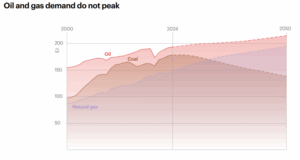
Looking at the “Stated Policies Scenario,” the IEA projects how energy use could change as countries work toward the goals they have already announced. In this scenario, oil demand would reach a high point of about 102 million barrels per day around 2030, then flattens as electric vehicles capture more than 50% of new global sales by 2035.
Even with these differences, the overall picture remains the same: energy demand keeps growing. Since 2000, global energy use has increased by nearly 60%, mostly from emerging and developing economies.
Because so much demand growth is coming from Asia, the IEA projects that by 2035 nearly 60% of global oil and gas exports will flow to Asian markets, up from 45% today. As a result, developing economies in the region are expected to see their fossil-fuel import bill grow by about 40%, reaching more than $1.2 trillion. This growing demand also connects directly to future supply needs.
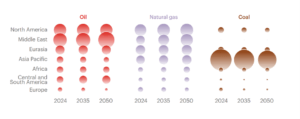
Therefore, industry would need to increase production due to existing fields naturally declining over time. Without new investment, production could fall by about 8% per year. To meet future demand, the world requires an additional 20 to 25 million barrels per day of new supply from projects that have not yet been approved. According to the report, The United States will remain the world’s largest oil and gas producer through to 2050, but production in the Middle East will grow robustly.
The outlook additionally explores the “Net-Zero Scenario,” the most climate-focused path, which shows what it would take to the world to move closer to long-term climate targets. To get there, global renewable energy capacity would need to triple by 2030, and low-emission power sources would need to supply about three-quarters of the world’s electricity by 2035; up from about one-third today. Under these expectations, oil and gas use would decline more quickly, and long-term oil prices could fall to around $25 per barrel in 2050, compared with $106 in a future where consumption keeps rising.
Taken together, the IEA’s data points to a future where oil and natural gas continue playing an important role in meeting global energy needs. While the pace of growth varies depending on policy progress and technology adoption, the outlook shows long-lasting global reliance on fossil fuels through at least the middle of the century.
This article is part of Daily Market News & Insights


MARKET CONDITION REPORT - DISCLAIMER
The information contained herein is derived from sources believed to be reliable; however, this information is not guaranteed as to its accuracy or completeness. Furthermore, no responsibility is assumed for use of this material and no express or implied warranties or guarantees are made. This material and any view or comment expressed herein are provided for informational purposes only and should not be construed in any way as an inducement or recommendation to buy or sell products, commodity futures or options contracts.