

EIA Raises Oil and Fuel Price Forecasts as Middle East Disruptions Continue
The U.S. Energy Information Administration’s latest Short-Term Energy Outlook points to a tighter oil and refined products market through the remainder of 2026 as disruptions in the Middle East continue to limit crude oil shipments and draw down inventories.
In the August outlook, the EIA raised its forecasts for crude oil, diesel, and gasoline prices compared with its July projections. The biggest factor behind the change is continued disruption through the Strait of Hormuz, where constrained tanker traffic has reduced oil shipments and contributed to production shut-ins across the Persian Gulf.
For fuel buyers, the report suggests that supply conditions and elevated prices could remain a concern through the end of the year, even as the EIA expects conditions to gradually improve heading into 2027.
Strait of Hormuz Remains the Key Market Driver
The EIA now assumes that oil shipments through the Strait of Hormuz will remain severely constrained through August before flows begin gradually increasing in September.
The impact has already been significant. According to the EIA, crude oil and petroleum liquids moving through Hormuz averaged approximately 4.9 million barrels per day during the second quarter of 2026, compared with 21.6 million barrels per day in the fourth quarter of 2025, before the conflict began.
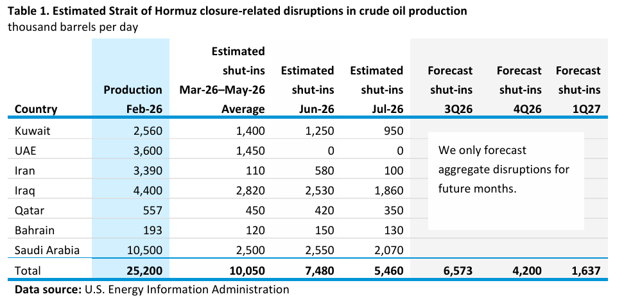
The agency estimates that Middle East crude oil production shut-ins averaged approximately 5.5 million barrels per day in July. Under its current assumptions, the EIA expects production and trade patterns to take until early 2027 to generally return to pre-conflict conditions.
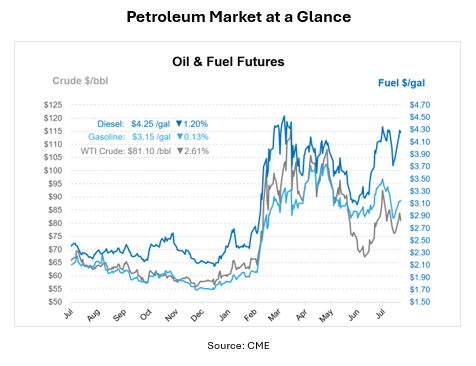
Those disruptions have also changed the direction of crude prices. Brent crude fell as low as $69 per barrel on July 2 following a June memorandum of understanding between the United States and Iran. Renewed attacks on tankers and reduced shipments through Hormuz later pushed Brent as high as $105 per barrel on July 23.
The EIA now forecasts Brent to average about $85 per barrel during the third quarter, $11 higher than its July forecast. Brent is expected to average $78 per barrel in the fourth quarter, then decline to an average of $69 per barrel in 2027 as production recovers and global inventories rebuild.
Diesel and Gasoline Forecasts Move Higher
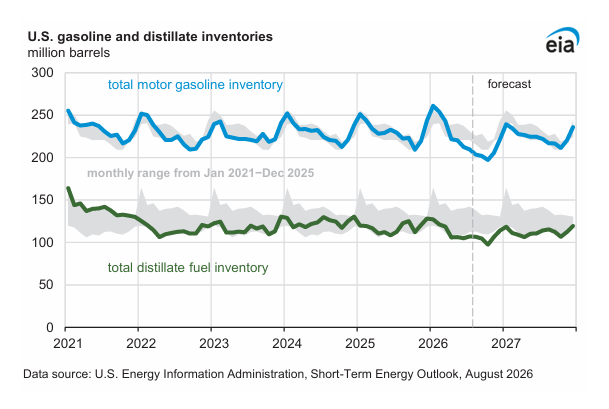
Higher crude costs and tighter global refined product supplies are also flowing into the EIA’s outlook for gasoline and diesel.
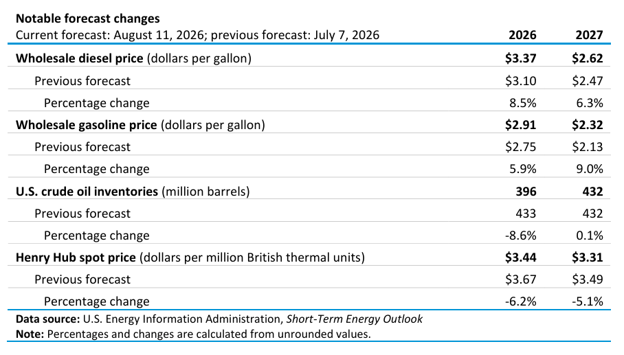
The agency raised its 2026 wholesale diesel price forecast to $3.37 per gallon, up 8.5% from the $3.10 forecast in July. Its wholesale gasoline forecast increased 5.9%, from $2.75 to $2.91 per gallon.
The increases are not being driven by crude oil alone. EIA estimates that global refining conditions have tightened due to lower Russian refined product exports, disruptions to product flows from Saudi Arabia and Kuwait, and reduced refinery runs in China.
These conditions have supported stronger U.S. refinery margins. EIA expects relatively high refinery crude inputs through the end of 2026 as domestic refiners respond to those margins. Through the first seven months of the year, U.S. refinery crude inputs were already at their highest level since 2019.
U.S. Crude Inventories Are Becoming Another Factor to Watch
While U.S. refineries are processing relatively high volumes of crude, domestic commercial inventories have been moving lower.
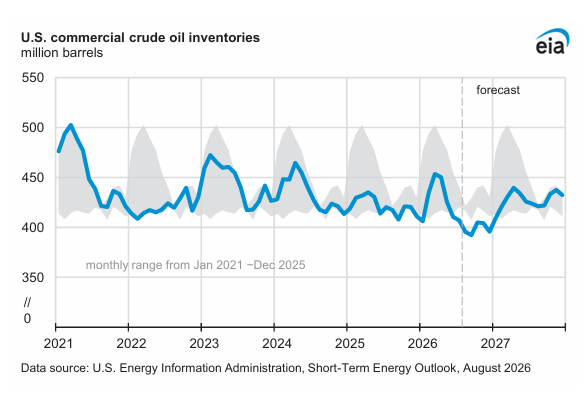
U.S. commercial crude inventories fell by approximately 25 million barrels in May, another 15 million barrels in June, and 4 million barrels in July, according to EIA. The agency now expects commercial crude stocks to remain below the five-year low through the end of 2026.
Strong U.S. crude exports, lower imports, and high refinery runs have all contributed to the decline.
The change is significant enough that the EIA reduced its 2026 U.S. crude inventory forecast to 396 million barrels, down from 433 million barrels in its July outlook. The current forecast assumes no additional releases from the Strategic Petroleum Reserve beyond those announced in March.
For fuel buyers, lower inventories leave less cushion if additional supply disruptions occur. At the same time, refiners are expected to begin seasonal maintenance this fall. EIA forecasts refinery crude inputs to fall below 16 million barrels per day on average in October as maintenance reduces utilization and petroleum product production.
Natural Gas Is Moving in the Opposite Direction
Oil and refined product forecasts rose this month, while the natural gas outlook became more favorable for consumers.
The EIA lowered its third-quarter Henry Hub natural gas price forecast to $2.87 per million British thermal units, 50 cents below its July forecast. Reduced demand from LNG export facilities undergoing maintenance and record U.S. natural gas production are contributing to higher inventories.
EIA expects natural gas storage to reach a record 3,985 billion cubic feet at the end of October, about 5% above the five-year average. The agency forecasts Henry Hub prices to remain below $3.00 per MMBtu until November.
Lower natural gas prices are also supporting increased natural gas-fired electricity generation. Meanwhile, solar and wind generation continued to expand during the first half of 2026, increasing 21% and 6%, respectively, compared with the same period last year.
What Fuel Buyers Should Watch Next
The August STEO shows how quickly the energy outlook can change when physical supply disruptions affect major global trade routes. Just one month ago, the EIA expected a faster normalization of Middle East production and lower oil prices. Continued constraints through the Strait of Hormuz have now pushed that timeline further out.
For businesses managing diesel and gasoline expenses, several factors will be important over the remainder of 2026: the pace of recovery in tanker traffic through Hormuz, the restart of shut-in production in the Middle East, global inventory levels, U.S. crude inventories, and refinery maintenance this fall.
The EIA’s current forecast assumes conditions will gradually improve, allowing crude oil prices to ease later this year and into 2027. But that outlook depends heavily on Middle East production and shipping flows returning toward normal.
Sources
U.S. Energy Information Administration, Short-Term Energy Outlook, August 2026, August 11, 2026. EIA August 2026 Short-Term Energy Outlook
This article is part of Daily Market News & Insights


MARKET CONDITION REPORT - DISCLAIMER
The information contained herein is derived from sources believed to be reliable; however, this information is not guaranteed as to its accuracy or completeness. Furthermore, no responsibility is assumed for use of this material and no express or implied warranties or guarantees are made. This material and any view or comment expressed herein are provided for informational purposes only and should not be construed in any way as an inducement or recommendation to buy or sell products, commodity futures or options contracts.