

Renewed Negotiation Hopes Ease Pressure on Oil Prices
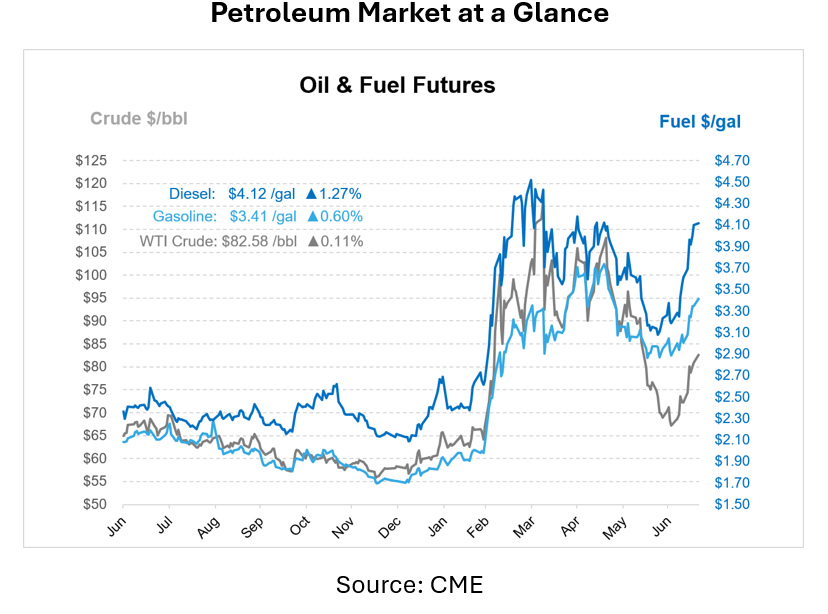
Oil prices are starting the week relatively flat as the possibility of renewed U.S.-Iran negotiations helps offset concerns about disrupted oil shipments, damaged energy infrastructure, and tightening global fuel supplies. WTI prices were down by more than $1.50 per barrel this morning after gaining approximately $11 per barrel last week. Prices had initially risen by about $2.50 per barrel overnight before reversing course after Iran’s foreign ministry said mediators had presented new ideas to the country, raising hopes that diplomatic efforts could help reduce tensions.
The possibility of diplomacy is providing some relief to the market. Mediators have reportedly proposed a 10-day ceasefire that could create an opportunity to revive an interim agreement reached last month. Any progress toward another pause in fighting could help restore shipping activity and reduce the geopolitical risk premium currently built into oil prices.
However, conditions on the ground remain tense. Military strikes between the United States and Iran have expanded, damaging civilian infrastructure and increasing uncertainty surrounding the movement of oil through the Strait of Hormuz. Visible traffic through the waterway had slowed to a near standstill Monday morning following Iranian strikes over the weekend.
Only four vessels reportedly passed through the strait on Sunday, down from eight on Saturday. Two oil tankers were also reportedly immobilized following explosions while attempting to transit the waterway, although those events had not been independently verified. Confirmed flows recently declined to approximately 5.1 million barrels per day, compared with 12.5 million barrels per day one week earlier.
Iran has also called on the Houthis in Yemen to close the Red Sea shipping route if the United States attacks Iranian power infrastructure. The Houthis’ declaration of a naval blockade against Saudi Arabia has added another layer of concern for markets already watching reduced traffic through the Strait of Hormuz.
Some oil-producing countries are searching for alternative transportation routes. Iraq is moving fuel oil and small volumes of crude by truck through Jordan and Syria to bypass the strait and recover lost revenue. Thousands of trucks are reportedly making the approximately four-day journey to Syria’s Mediterranean ports. While this provides another outlet for some supply, trucking cannot easily replace the large volumes normally transported by tankers.
Supply concerns are not limited to the Middle East. A key Kazakh crude export terminal on the Black Sea was forced to halt loadings after a Ukrainian drone strike. If the facility remains offline, the disruption could reduce supplies available to European refineries.
At the same time, higher oil prices are encouraging additional drilling activity in North America. The U.S. crude oil rig count increased by seven to 452 for the week ending July 17, marking the twelfth consecutive week without a decline, the longest such period since January 2022. The U.S. oil rig count is now 30 rigs higher than it was one year ago. Canada’s crude oil rig count increased by 18 to 136 and is up by 16 rigs year over year.
Refineries in Saudi Arabia, Bahrain, Kuwait and the United Arab Emirates remain partially or completely offline following disruptions related to the conflict. Russian refineries have also been damaged by Ukrainian drone strikes, contributing to domestic fuel shortages and restrictions on diesel exports. Across Asia, some refiners have reduced operations because of limited crude availability.
Together, these disruptions removed approximately 5 million barrels per day of global refining output during the second quarter compared with the previous year. Refined product exports from the Gulf also remain well below normal levels. Although the region exported around 4 million barrels per day of crude in June, product exports totaled only about 1 million barrels per day, approximately one-quarter of prewar levels.
The United States helped offset some of these losses during the first half of the year by increasing exports of crude oil, gasoline, diesel, and aviation fuel. However, its ability to continue supporting global markets may be becoming more limited.
U.S. crude inventories, including commercial supplies and the Strategic Petroleum Reserve, have fallen to their lowest level since 1984. Gasoline inventories are at their lowest seasonal level since 2012, while diesel inventories only recently recovered from their lowest point in more than two decades. Weekly U.S. crude and petroleum product exports fell to 10.7 million barrels per day last week after reaching a record 14.2 million barrels per day in April.
Tight supplies are especially visible in refining margins. The U.S. 3-2-1 crack spread, a common measure of refinery profitability, recently approached $70 per barrel, while European diesel margins reached approximately $65 per barrel. These unusually high margins reflect strong competition for limited supplies of finished fuels.
This article is part of Daily Market News & Insights
Tagged: Crude Oil Exports, fuel markets, fuel supply chain, global energy markets, global fuel supply, iran war, Middle East conflict, oil price volatility, oil shipping disruptions, Petroleum Exports, Red Sea shipping, refinery disruptions, Refining Margins, Strait of Hormuz, U.S.–Iran negotiations


MARKET CONDITION REPORT - DISCLAIMER
The information contained herein is derived from sources believed to be reliable; however, this information is not guaranteed as to its accuracy or completeness. Furthermore, no responsibility is assumed for use of this material and no express or implied warranties or guarantees are made. This material and any view or comment expressed herein are provided for informational purposes only and should not be construed in any way as an inducement or recommendation to buy or sell products, commodity futures or options contracts.