

Week in Review – New Attacks, Lower Crude Flows, and Tight Inventories Push Oil Prices Higher
Oil prices moved higher Friday as the conflict between the United States and Iran expanded beyond military targets, raising concerns about energy infrastructure and the security of major oil-shipping routes. WTI crude futures gained nearly $2 per barrel Friday morning, while Brent crude climbed more than 3% to nearly $87 per barrel, its highest level since an interim agreement aimed at ending the conflict was reached about a month ago.
The latest price increase followed new U.S. strikes on bridges, an airport, and other infrastructure in southern Iran. Several bridges in and around the port city of Bandar Abbas were reportedly targeted to disrupt supply routes to an Iranian naval base near the Strait of Hormuz.
Iran responded by launching attacks against American bases in Kuwait and Jordan. A power and desalination facility in Kuwait was also struck, causing a fire. The expansion of attacks to infrastructure has increased concerns that the conflict could further disrupt energy production, transportation, and power systems throughout the region.
The seven-day moving average of crude oil flows through the Strait of Hormuz has fallen to approximately 5.5 million barrels per day, down from about 9.4 million barrels per day the previous week. That decline is removing millions of barrels from the normal supply route and adding pressure to global prices.
There are signs that some oil is still moving. At least four tankers were reportedly seen conducting ship-to-ship transfers off the coast of Oman, potentially allowing cargoes to continue despite the disruptions. However, the use of alternative transfer methods highlights how difficult and uncertain transportation has become.
Security concerns also increased after U.S. Marines boarded a tanker near the Strait of Hormuz, another tanker was reportedly hit, and armed men seized a vessel near Yemen.
The risk is no longer limited to the Strait of Hormuz. Iran has reportedly asked its Houthi allies in Yemen to prepare to close the Bab al-Mandeb Strait if the United States attacks Iran’s power infrastructure.
The Bab al-Mandeb connects the Red Sea with the Gulf of Aden and is another important route for global energy shipments. Some cargoes have already been redirected toward the Red Sea because of disruptions near the Strait of Hormuz.
If both routes face significant interruptions, oil and fuel shipments could experience longer delays, higher transportation costs, and additional security risks. That possibility is helping keep crude prices elevated even though the conflict has not yet returned to the full-scale fighting seen earlier in the war.
The pressure is also spreading beyond crude oil. Fuel markets in the United States and Europe remain tight, creating opportunities for Asian refiners to ship products into those markets at attractive margins.
Domestic inventory conditions are adding another layer of concern. Crude oil inventories at the Cushing, Oklahoma, storage hub remained below 20 million barrels from the week ending June 19 through the week ending July 10, according to the U.S. Energy Information Administration.
Cushing is the delivery point for WTI crude futures and plays an important role in the U.S. oil market. Storage facilities must maintain a minimum amount of oil in their tanks and pipelines to keep pumps operating properly. This minimum volume is commonly known as “tank bottoms.”
The tightness recently pushed the WTI spot price above Brent and moved the rolling average price differential between the two benchmarks below zero. That unusual relationship indicates that buyers are willing to pay a premium for crude available at Cushing.
With inventories already near operational minimums, the market has less protection against unexpected supply losses. As a result, developments in the Middle East can have a larger and faster effect on prices.
For now, several risks are developing at the same time: fewer barrels are moving through the Strait of Hormuz, Iran is threatening disruptions in the Red Sea, attacks are expanding to infrastructure, fuel inventories are tightening, and Cushing crude stocks are near minimum operating levels.
Any further disruption to shipping, energy facilities, or regional power infrastructure could push prices higher. A reduction in attacks or progress toward a new agreement could ease some of the risk premium, but negotiations have stalled and the previous interim agreement has unraveled.
Prices in Review
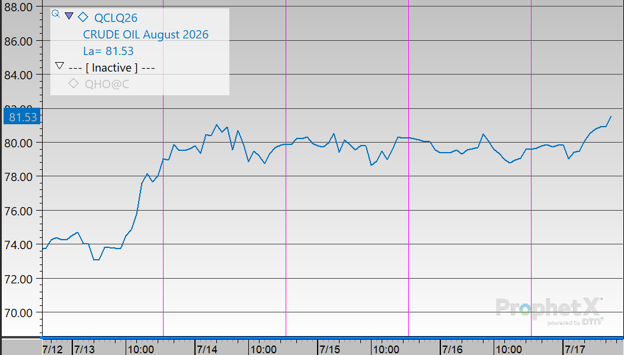
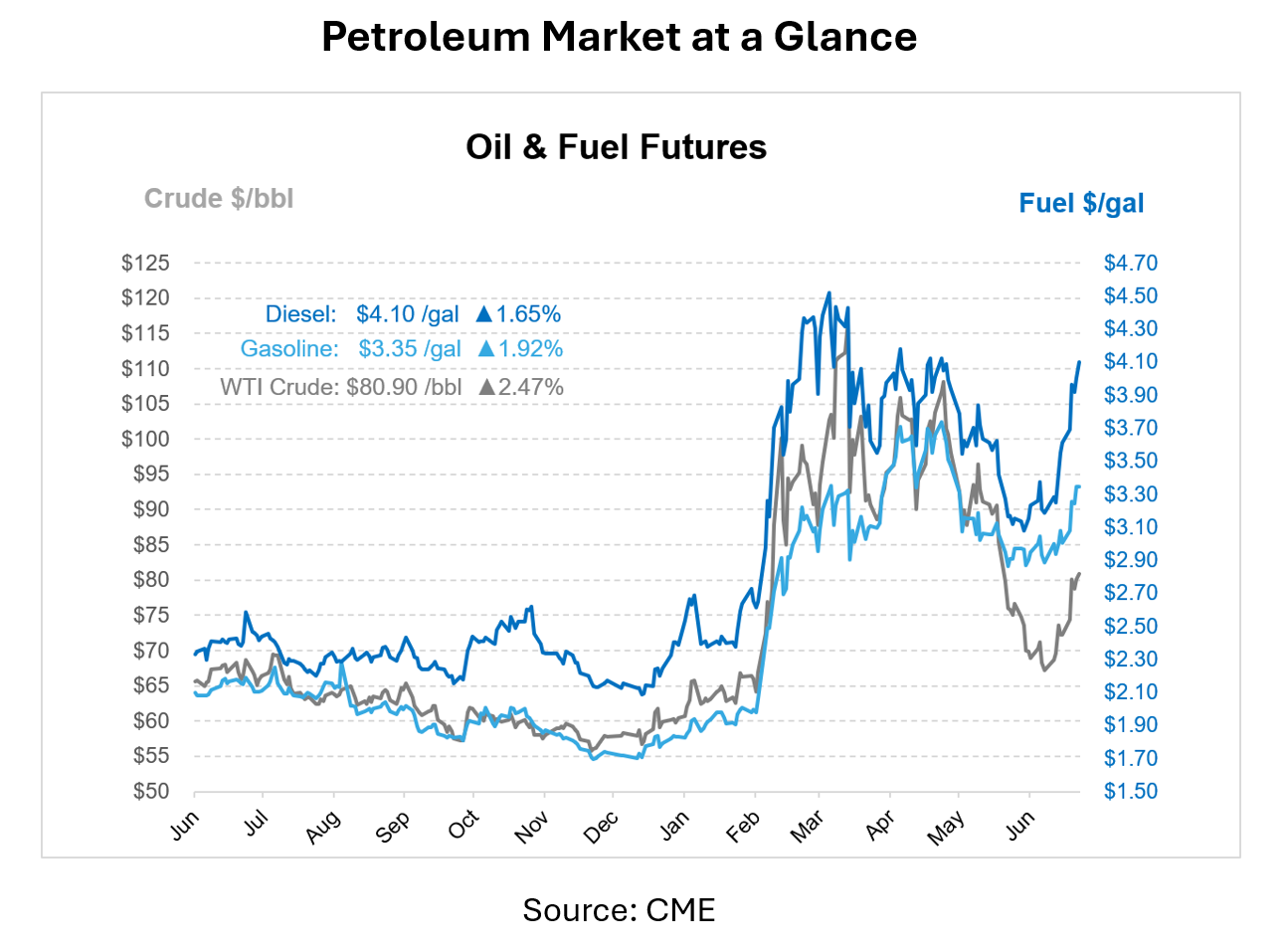
Crude prices opened at $73.69 on Monday and climbed to $78.04 on Tuesday, followed by additional gains to $79.74 on Wednesday. The market reached a weekly high of $80.00 on Thursday before easing slightly to $79.57 on Friday. Overall, crude prices increased by $5.88 per barrel, representing an approximate 8.0% gain during the week.
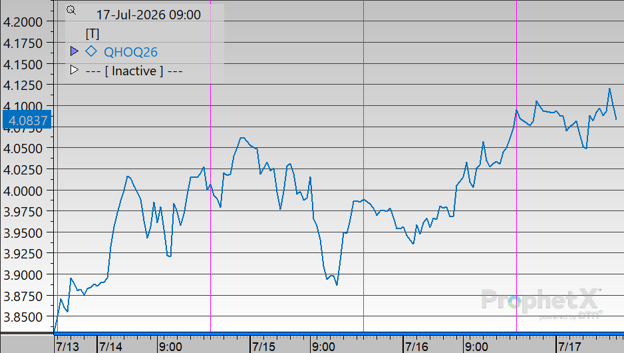
Diesel prices opened at $3.6128 on Monday and climbed to $3.8428 on Tuesday, before advancing to $3.9940 on Wednesday. After a slight pullback to $3.9825 on Thursday, diesel prices opened this morning at $4.0838. Overall, diesel prices rose by $0.4710 per gallon, representing an approximate 13.0% increase during the week.
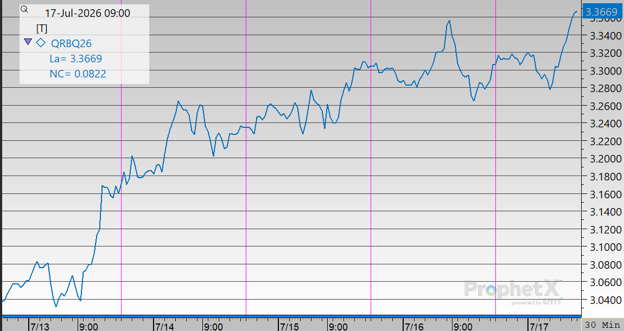
Gasoline prices moved steadily higher throughout the week, posting gains each day. Prices opened at $3.0404 on Monday and climbed to $3.1540 on Tuesday, followed by increases to $3.2285 on Wednesday and $3.2981 on Thursday. The upward trend continued Friday, with gasoline opening at $3.3092. Overall, prices rose by $0.2688 per gallon, representing an approximate 8.8% increase for the week.
This article is part of Daily Market News & Insights


MARKET CONDITION REPORT - DISCLAIMER
The information contained herein is derived from sources believed to be reliable; however, this information is not guaranteed as to its accuracy or completeness. Furthermore, no responsibility is assumed for use of this material and no express or implied warranties or guarantees are made. This material and any view or comment expressed herein are provided for informational purposes only and should not be construed in any way as an inducement or recommendation to buy or sell products, commodity futures or options contracts.