
How Companies Are Budgeting for Fuel Volatility in an Unpredictable Market
For many businesses, fuel is more than just another operating expense. Outside of payroll, it is often one of the largest and least predictable costs on the balance sheet.
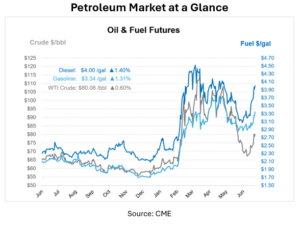
This challenge has intensified in recent years. Geopolitical tensions in the Middle East, including concerns over major shipping routes such as the Strait of Hormuz, changes in OPEC production, and political developments have contributed to significant fuel price swings that many businesses have never experienced before. Budgets that seemed reasonable weeks earlier can be quickly disrupted by major market shifts.
As organizations plan for the coming year, a key question arises: How do you build a fuel budget when prices are so unpredictable?
Mansfield experts advise that the focus should not be on predicting fuel prices, but on understanding your exposure and developing a risk management strategy. Companies unsure where to start can benefit from working with a fuel supplier for market insights, budgeting support, and guidance on pricing options.
Fuel Volatility Is Changing the Budget Conversation
While fuel markets have always fluctuated, recent conditions are different. Historically, prices tended to trade within relatively predictable ranges, often moving just a few cents per gallon from day to day. Those normal fluctuations allowed companies to build budgets with a reasonable degree of confidence. Today’s market is far less predictable.
In a volatile fuel market, those normal day-to-day moves can become much larger, with prices rising or falling sharply over a short period, reflecting high uncertainty. The result is a market that can move sharply one week and pull back the next.
For many businesses, recent events serve as a wake-up call. Fuel price volatility is now a reality that must be addressed in the budgeting process.
The Biggest Mistake Is Trying to Time the Market
One of the most common mistakes companies make is waiting for the perfect price before making a purchasing decision. Businesses often believe the market may fall just a little further before they commit to a strategy. But fuel markets can move quickly, and waiting for a few additional cents of downside can sometimes lead to substantially higher costs if prices suddenly rise. The reality is that no one can consistently predict short-term fuel price movements.
Even experienced traders and analysts cannot consistently predict short-term price movements. Instead, companies should prioritize understanding their budget objectives and determining how much price uncertainty they are willing to accept.
For many organizations, the goal is not to secure the lowest possible fuel price, but to create enough certainty to plan confidently, protect margins, and avoid major financial surprises. More businesses are moving away from trying to outguess the market and toward strategies that reduce risk and make fuel costs more predictable.
Why More Companies Are Evaluating Fixed Pricing
Periods of heightened volatility often led companies to consider fixed-price fuel programs. A common misconception is that fixed pricing means locking in today’s market price. In reality, fixed-price programs are based on future market prices, which can differ significantly from current spot prices.
The primary benefit of a fixed-price strategy is predictability. Knowing that at least a portion of future fuel costs is already established can make budgeting and forecasting much easier, especially for businesses with tight margins. Many organizations choose to lock in only a percentage of their expected fuel consumption while leaving the remainder exposed to market prices. For example, a company may fix 50% to 70% of its anticipated fuel needs while purchasing the rest at index pricing. This blended approach provides greater budget certainty while still allowing companies to benefit if prices decline.
Some companies also spread their fixed-price purchases over time instead of locking in all at once. By securing smaller portions of their fuel needs throughout the year, they can reduce the risk of entering the market on a single high or low day and create a more balanced average price.
Ultimately, fixed pricing isn’t about beating the market. It’s about reducing uncertainty and giving businesses more confidence in one of their largest operating expenses.
Not Every Business Feels Volatility the Same Way
Not every company experiences fuel price swings in the same way. Some businesses pass fuel costs directly to customers through cost-plus pricing arrangements. For these organizations, volatility may have less impact on profitability.
Others have far less flexibility. Companies bidding on fixed-price projects, waste and recycling companies, and fleets operating under long-term contracts may have to absorb higher fuel costs themselves. For these businesses, a sharp increase in diesel prices can quickly disrupt budgets and put margins under pressure.
A simple question can help determine how exposed a company is to fuel volatility: If fuel prices increased significantly tomorrow, would it materially impact your business? If the answer is yes, it may be worth evaluating strategies that provide more certainty around fuel costs.
Fuel Budgeting Is Becoming a Strategic Decision
Recent market events have shown that situations once considered unlikely can quickly become reality. Fuel markets can change rapidly, and businesses that depend heavily on fuel can feel the effects almost immediately.
At Mansfield, those conversations increasingly go beyond simply supplying fuel. Customers are looking for guidance on how market conditions may affect their budgets and what options are available to help manage risk. Businesses that take the time to understand their fuel exposure and evaluate their options are often better positioned to navigate changing market conditions.
When it comes to fuel budgeting, the goal is not to predict the future perfectly. It is to build a plan that can withstand whatever the market does next.
Lower Fuel Costs
With Mansfield Fuel Price Risk Management services, you can plan for the unexpected and mitigate the impact of these events on your bottom line. Protect your business against fuel price fluctuations and ensure cost stability.
Our Price Risk Management experts will analyze your buying history and organizational goals to provide an assessment of your current fuel spending, a forecasted outlook, and recommendations. Contact us today!
This article is part of Daily Market News & Insights


MARKET CONDITION REPORT - DISCLAIMER
The information contained herein is derived from sources believed to be reliable; however, this information is not guaranteed as to its accuracy or completeness. Furthermore, no responsibility is assumed for use of this material and no express or implied warranties or guarantees are made. This material and any view or comment expressed herein are provided for informational purposes only and should not be construed in any way as an inducement or recommendation to buy or sell products, commodity futures or options contracts.