

Oil Prices Track U.S.-Iran Strikes, Hormuz Tolls, and Shipping Recovery
Energy markets are tracking several moving pieces this week, with the Strait of Hormuz still at the center of the conversation. Shipping activity through the waterway has improved, helping ease some supply concerns, but recent U.S.-Iran strikes, possible transit tolls, and upcoming peace talks continue to influence market direction.
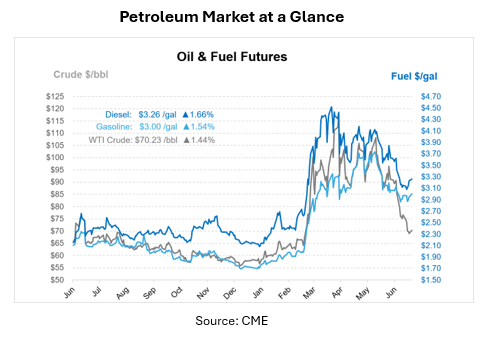
This morning, WTI futures were up 73 cents per barrel after closing down by about $7 per barrel week-over-week. The move came after another active weekend in the Middle East, where the U.S. launched strikes against multiple targets in Iran following Iran’s attack on a commercial ship in the Strait of Hormuz. Although those events added fresh risk to the market, the U.S. and Iran agreed yesterday to stop attacking each other before peace talks resume this week.
Those talks are especially important for energy markets because they are expected to cover several provisions tied to shipping through the Strait of Hormuz. One of the key issues is whether Iran will impose tolls or other costs on ships moving through the waterway. Oman has reportedly told European officials that vessels will need to pay a toll to cross the Strait, described as a service fee for helping tankers navigate the waterway.
While the political discussion continues, physical oil flows through the region have been improving. Middle East producers have continued loading oil and LNG despite recent ship attacks and renewed strikes between the U.S. and Iran, and Saudi Aramco resumed crude oil loadings at its Ras Tanura terminal on Friday after the terminal had been halted for nearly four months. That increase in activity has helped explain why oil prices moved lower last week despite ongoing security concerns.
However, the return of more oil through the Strait does not mean the supply chain has fully normalized. Dozens of tankers that had been stranded in the Gulf during the conflict have moved out in recent days, while inbound tankers are still needed to load crude stored onshore. That movement is an important step for producers working to restart fields and refineries that were shut during the war, but the process could remain uneven as the backlog clears.
Iran is also part of the supply outlook as the market watches how quickly production could increase following the suspension of most U.S. sanctions restricting Iranian oil exports and sales. According to Rystad, Iran’s oil output could reach 3.3 million barrels per day by year-end if sanctions relief remains in place, adding another supply factor for the market to consider as Gulf flows continue to recover.
At the same time, short-term demand is affecting how quickly those additional barrels can be absorbed. Refineries in Asia and Europe have already secured much of their crude supply for July and August, which means some of the extra barrels leaving the Gulf may not have immediate buyers. As a result, some tankers may remain at sea as floating storage until demand catches up with the available supply.
Supply indicators in North America also moved higher during the week ended June 26. The U.S. crude oil net rig count increased by seven rigs to 440, leaving the count up 11 rigs month-over-month but still down eight rigs year-over-year. In Canada, the crude oil net rig count increased by eight rigs to 137, putting the count up 28 rigs from last month and 43 rigs from the same period last year.
Outside of the Middle East, Russia remains another factor for energy markets. Ukrainian strikes on Russian energy infrastructure have continued to cause fuel shortages in Russia, prompting President Putin to pledge additional air defense systems to protect Russian energy assets. At the same time, Russia expects U.S. negotiators to travel to Moscow to continue talks on ending the war in Ukraine, keeping another geopolitical issue connected to energy supply in focus.
Refinery operations in Venezuela are also being monitored after a power outage forced the shutdown of the 645,000-barrel-per-day Amuay refinery, the country’s largest refinery. The power outage came as Venezuela continued dealing with electricity disruptions following two deadly earthquakes. Power was later restored, allowing workers to begin restarting operational units. While the country’s oil ministry said the earthquakes did not affect crude output or exports, domestic fuel and petrochemical output could be affected if refinery operations remain unstable.
Although shipping through the Strait of Hormuz has improved, talks over transit costs, ongoing security incidents, changes in investor positioning, higher drilling activity, and refinery disruptions are all contributing to price movement. The next round of U.S.-Iran talks will be closely watched, particularly for any details related to shipping access and costs through the Strait.
This article is part of Daily Market News & Insights


MARKET CONDITION REPORT - DISCLAIMER
The information contained herein is derived from sources believed to be reliable; however, this information is not guaranteed as to its accuracy or completeness. Furthermore, no responsibility is assumed for use of this material and no express or implied warranties or guarantees are made. This material and any view or comment expressed herein are provided for informational purposes only and should not be construed in any way as an inducement or recommendation to buy or sell products, commodity futures or options contracts.