

Week in Review – Oil Prices Ease as Ceasefire Talks Gain Momentum
Oil prices moved lower on Friday as the market focused on the possibility of a longer ceasefire between the U.S. and Iran. Prompt WTI futures were trading down by about $1.30 per barrel and were on track to end the week more than $9 per barrel lower. Brent and WTI were also headed for their steepest weekly losses since early April, showing how quickly market sentiment can shift when geopolitical risk starts to ease.
Reports indicate the U.S. and Iran are working toward a preliminary framework that would extend the ceasefire by 60 days and open the door for future nuclear talks. The agreement has not been finalized, and President Trump has not yet approved the terms. Iranian state media also said the text of the agreement was still not complete. For now, the market is reacting to the possibility of progress, but the deal still carries several unanswered questions.
The biggest issue for energy markets remains the Strait of Hormuz. The waterway is still operating well below normal levels, even though it previously handled about one-fifth of the world’s oil and liquefied natural gas supplies. A reopening would be welcomed by the global market, but it would mostly restore shipping conditions to where they were before the conflict began. Analysts also noted that normal flows may not recover immediately, even if restrictions are lifted.
The possible deal could reduce the risk premium that has supported oil prices during the conflict. However, it does not resolve the larger questions around Iran’s nuclear program, sanctions relief, or the long-term status of the Strait of Hormuz. According to Reuters, the proposed agreement would defer nuclear discussions to a future round of negotiations. That means the market may get short-term relief while still facing longer-term uncertainty.
Supply conditions also remain tight. The Energy Information Administration (EIA) reported that U.S. crude inventories fell by 3.3 million barrels for the week ended May 22, while Cushing inventories declined by 2.8 million barrels. Refined product stocks also moved lower, with gasoline inventories down 2.6 million barrels and distillate inventories down 2.1 million barrels.
Those inventory draws are important because U.S. stock levels are already below normal. Crude inventories are about 2% below the five-year average for this time of year. Gasoline inventories are about 6% below the five-year average, while distillate inventories are about 11% below the five-year average. That gives the market less room to absorb additional supply disruptions, especially if the ceasefire talks stall or shipping through Hormuz remains limited.
The impact of restricted Middle East flows is already being felt outside the region. Japan’s crude oil imports fell nearly 66% year-over-year in April to 850,000 barrels per day, the lowest level since August 1967. Because Japan depends heavily on Middle East oil, the decline shows how shipping disruptions can quickly affect major importers far from the conflict itself.
At the same time, sanctions and attacks on energy infrastructure continue to add risk. The U.S. imposed fresh sanctions on Iran’s military oil sales, targeting eight vessels and 15 entities connected with Iranian crude. Separately, Ukrainian drone strikes hit a Russian fuel storage facility in Yaroslavl and several energy facilities in Volgograd, continuing pressure on Russia’s energy system.
For now, the market is treating the possible U.S.-Iran framework as a reason to pull prices lower, but the broader risk picture has not gone away. A finalized ceasefire extension could ease some pressure if it leads to improved shipping through the Strait of Hormuz. However, low inventory, sanctions, and continued attacks on energy infrastructure mean the market still has little room for disruption. Until a signed agreement and a clear recovery in shipping flows are in place, oil prices are likely to remain highly reactive to new developments.
Prices in Review
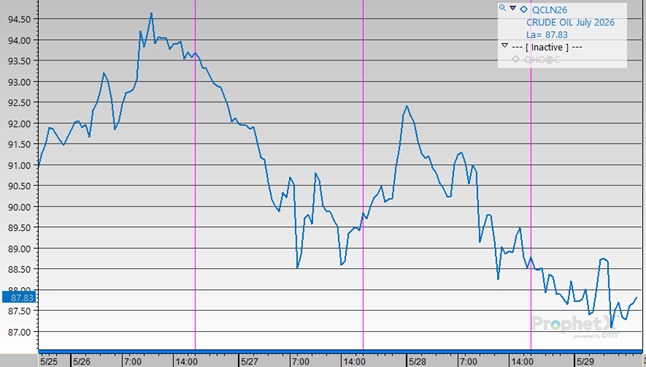
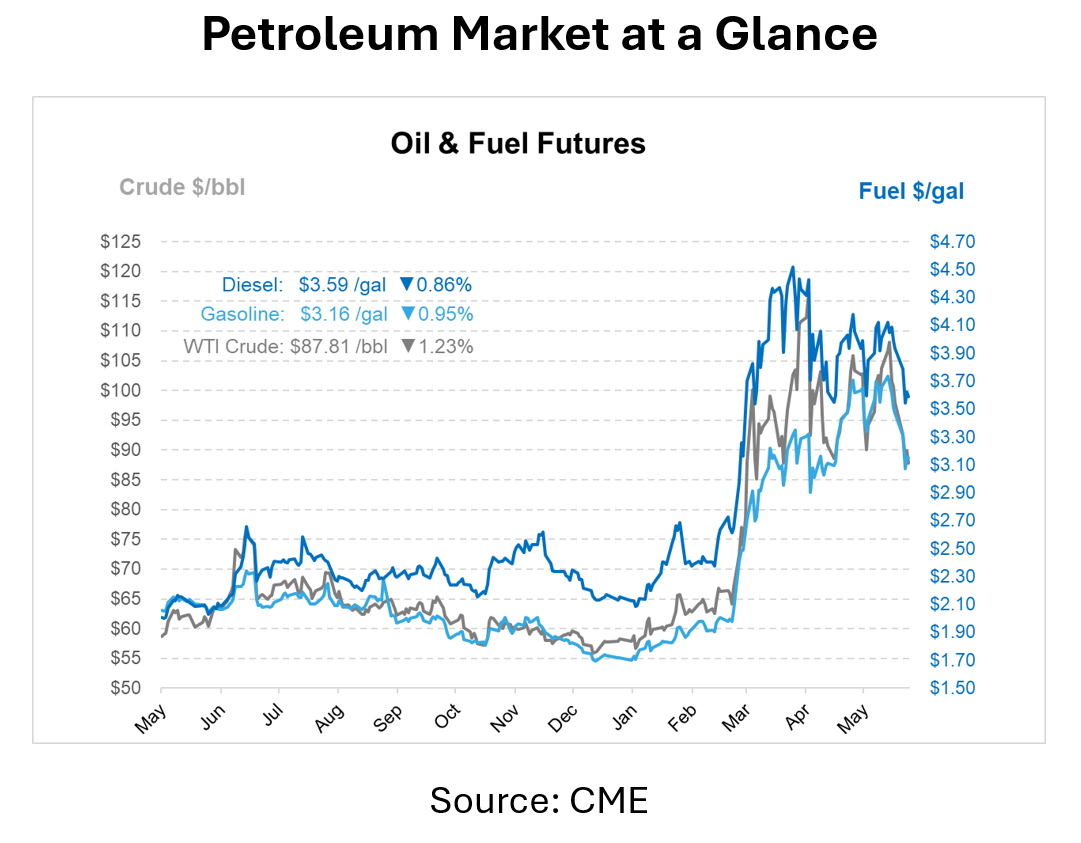
Crude prices moved lower throughout the week following the Memorial Day holiday. With markets closed on Monday, trading resumed at $93.88 on Tuesday before edging down to $93.39 on Wednesday. Selling pressure intensified later in the week, pushing prices to $89.11 on Thursday and $88.55 on Friday. From Tuesday to Friday, crude prices fell by $5.33 per barrel, representing an overall 5.7% decline.
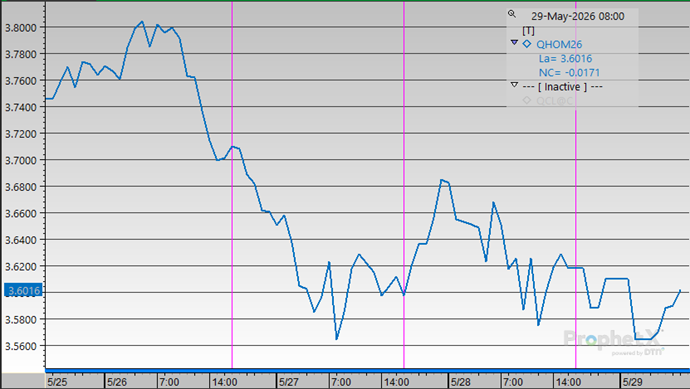
Diesel prices remained under pressure throughout the week. Prices began at $3.8231 on Tuesday and fell to $3.7088 on Wednesday, before continuing lower to $3.6115 on Thursday. Prices opened at $3.5980 on Friday, the lowest level of the period. From Tuesday to Friday, diesel prices declined by $0.2251 per gallon, representing an overall 5.9% decrease.
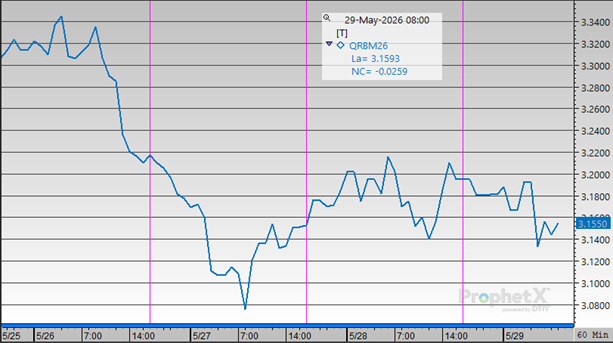
Gasoline prices opened at $3.3900 on Tuesday and dropped to $3.2125 on Wednesday, followed by another decline to $3.1524 on Thursday. On Friday, gasoline edged higher to $3.1777, recovering a portion of the previous losses. From Tuesday to Friday, prices decreased by $0.2123 per gallon, representing an overall 6.3% decline during the week.
This article is part of Daily Market News & Insights


MARKET CONDITION REPORT - DISCLAIMER
The information contained herein is derived from sources believed to be reliable; however, this information is not guaranteed as to its accuracy or completeness. Furthermore, no responsibility is assumed for use of this material and no express or implied warranties or guarantees are made. This material and any view or comment expressed herein are provided for informational purposes only and should not be construed in any way as an inducement or recommendation to buy or sell products, commodity futures or options contracts.