

U.S.-Iran Strikes Push Oil Higher After Brief Price Drop
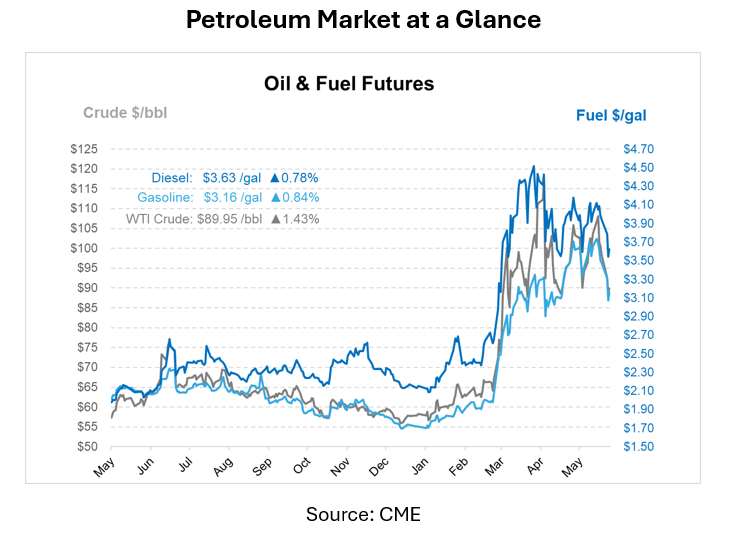
Oil prices moved higher as the Iran war continued to inject uncertainty into global energy markets. After falling more than 5% yesterday on hopes that a U.S.-Iran deal could bring the conflict closer to an end, crude prices reversed course after both sides traded new military strikes. At today’s opening price, Brent rose about 3% to $97.14 per barrel, while WTI climbed 3.1% to $91.44 per barrel.
The latest move came after Iran’s Revolutionary Guards said they targeted a U.S. airbase in response to an earlier U.S. attack in Bandar Abbas, a port city near the Strait of Hormuz. The U.S. strike was reportedly aimed at an Iranian drone operation in the area. The exchange of airstrikes has reminded markets that, despite ongoing talks, the situation remains fragile and the risk to oil flows through the Strait of Hormuz has not gone away.
There were some signs of limited movement this week, as two supertankers and one liquefied natural gas tanker exited the strait with their transponders switched off. Those vessels are reportedly heading toward India and China. Still, the broader picture remains tight. Middle Eastern crude export volumes have fallen from around 75 million metric tons per month before the crisis to about 36 million tons per month since March. Refined product shipments, including gasoline, diesel, jet fuel, and naphtha, have also declined.
Other regions have tried to make up for the shortfall. U.S. crude exports have climbed to record highs, and shipments from Canada, Brazil, and Mexico have also increased. However, those gains have not been enough to fully offset the loss of Middle Eastern barrels. Global crude loadings from January through May are down about 8%, while refined product shipments are down 8.7% compared with the same period last year.
The disruption is also showing up in shipping costs. The main benchmark for moving crude from the Middle East to China surged from about $130,000 per day before the crisis to more than $500,000 per day during the height of the bombing activity. While rates have eased to around $390,000 per day, they remain well above pre-crisis levels. Elevated freight costs are adding another layer of pressure to fuel markets already dealing with lower supply availability.
Europe is watching the situation closely, especially when it comes to jet fuel. The European Commission said the EU has experienced price effects so far, but no physical supply disruptions at the consumer level. However, officials warned that if the situation in the Strait of Hormuz does not improve in the coming weeks, markets are expected to become increasingly tight, particularly for jet fuel.
The U.S. is also seeing signs of shifting supply routes. A cargo of crude from the Strategic Petroleum Reserve was sent to California for the first time ever, according to Kpler. The move highlights how the conflict has forced buyers and suppliers to redraw trade flows as Middle Eastern crude becomes harder to access. California, which has become more dependent on crude imports in recent years, received cargo as part of broader efforts to support supply during a period of energy stress.
At the same time, U.S. crude inventories are falling. American Petroleum Institute data showed crude stockpiles declined by 2.8 million barrels last week, marking the sixth straight weekly draw.
For now, the oil market remains caught between hopes for a diplomatic agreement and the reality of continued military escalation. If talks make progress, prices could ease as traders anticipate the reopening of normal flows through the Strait of Hormuz. But if the conflict continues, global inventories could keep tightening, freight costs may stay elevated, and fuel markets could face more pressure in the weeks ahead.
This article is part of Daily Market News & Insights
Tagged: Brent Crude, crude exports, crude oil supply, energy logistics, energy supply disruption, fuel market volatility, geopolitical risk in oil markets, global crude loadings, global energy markets, iran war, jet fuel market, Middle East oil exports, oil market uncertainty, oil prices, refined product shipments, Strait of Hormuz, U.S.-Iran conflict, wti crude


MARKET CONDITION REPORT - DISCLAIMER
The information contained herein is derived from sources believed to be reliable; however, this information is not guaranteed as to its accuracy or completeness. Furthermore, no responsibility is assumed for use of this material and no express or implied warranties or guarantees are made. This material and any view or comment expressed herein are provided for informational purposes only and should not be construed in any way as an inducement or recommendation to buy or sell products, commodity futures or options contracts.