

Iran Negotiations Offer Hope, but Strait Risks Continue to Threaten Oil Flows
The energy industry opened the week caught between growing optimism that the United States and Iran may finally reach a diplomatic agreement and renewed military strikes in the Strait of Hormuz that continue to threaten global oil flows. According to U.S. officials, Washington and Tehran are still working through the language surrounding key issues, and a finalized agreement may still take days to complete. U.S. Secretary of State Marco Rubio reinforced that message, stating that negotiations with Iran could “take a few days,” signaling that markets should not expect an immediate resolution.
Despite diplomatic progress, military activity in the region continues to create uncertainty. U.S. and Israeli jets reportedly struck several Iranian vessels in the Strait of Hormuz yesterday, shortly after President Trump commented that negotiations were “proceeding nicely.”
While signs indicate that some vessel traffic is beginning to return, shipping activity remains limited. Recent ship-tracking data showed several LNG cargoes successfully transiting the Strait toward Pakistan, China, and India, alongside a supertanker carrying Iraqi crude that had reportedly been stranded for nearly three months. Markets are watching these movements closely because they may signal whether regional shipping conditions are slowly stabilizing.
At the same time, reports suggest Iran could eventually agree to clear mines from the Strait of Hormuz within 30 days under a broader diplomatic framework. Under the proposed arrangement, shipping lanes would reopen to international vessels, and Tehran would reportedly end transit-fee collection. Even so, analysts warn that any reopening would likely happen gradually rather than immediately, meaning supply chain disruptions could persist well into the summer months.
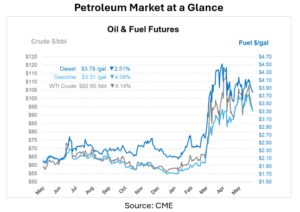
The market reaction reflects just how sensitive oil prices have become to geopolitical headlines. Brent crude rose more than 2% following the latest military strikes, even after prices had dropped sharply during the previous trading session in hopes of a peace agreement. Analysts noted that markets remain highly cautious because previous diplomatic attempts between the U.S. and Iran have repeatedly collapsed late in negotiations.
According to the International Energy Agency (IEA), global oil supply fell by another 1.8 million barrels per day in April, while Gulf-region production impacted by Strait disruptions remained significantly below pre-war levels. At the same time, OPEC revised its 2026 oil demand growth forecast lower, highlighting growing uncertainty around future fuel demand.
That demand uncertainty is becoming increasingly important. Higher oil prices continue to pressure transportation companies, airlines, industrial consumers, and energy-sensitive economies worldwide. Analysts warn that sustained elevated fuel costs may begin reducing consumption, particularly if economic conditions weaken further. Recent inflation data and consumer confidence figures are now being watched closely because they could influence expectations for fuel demand during the summer driving season.
Meanwhile, some physical indicators already point to the development of demand pressure. Indian refiners reduced crude throughput by nearly 9% month over month in April as disruptions in the Strait forced them to rely more heavily on imports from Russia, Latin America, and Africa. Analysts also noted that high prices have already started contributing to “demand destruction” through lower refinery intake, government conservation measures, and shifts in consumer behavior.
Analysts at Saxo Bank described oil as the market’s “macro thermostat,” arguing that energy prices are now influencing inflation expectations, bond yields, currencies, and overall investor sentiment across global financial markets. Even though prices remain elevated, several factors have prevented an even larger rally, including strategic petroleum reserve releases, rerouted exports through pipelines in Saudi Arabia and the UAE, increased U.S. exports, and China drawing from domestic inventories.
Still, concerns are growing that the market could tighten further during peak summer fuel demand. The IEA warned that ongoing supply disruptions combined with depleted global stockpiles could push oil markets into what analysts describe as the “red zone” during July and August. Even if the Strait of Hormuz eventually reopens fully, analysts caution that the next phase of the market could involve aggressive inventory rebuilding, which may continue supporting prices long after military tensions ease.
This article is part of Iran


MARKET CONDITION REPORT - DISCLAIMER
The information contained herein is derived from sources believed to be reliable; however, this information is not guaranteed as to its accuracy or completeness. Furthermore, no responsibility is assumed for use of this material and no express or implied warranties or guarantees are made. This material and any view or comment expressed herein are provided for informational purposes only and should not be construed in any way as an inducement or recommendation to buy or sell products, commodity futures or options contracts.