

Week in Review – Iran’s Push for Hormuz Control Continues Shaking Energy Markets
Energy markets remain highly focused on the Iran war, as ongoing disruptions in the Strait of Hormuz continue to affect crude flows, shipping activity, refining operations, and broader supply chain logistics. This morning, WTI crude futures traded up by more than $1.50 per barrel after reversing yesterday’s losses, although prices remain on track to finish the week roughly $3 per barrel lower overall. Markets initially sold off after reports suggested the latest US proposal to Iran had “partly bridged the gap” between the two sides, but prices quickly recovered as traders continued to evaluate risks surrounding the Strait of Hormuz and the potential for additional supply disruptions. Since the conflict began on February 28, vessel traffic through the strait has fallen sharply from approximately 125-140 daily vessel passages before the war to only a fraction of that level today, significantly tightening global energy logistics and increasing uncertainty across crude, diesel, and LNG markets.
One of the latest developments involves Iran and Oman discussing a proposed tolling system for vessels transiting the Strait of Hormuz. Iranian ambassador to France Mohammad Amin-Nejad stated that countries benefiting from the route “must pay their share,” signaling Iran’s effort to formalize control over the waterway. President Trump publicly opposed the proposal, stating that the United States wants the strait to remain “open” and “free” without tolls. At least five Middle Eastern countries also rejected Iran’s authority over the route, warning that recognizing Tehran’s proposed maritime system would create a dangerous precedent for global shipping and trade.
Iran has also continued expanding administrative control over vessel traffic in the region. Reuters reported that Iran’s newly created Persian Gulf Strait Authority published a new map this week, reaffirming Tehran’s claims to large controlled maritime zones around the Strait of Hormuz. Ship owners seeking to move vessels through the area are now reportedly navigating a complex system of permissions and payments established by Iranian authorities.
Diplomatic efforts remain active as countries attempt to prevent further escalation. Secretary of State Marco Rubio stated this week that some progress has been made in negotiations with Iran, although he cautioned that significant work remains before any agreement can be reached. Rubio also reiterated that Iran’s proposal involving tolls and operational control over Hormuz remains “unacceptable.” Qatar has now sent a negotiating team to Tehran in coordination with the United States, while Pakistan continues acting as an intermediary between Washington and Iran.
Despite the ongoing negotiations, several key disagreements remain unresolved. Iran continues demanding sanctions relief, compensation for war damages, the release of frozen assets, and recognition of its control over Strait of Hormuz operations. Reports also indicated this week that Iranian leadership directed that enriched uranium should not be transferred abroad, further complicating negotiations surrounding Iran’s nuclear program.
The conflict continues to create major operational challenges for the global shipping industry. More than 20,000 sailors remain stranded aboard approximately 2,000 vessels trapped inside the Persian Gulf as restricted access through Hormuz continues to disrupt maritime activity. Shipping organizations warned that some crews have not been paid for months, while others are struggling to secure authorization to leave vessels or return home. Saudi authorities stated they have assisted hundreds of vessels with food, fuel, medicine, and crew transfers as shipping congestion in the Gulf continues.
Iranian authorities stated that 35 commercial vessels successfully passed through the Strait of Hormuz during the last 24 hours after receiving authorization from the Revolutionary Guards Navy. However, traffic through the region remains significantly below normal levels as tanker operators continue facing security risks, elevated insurance costs, operational delays, and uncertainty surrounding future transit conditions.
Elsewhere in the region, military tensions continue adding pressure to global energy balances. The UAE reported that a drone strike targeting a large nuclear power plant was launched from Iraq, forcing the facility to temporarily rely on backup power systems. Ukraine also continued attacks on Russian refinery infrastructure overnight, adding further pressure to global refined product markets, particularly diesel supplies.
Economic concerns tied to the conflict also continue to build globally. Rising energy prices and shipping disruptions are increasing inflation concerns, strengthening the US dollar, and adding pressure to transportation, logistics, and manufacturing costs worldwide. Analysts continue warning that prolonged disruptions in the Strait of Hormuz could create additional volatility across both energy and financial markets if negotiations fail to progress further.
Prices in Review
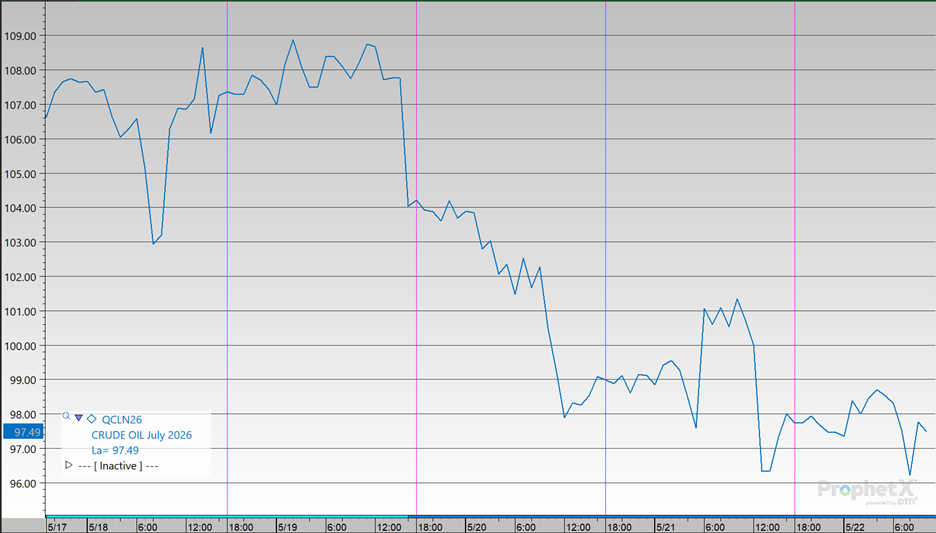
Crude prices moved lower over the course of the week. Prices opened at $106.00 on Monday and climbed to $107.11 on Tuesday. Prices then returned lower to $104.12 on Wednesday before declining sharply to $98.95 on Thursday. Crude opened at $98.00 on Friday, down $8.00 per barrel, for an overall 7.5% decline during the week.
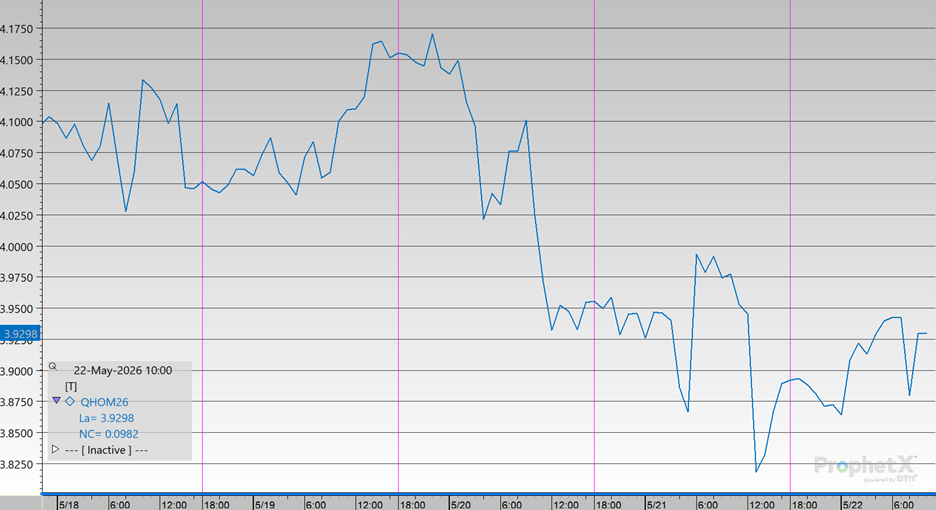
Diesel markets softened during the second half of the week after reaching a midweek high. Prices opened at $4.0534 on Monday and remained relatively steady at $4.0545 on Tuesday, before climbing to $4.1599 on Wednesday. Diesel prices then turned lower, falling to $3.9570 on Thursday and declining further to $3.9076 on Friday. Overall, diesel prices decreased by $0.1458 per gallon, representing a 3.6% decline during the week.
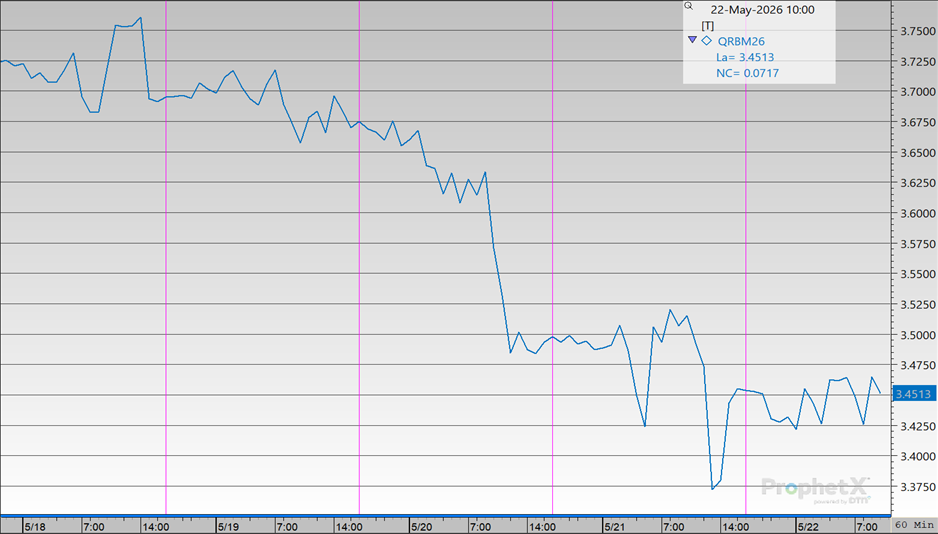
Gasoline prices started at $3.7060 on Monday and moved slightly higher to $3.7143 on Tuesday, before easing back to $3.6804 on Wednesday. Selling pressure pushed prices down to $3.5099 on Thursday, the weekly low, but the market reversed sharply on Friday, jumping to $3.4374. Overall, gasoline prices finished the week $0.2686 per gallon below Monday’s opening level, representing an approximate 7.2% decline.
This article is part of Daily Market News & Insights


MARKET CONDITION REPORT - DISCLAIMER
The information contained herein is derived from sources believed to be reliable; however, this information is not guaranteed as to its accuracy or completeness. Furthermore, no responsibility is assumed for use of this material and no express or implied warranties or guarantees are made. This material and any view or comment expressed herein are provided for informational purposes only and should not be construed in any way as an inducement or recommendation to buy or sell products, commodity futures or options contracts.