
What’s That: Kharg Island
Most people have never heard of Kharg Island, but the small Iranian island sits at the center of one of the world’s most critical oil export systems. As Iran’s main crude export hub, Kharg handles the vast majority of the country’s oil shipments, making it a key focal point in the ongoing Iran war and a growing concern for global energy markets.
Any disruption to operations on Kharg Island would likely extend far beyond Iran’s borders. Because so much Iranian crude flows through the terminal, damage, delays, or export halts could quickly tighten global supply and push oil prices higher, especially as tensions around the Strait of Hormuz continue to escalate.
Where It Is and How It Works
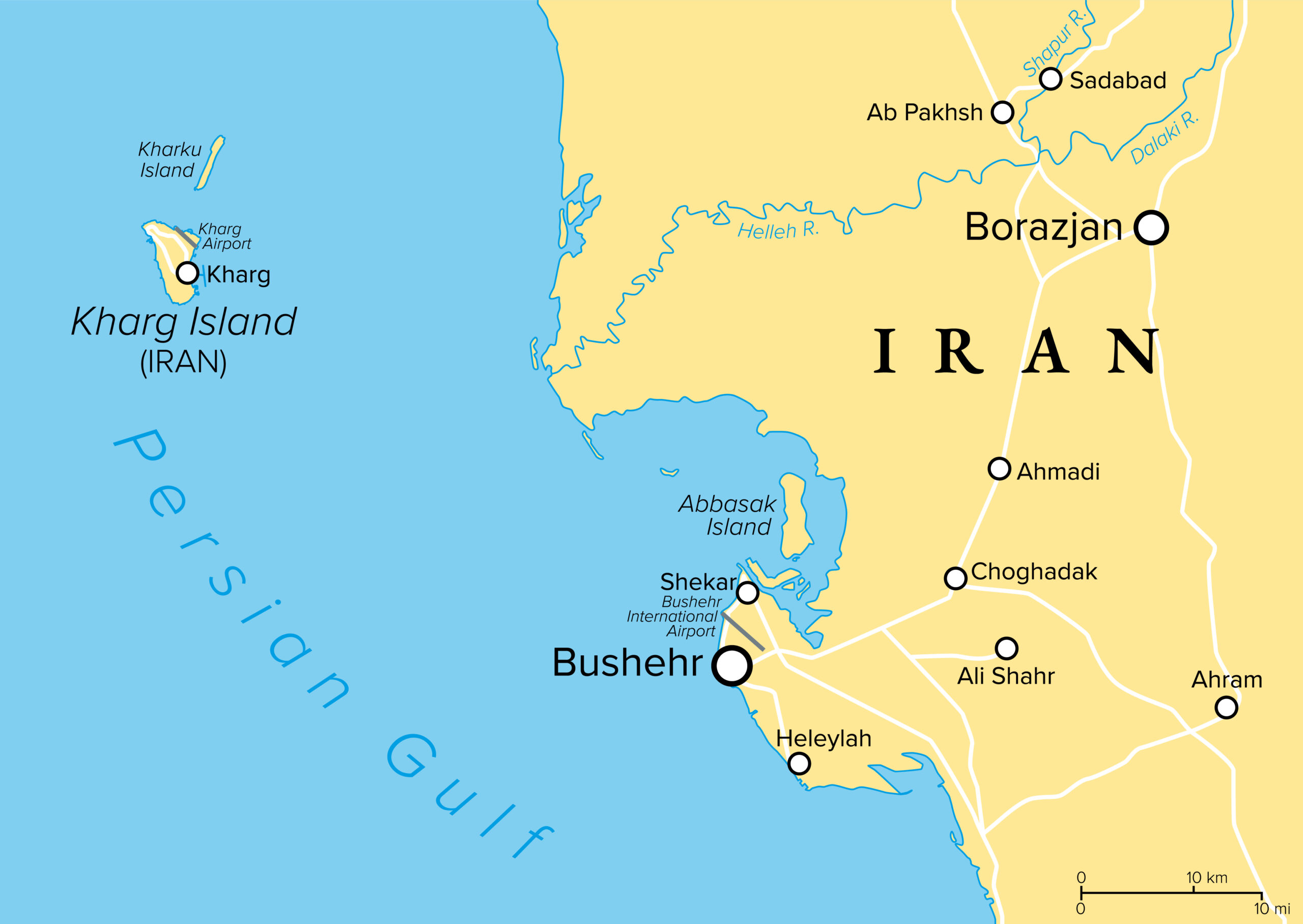
Kharg Island is a small coral island in the northern Persian Gulf, located about 20 miles off Iran’s coast and 34 miles northwest of the port of Bushehr. At roughly five miles long, about a third the size of Manhattan, it is physically small but operationally critical. For decades, it has served as the primary terminal for Iran’s oil exports, handling the vast majority of outbound crude.
The island sits near the Strait of Hormuz, one of the busiest oil transit routes in the world. Its position allows tankers to quickly move from loading operations into global shipping lanes. At the same time, being slightly offshore gives large vessels room to maneuver, making it an efficient location for high-volume export activity.
Kharg is not just a pass-through point, but instead, it is the final destination for Iran’s oil before export. A network of pipelines brings crude from inland oil fields directly to the island, where it is stored, staged, and loaded onto tankers. In that way, the entire system funnels into one place before reaching the global market.
Why Does Kharg Island Matter
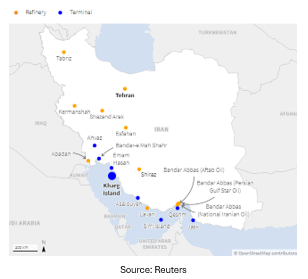
Before the current conflict, the island was responsible for roughly 90% of Iran’s oil exports. Today, it remains the central export hub, often described by U.S. officials as the “nexus for all the Iranian oil supply.” A network of pipelines feed crude directly from inland fields to the island, where it is stored and prepared for shipment.
Kharg is built to move large volumes quickly. The island can hold tens of millions of barrels of crude at any given time, with about 18 million barrels currently stored there. It has the capacity to load multiple supertankers simultaneously to support export volumes of up to 7 million barrels per day when operating normally. Once loaded, tankers move out through the Persian Gulf and into global shipping lanes via the Strait of Hormuz.
The system works efficiently as long as flows continue uninterrupted. Kharg functions as the final release point in Iran’s oil network. When exports move, the system stays balanced. When they slow, pressure builds quickly behind it.
If exports are restricted, storage fills. Onshore capacity, estimated between 42 and 50 million barrels, begins to tighten, forcing producers to adjust. In extreme cases, output may be reduced, or alternative storage options, including decommissioned tankers, are used to manage excess supply.
That level of dependence is why Kharg has long been considered essential to Iran’s economy. A declassified CIA document from 1984 described the island’s facilities as “the most vital in Iran’s oil system,” noting that continued operation is critical to the country’s economic stability.
That importance is also why Kharg Island has become a focal point in the current Iran conflict.
What’s Happened at Kharg Island
On March 13, U.S. Central Command carried out a large-scale precision strike targeting more than 90 military sites on the island. Military assets were heavily hit, but oil export infrastructure was deliberately left untouched. The distinction reflects how the island is being approached as not just a target, but as leverage.
At the same time, a U.S. naval blockade implemented on April 13 has severely restricted Iran’s ability to export oil. As fewer barrels leave the country, storage levels are rising toward capacity, increasing the likelihood that production cuts may be needed if the situation continues.
The strategy combines military pressure with economic constraints. The U.S. maintains dominance over military targets on the island while limiting exports externally, creating a scenario where Iran must either comply with demands or face mounting operational and financial pressure.
Officials have suggested that taking or shutting down Kharg Island entirely could significantly impact Iran’s economy, potentially “totally bankrupting” key military organizations tied to oil revenues. However, such a move would likely require major resources and carries broader risks, including immediate disruption to global oil markets.
For the oil industry, Kharg Island highlights a familiar risk of concentration. When one location handles most of a country’s exports, any disruption, whether operational, military, or economic, can have outsized effects.
That risk is still playing out. With exports restricted and storage building, Kharg Island remains a central pressure point in Iran’s oil system and a key factor shaping current supply dynamics.
This article is part of Daily Market News & Insights


MARKET CONDITION REPORT - DISCLAIMER
The information contained herein is derived from sources believed to be reliable; however, this information is not guaranteed as to its accuracy or completeness. Furthermore, no responsibility is assumed for use of this material and no express or implied warranties or guarantees are made. This material and any view or comment expressed herein are provided for informational purposes only and should not be construed in any way as an inducement or recommendation to buy or sell products, commodity futures or options contracts.