
Sticky Pump: What Rack-to-Retail Spreads Are Telling Us
Fuel markets have been anything but calm in recent weeks, and the latest price swings are offering a textbook example of “sticky pump” behavior – a dynamic that plays a critical role in shaping rack‑to‑retail (R2R) spreads.
Understanding how and why these spreads expand and contract can help fuel buyers better understand why retail prices do not always move in sync with wholesale markets, creating periods where pump prices remain elevated even as underlying fuel costs decline. Recognizing these patterns can also help identify opportunities to reduce long-term fuel expenses.
What Is “Sticky Pump” Behavior?
“Sticky pump” refers to the way retail fuel prices tend to adjust asymmetrically to changes in wholesale costs.
When wholesale prices rise sharply, retail stations are often slow to increase prices, wary of consumer backlash and competitive pressure. As a result, rack-to-retail spreads – the difference between the bulk cost of fuel and the gas station’s price, less taxes – typically compress during rapid price increases.
When wholesale prices fall quickly, retail prices tend to remain elevated for longer. Some stations might wait to see competitors move first, causing R2R spreads to widen as wholesale costs decline faster than pump prices.
What We’ve Seen Recently
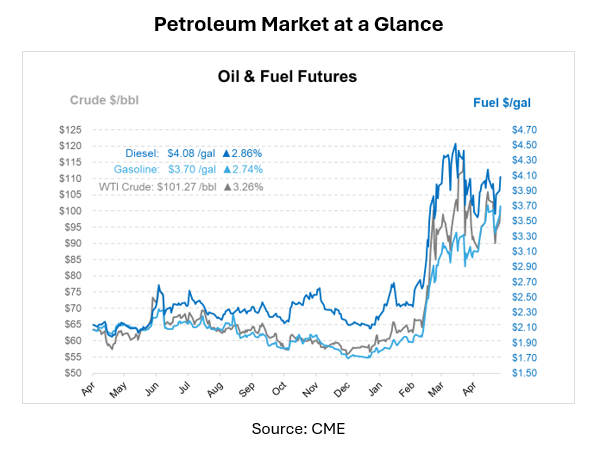
Over the past three months, fuel markets have experienced some of the most volatile trading conditions in years, driven largely by the ongoing Iran war and repeated disruptions in the Strait of Hormuz. Crude prices have swung sharply on nearly every geopolitical headline, with markets reacting to military strikes, tanker attacks, blockade threats, ceasefire negotiations, and changing expectations around global supply flows. At several points, WTI crude moved by over $100 per barrel.
That volatility has created a challenging environment for fuel buyers, especially as retail prices and rack markets have not always moved in sync with underlying crude costs. In many cases, pump prices remained elevated even after wholesale prices pulled back, widening rack-to-retail spreads and reinforcing the “sticky pump” effect seen during periods of market stress. Physical fuel markets also remained tight throughout the conflict, particularly for diesel and refined products, as supply disruptions, shipping delays, and refinery concerns added pressure across the downstream market.
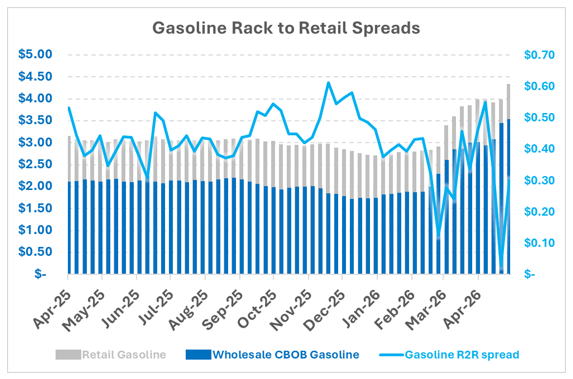
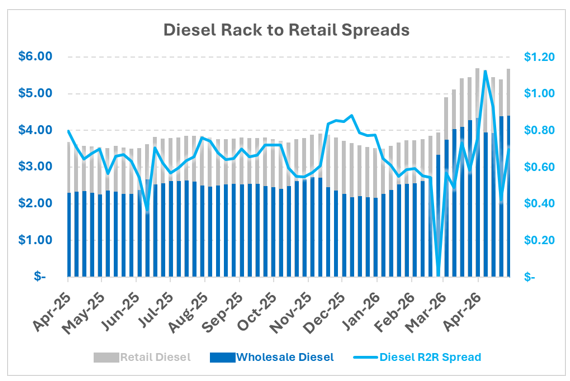
This dynamic has been clearly visible over the past six months.
- November 2025 through January 2026: Wholesale prices moved lower, but retail prices declined more slowly, causing rack-to-retail (R2R) spreads to widen significantly.
- Since February 2026: Energy markets have experienced sharp price increases and heightened volatility tied to the Iran war and ongoing disruptions around the Strait of Hormuz. As wholesale and rack prices surged, R2R spreads compressed rapidly, with diesel spreads briefly turning negative in some markets as retail pricing struggled to keep pace with rising replacement costs.
These swings are not unusual, but the magnitude highlights just how influential sticky pump behavior can be during periods of volatility.
What Does This Mean Going Forward?
Looking ahead, spread behavior will largely depend on the direction of prices:
- If prices continue to rise: Expect R2R spreads to remain compressed, as retail prices struggle to keep pace with wholesale increases.
- When prices eventually roll over: History suggests R2R spreads will expand quickly, often overshooting historical averages for a period of time.
In other words, today’s compressed spreads may be setting the stage for significantly wider spreads once the market turns lower.
Why This Matters for Fleet Fueling Strategies
For fleets evaluating their fueling approach, R2R spreads can have a meaningful impact on total fuel costs.
Historically:
- Diesel spreads average around $0.40-$0.60 per gallon
- Gasoline spreads typically fall in the $0.25–$0.30 per gallon range
Over the past year, however, diesel spreads have averaged closer to the high end of their typical range and could climb into the $0.80–$0.90 range in the coming months if the market shifts lower and sticky pump behavior continues.
A Timely Opportunity
Wider R2R spreads can significantly accelerate the return on investment for fleets considering a transition from retail fueling to bulk fuel storage. Installing a fuel tank is one of the most common cost-saving moves, and large spreads can accelerate savings. If you have over 200,000 gallons of retail spend (or less when R2R spreads widen) in a market that you could convert to backyard fueling, you should consider a bulk fuel tank. Higher spreads mean a greater cost advantage for bulk buyers, effectively cutting payback periods in half compared to more typical market conditions.
If your location lacks room for a bulk tank, mobile fueling is another way to peg your fuel prices to rack markets, rather than retail. While you’ll pay a premium for the service, you’ll also save driver time, lowering your total program costs.
Finally, if your fleet must purchase fuel over the road, make sure you’re getting the best possible discount – whether you’re buying at the front-of-the-house retail side or the back-of-the-house truck stop side. Evaluating your discount and benchmarking your savings can lead to significant opportunities to cut costs.
This article is part of Daily Market News & Insights


MARKET CONDITION REPORT - DISCLAIMER
The information contained herein is derived from sources believed to be reliable; however, this information is not guaranteed as to its accuracy or completeness. Furthermore, no responsibility is assumed for use of this material and no express or implied warranties or guarantees are made. This material and any view or comment expressed herein are provided for informational purposes only and should not be construed in any way as an inducement or recommendation to buy or sell products, commodity futures or options contracts.