

Week in Review: WTI Jumps Nearly $6 as Geopolitical Flashpoint Erupts in the Middle East
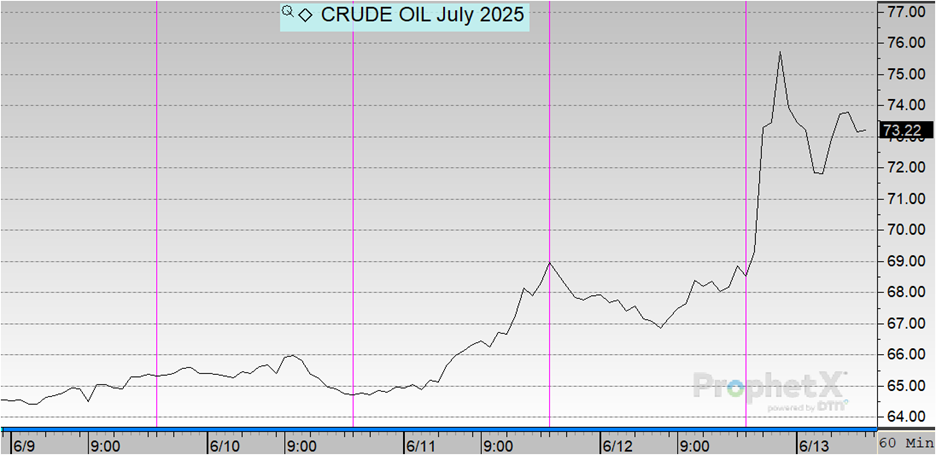
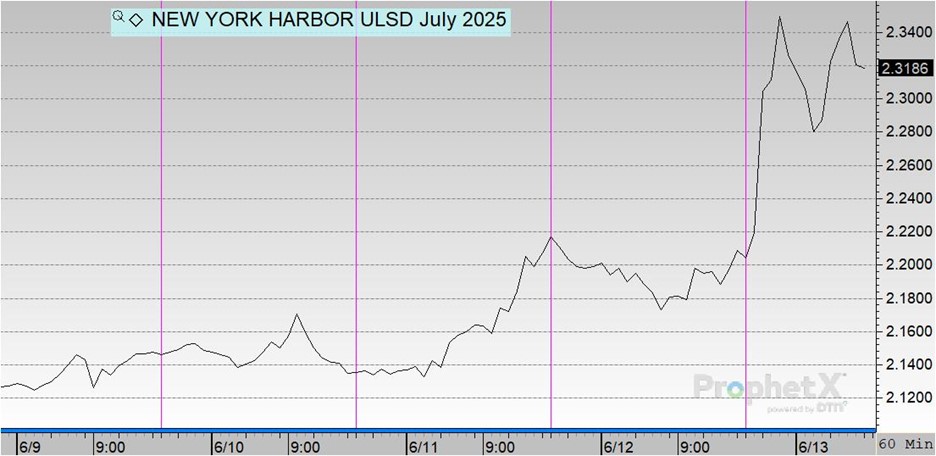
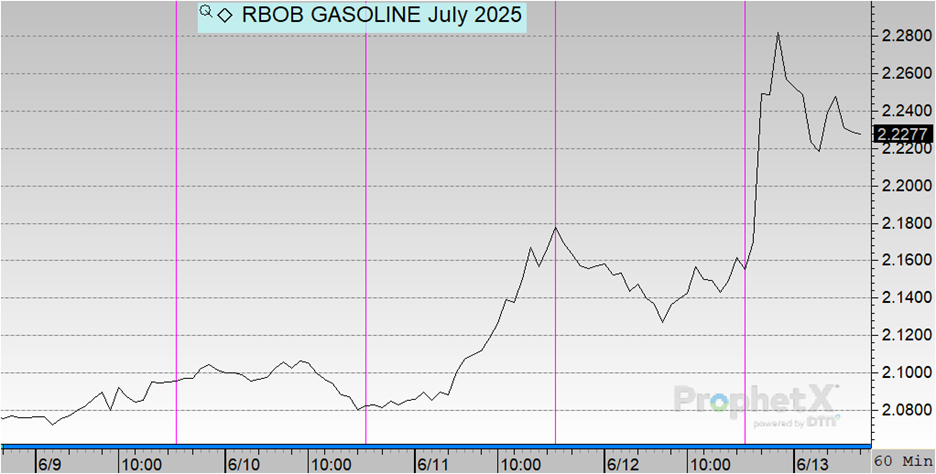
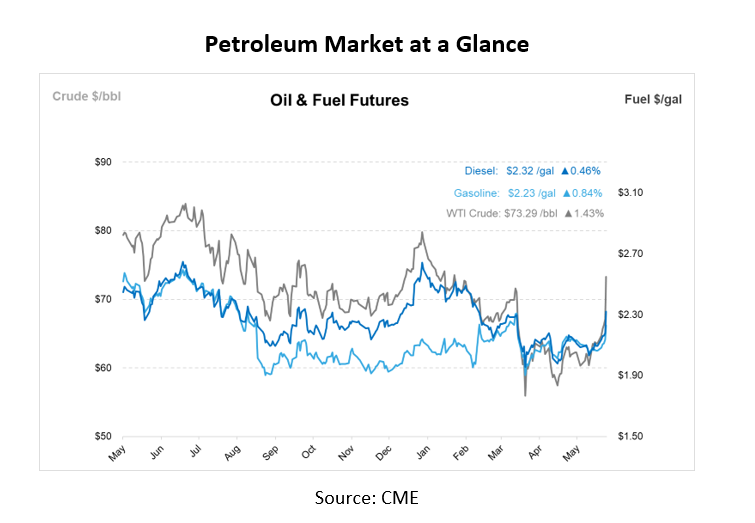
Fuel markets are heading into the weekend on a dramatic upswing following news that Israel has launched a military offensive against Iran, shortly after the expiration of a nuclear deal deadline. WTI crude prices jumped as high as $73 per barrel early Friday morning—up over $5/bbl from Thursday’s close. Meanwhile, ULSD futures have spiked by more than 13 cents, and RBOB gasoline is up by almost 9 cents.
The escalation marked a significant turning point in what had already been a week dominated by geopolitical uncertainty. Tensions had been mounting steadily after the U.S. announced the evacuation of non-essential personnel from diplomatic outposts across the Middle East and issued travel advisories citing the threat of potential conflict. President Trump reaffirmed a hardline stance against Iran’s nuclear ambitions, while Iran warned of retaliation against both U.S. and Israeli assets should talks collapse. As diplomatic efforts stalled, markets became increasingly sensitive to headline risk.
The attack on Iran, though not entirely unexpected, jolted crude markets due to its implications for global supply. The Strait of Hormuz—a narrow maritime passage bordering Iran—remains one of the world’s most critical energy chokepoints, handling up to 20% of global oil flows. Any military disruption in the area, even short-lived, could severely constrain global crude availability and send prices soaring. JPMorgan had previously projected that a full closure of the strait could push crude above $120 per barrel. While such a scenario remains extreme, Friday’s spike shows the market’s fragility to geopolitical shocks.
Earlier in the week, oil prices had rallied more than 4% on speculation that a resolution to the U.S.-Iran standoff was unlikely, but gains temporarily reversed Thursday as traders looked to the upcoming diplomatic talks in Oman. Those hopes were extinguished late Thursday night when the deadline for a nuclear agreement expired without progress, and Israel acted swiftly in response to perceived threats.
Amid this geopolitical backdrop, market fundamentals also continued to evolve. U.S. refinery activity accelerated sharply, leading to increased product inventories, particularly diesel. The improved diesel supply translated to a rise in “days of supply” metrics, signaling a healthier balance on the downstream side. However, the seasonal uptick in output is now creating localized pressure at fuel racks, where oversupply could result in negative netbacks, particularly in the absence of unplanned outages or hurricane disruptions. While this dynamic may temporarily cap regional price increases, it is unlikely to offset the upward pressure created by heightened geopolitical risk.
Futures spreads also shifted this week, with Brent and WTI contracts flipping back into backwardation—a technical signal of near-term supply tightness—and options markets displaying a strong bullish tilt. The heightened volatility and volume indicate traders are preparing for more price swings in the days ahead.
Looking forward, markets will be laser-focused on developments in the Middle East. Any escalation or signs of supply disruption could push prices even higher, while a diplomatic breakthrough—however unlikely in the immediate term—might offer a measure of relief. For now, the oil market is firmly in risk-on mode, with geopolitical tensions outweighing economic soft spots or seasonal supply trends.
Prices in Review
Crude prices opened at $64.80 on Monday and experienced notable volatility throughout the week. After dipping midweek to a low of $64.76 on Wednesday, prices increased sharply on Thursday, reaching $69.03 as geopolitical tensions in the Middle East intensified. By Friday morning, crude held steady at $68.90, and saw major increases from the opening point. Overall, crude gained $4.10 per barrel on the week—a 6.33% increase—driven largely by supply concerns following escalating conflict between Israel and Iran.
Diesel prices opened at $2.1331 on Monday and showed a steady upward trend throughout the week, driven by rising crude prices and increased geopolitical tensions. After modest gains early in the week, prices jumped sharply on Thursday to $2.2185—the weekly high—before opening slightly lower at $2.2071 on Friday. Overall, diesel prices rose by 7.4 cents this week, reflecting a 3.47% increase. The rally was largely supported by fears of potential supply disruptions in the Middle East and a surge in refined product futures.
Gasoline prices opened at $2.0820 on Monday and remained relatively flat through midweek before surging on Thursday to a high of $2.1805 amid rising crude prices and mounting geopolitical tensions. By Friday, prices edged slightly lower to $2.1658. Overall, gasoline gained 8.38 cents this week, representing a 4.02% increase.
This article is part of Daily Market News & Insights
Tagged:


MARKET CONDITION REPORT - DISCLAIMER
The information contained herein is derived from sources believed to be reliable; however, this information is not guaranteed as to its accuracy or completeness. Furthermore, no responsibility is assumed for use of this material and no express or implied warranties or guarantees are made. This material and any view or comment expressed herein are provided for informational purposes only and should not be construed in any way as an inducement or recommendation to buy or sell products, commodity futures or options contracts.