Oil Prices Surge as Red Sea Attacks Create a Second Supply Chokepoint
Oil prices climbed sharply on Thursday as escalating attacks in the Middle East raised concerns that global crude shipments could face disruptions at two critical waterways at the same time.
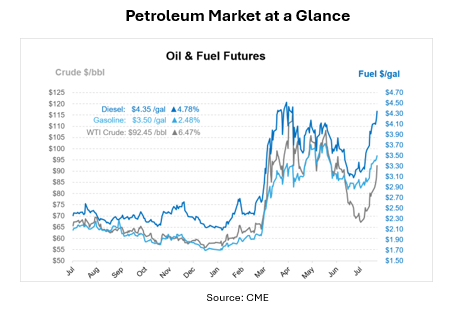
WTI prices rose about $4 per barrel this morning, extending gains from the previous session and moving above $90 per barrel for the first time since June 11. Brent crude approached $100 per barrel, reaching its highest level in more than a month. The latest rally followed attacks by the Iran-backed Houthis on two Saudi Arabian oil tankers in the Red Sea – the group’s first reported attacks on commercial vessels in months.
The attacks have added a new layer of uncertainty to an oil market already dealing with severely restricted traffic through the Strait of Hormuz. The Bab el-Mandeb Strait, located at the southern entrance to the Red Sea, is now becoming a second major concern. The waterway connects the Red Sea with the Indian Ocean and serves as an important route for oil moving between the Middle East, Europe, and Asia. Oil flows through the strait have averaged nearly 9 million barrels per day over the past month.
Saudi Arabia has relied increasingly on its East-West pipeline and the Yanbu port on the Red Sea to move crude while shipments through Hormuz remain restricted. Oil loadings at Yanbu have remained near 5 million barrels per day over the past week. However, attacks near the Red Sea route could weaken the effectiveness of that alternative.
Two Chinese supertankers carrying a combined 4 million barrels of Saudi crude continued toward the Bab el-Mandeb Strait on Thursday despite the attacks. At least two other tankers scheduled to load Saudi crude later this month reportedly slowed their approach and began circling in the Gulf of Aden.
Asian refiners are also discussing possible alternatives with Saudi Aramco, including rerouting vessels around Africa. That route could allow cargoes to avoid the Red Sea, but it would require longer voyages, consume more fuel, reduce tanker availability, and increase freight and insurance costs. Even when oil continues to move, these additional costs can contribute to higher delivered fuel prices.
Hormuz Traffic Remains Restricted
Conditions in the Strait of Hormuz also continue to support higher oil prices. Recent vessel traffic has fallen well below normal levels, with liquids flows estimated at less than 2 million barrels per day over the past six days. That compares with more than 6 million barrels per day in June and more than 10 million barrels per day in early July before the latest escalation.
Iran’s Revolutionary Guards said the strait remained under Iranian control and that vessels would not be permitted to enter or leave without coordination. The group also reported that an oil tanker caught fire following an explosion along what it described as a mined route near Oman, while two other tankers turned back.
Meanwhile, the United States completed its 12th consecutive night of attacks on Iran. Iran has continued retaliatory strikes against locations in neighboring countries that host U.S. military operations, adding to concerns that energy infrastructure and shipping routes could face further threats.
Oil’s Direction Depends on Shipping and Diplomacy
Goldman Sachs maintained its fourth-quarter 2026 Brent forecast of $80 per barrel, based on the assumption that tensions ease and shipping conditions improve by the end of the year. The bank expects lower Middle Eastern production, summer travel demand, declining global inventories, and slower releases from strategic petroleum reserves to support prices through July and August.
However, the range of possible outcomes has widened considerably. Goldman said Brent could exceed $120 per barrel during the fourth quarter and average $100 in 2027 if disruption through the Strait of Hormuz continues and problems spread across Bab el-Mandeb and the Suez Canal.
Continued attacks or further restrictions at either chokepoint could push prices higher and increase transportation costs. Signs of negotiations, safer shipping conditions, or a recovery in tanker movements could quickly remove part of the geopolitical premium.
This article is part of Daily Market News & Insights


MARKET CONDITION REPORT - DISCLAIMER
The information contained herein is derived from sources believed to be reliable; however, this information is not guaranteed as to its accuracy or completeness. Furthermore, no responsibility is assumed for use of this material and no express or implied warranties or guarantees are made. This material and any view or comment expressed herein are provided for informational purposes only and should not be construed in any way as an inducement or recommendation to buy or sell products, commodity futures or options contracts.