

Thanksgiving Week Commences on Bearish Momentum and Busy Roads
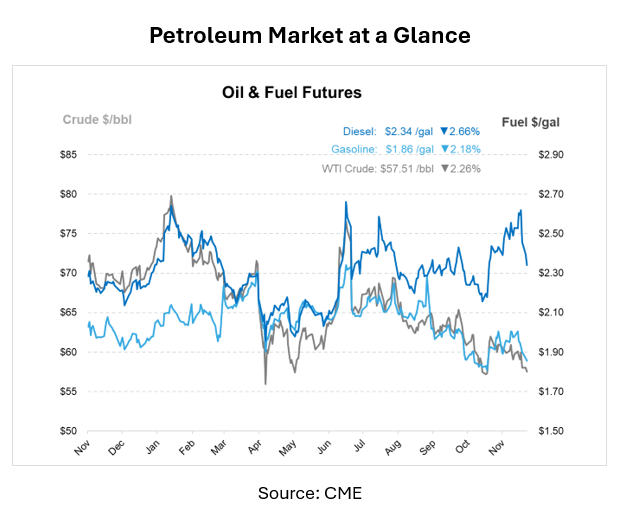
U.S. fuel markets are heading into the Thanksgiving holiday with a decidedly bearish tone as petroleum futures continue to slip and refined products retreat from recent highs. WTI has fallen by more than $1.30 to $57/bbl, while diesel and gasoline futures are down six cents and four cents, respectively. Despite this, retail gasoline prices have remained remarkably steady, holding within a narrow range since mid-October and averaging $3.059/gal on Monday, which is virtually unchanged from last year and just one cent below last Thanksgiving’s national average. This comes even as RBOB futures slid more than 6% last week and diesel contracts also trended lower, pointing to softer wholesale conditions heading into the long weekend.
AAA expects a record number of Americans to travel on the highways this Thanksgiving, forecasting that more than 73 million will drive, a 1.8% increase from 2024. Historically, gasoline demand peaks the week before Thanksgiving and eases slightly during the holiday itself, keeping overall consumption firm but not exceptionally strong.
On the futures side, both crude and refined products are entering the holiday with clear bearish momentum. WTI and Brent fell roughly 2% week-over-week, while gasoline and diesel posted even larger percentage declines. Light trading volumes, which are historically typical during the holiday week, may magnify price swings, especially as January product contracts settle in well below expiring December futures.
Other market dynamics are also shaping sentiment, including the ongoing shutdown of the Olympic Pipeline and the onset of colder temperatures. Winter forecasts calling for below-normal temperatures across much of the country could boost short-term diesel demand, though diesel futures appear increasingly bearish after completing their recent upward trend.
The Olympic Pipeline outage continues to disrupt fuel supply in the Pacific Northwest. Washington Gov. Bob Ferguson issued an emergency hours-of-service waiver for tanker truck drivers hauling jet fuel to support supply at Seattle-Tacoma International Airport, which depends heavily on the line. Sea-Tac has also instructed inbound airlines to “ferry in” additional fuel to reduce strain on local inventories. The pipeline was initially shut down after a release on Nov. 11 near Everett, WA, and a full restart timeline remains unclear as crews continue their investigation.
Meanwhile, in Canada, political momentum is building behind new energy infrastructure. Canadian Prime Minister Mark Carney and Alberta Premier Danielle Smith have reached broad terms on a deal to support a new pipeline to the West Coast. According to CBC, an upcoming memorandum of understanding would grant Alberta exemptions from certain federal environmental regulations and provide political backing for the project, signaling a significant alignment between the federal and provincial governments aimed at expanding Canada’s export capacity.
This article is part of Daily Market News & Insights
Tagged: crude prices, Daily Market News & Insights, demand, fuel prices, gasoline, Supply, wti crude


MARKET CONDITION REPORT - DISCLAIMER
The information contained herein is derived from sources believed to be reliable; however, this information is not guaranteed as to its accuracy or completeness. Furthermore, no responsibility is assumed for use of this material and no express or implied warranties or guarantees are made. This material and any view or comment expressed herein are provided for informational purposes only and should not be construed in any way as an inducement or recommendation to buy or sell products, commodity futures or options contracts.