

Week in Review – Fuel Prices Driven by Storms, Sanctions, and Economic Signals
Crude oil prices ended the week with small gains as markets balanced geopolitical uncertainty, storm risks, and shifting economic indicators. Brent crude rose to around $67.72 per barrel while West Texas Intermediate (WTI) rose to $63.64 putting both benchmarks on track for their first weekly gain in three weeks. The increase reflected a combination of tighter U.S. inventories, ongoing disruptions in Eastern Europe, and market speculation over central bank policy.
Geopolitical Tensions Resurface
Hopes for an imminent peace deal between Russia and Ukraine faded, keeping upward pressure on prices. Russia launched fresh airstrikes near Ukraine’s border with the European Union, while Ukraine retaliated by striking a Russian refinery and the Unecha pumping station, part of the crucial Druzhba pipeline. Hungary reported that flows through the system had been stopped, proving the fragility of Europe’s energy security. Meanwhile, U.S. and European planners met to consider military options as President Trump sought to broker a summit between Vladimir Putin and Volodymyr Zelenskiy. However, Russia’s demands, including Ukraine ceding the Donbas region and renouncing NATO aspirations, make an agreement unlikely. The less probable a ceasefire appears, the more likely Washington will impose tougher sanctions on Russia, further constraining global crude flows.
Hurricane Erin and Supply Security
Closer to home, Hurricane Erin remained a focus for U.S. energy markets. Earlier forecasts suggested risks to Virginia shorelines and then offshore Canadian oil platforms, but the storm’s track shifted southward, reducing immediate threats to production.
Inventory Draw and Market Fundamentals
Fundamentals also pushed prices higher this week. The U.S. Energy Information Administration (EIA) reported a larger-than-expected 6 million barrel draw from crude stockpiles, compared to expectations of a 1.8 million barrel decline. The sharp drop points to resilient demand despite macroeconomic uncertainty and provided a bullish counterweight to geopolitical headwinds.
Economic Indicators
In the U.S., initial jobless claims climbed to 235,000 last week, the highest since June, while continuing claims reached 1.972 million, their highest since late 2021. Economists noted that these figures suggest softening in the labor market, with unemployment likely ticking up to 4.3% in August. Overseas, Germany reported a 0.3% contraction in second-quarter GDP, raising concerns about slowing demand in Europe’s largest economy.
Markets are also watching the Federal Reserve for signals on monetary policy. With central bankers gathering at the annual Jackson Hole conference, markets await comments from Chair Jerome Powell that could pave the way for interest rate cuts next month. Lower rates would stimulate economic growth, potentially boosting energy consumption.
Prices in Review
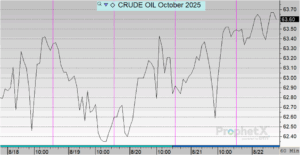
Crude prices opened at $63.00 on Monday and traded narrowly throughout the week. Prices inched up to $63.27 on Tuesday before dipping to the weekly low of $62.60 on Wednesday. By Thursday, crude increased slightly to $62.85 and finished the week higher at $63.50 on Friday. Overall, crude gained $0.50, or 0.79%, for the week.
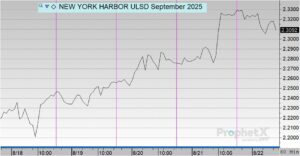
Diesel prices opened at $2.2286 on Monday and trended higher throughout the week. Prices rose to $2.2475 on Tuesday and $2.2610 on Wednesday, before continuing upward to $2.2751 on Thursday. The rally extended into Friday, with diesel opening at $2.3312, marking the weekly high. Overall, diesel gained $0.1026, or 4.6%, for the week.
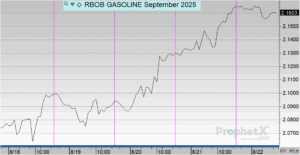
Gasoline prices opened at $2.0711 on Monday and moved steadily higher through the week. Prices climbed to $2.1015 on Tuesday before dipping slightly to $2.0905 on Wednesday. The upward trend resumed on Thursday at $2.1305, with prices reaching the weekly high of $2.1627 on Friday. Overall, gasoline gained $0.0916, or 4.4%, for the week.
This article is part of Daily Market News & Insights
Tagged:


MARKET CONDITION REPORT - DISCLAIMER
The information contained herein is derived from sources believed to be reliable; however, this information is not guaranteed as to its accuracy or completeness. Furthermore, no responsibility is assumed for use of this material and no express or implied warranties or guarantees are made. This material and any view or comment expressed herein are provided for informational purposes only and should not be construed in any way as an inducement or recommendation to buy or sell products, commodity futures or options contracts.