

Trump Administration’s Diesel Tax Relief Raises Questions for Fuel Buyers as Global Supply Risks Persist
The Trump administration’s temporary tax provisions for on-road dyed diesel use could provide additional supply options, but uncertainty over federal excise taxes and state restrictions leaves the financial benefits unresolved. On October 14, the Internal Revenue Service (IRS) temporarily waived federal penalties for selling or using dyed diesel in on-highway vehicles nationwide. The relief follows an October 5 executive order and applies retroactively from October 1 through December 31, 2026. While the measure could help address domestic diesel availability, buyers are still waiting to learn whether federal fuel taxes will be deferred or forgiven. Internationally, continued attacks near the Strait of Hormuz and disruptions to Middle East oil shipments are keeping crude and diesel prices elevated.
The federal waiver allows dyed diesel, typically reserved for off-road use, to enter the highway market without certain federal excise-tax penalties. However, customers who choose to use dyed diesel in highway vehicles may still owe the federal excise tax. The IRS has not forgiven these taxes and has yet to clarify when payments will be due or how they should be reported on Form 720. If taxes are ultimately deferred or forgiven, the provisions could reduce near-term costs for qualifying fuel purchases. Until those details are finalized, customers should account for the potential tax expense and maintain records of all dyed diesel purchases and usage.
The federal waiver also does not give drivers permission to use dyed diesel on public highways in every state. States can still collect fuel taxes and impose penalties, and some have announced their own exemptions, while others continue to enforce existing rules.
Mansfield does not recommend using dyed diesel in clear diesel tanks or changing existing fuel supply plans based solely on the federal announcement. Until the operational, financial, tax, and regulatory implications are more clearly defined, customers should continue using clear diesel for highway vehicles. Through our extensive supplier network, Mansfield will continue to prioritize clear diesel availability and identify alternative sourcing and delivery options when local constraints arise. Mansfield is monitoring state and federal developments as requirements change and can help customers understand available fuel options in their markets.
The tax provisions arrive as domestic diesel inventories remain well below seasonal averages and crude prices continue climbing. According to the Energy Information Administration (EIA), U.S. distillate inventories declined by 2.5 million barrels to 102.6 million barrels last week, leaving supplies 12% below the five-year average. Distillate demand increased by 673,000 bpd to 4.323 Mbpd, its highest weekly level since March. With less diesel in storage and consumption increasing, any interruption to refinery production or fuel deliveries could push prices higher. Gasoline moved in the opposite direction, with inventories increasing by 3.5 million barrels to 208.3 million barrels as demand fell to 8.408 Mbpd.
Crude inventories also declined as Hurricane Isaias disrupted offshore production in the Gulf of Mexico. The EIA reported an 8.6 million barrel draw in U.S. commercial crude inventories, bringing total stocks to 415.6 million barrels, approximately 3% below the five-year seasonal average. Domestic crude production fell by 300,000 bpd to 13.679 Mbpd, while imports declined by 791,000 bpd. Gulf Coast inventories accounted for much of the decline, falling by 9.2 million barrels. Meanwhile, crude inventories at Cushing, OK, increased by 1.9 million barrels, providing a bearish counterweight to the broader inventory draw. Some of the Gulf Coast supply tightening could reverse as offshore production and imports recover from hurricane-related disruptions.
Despite efforts to increase domestic fuel availability, international supply disruptions continue to influence petroleum prices. West Texas Intermediate (WTI) traded near $97.78/bbl Friday morning, approximately 6.4% higher for the week, while Brent traded near $106.28/bbl, up 1.4%. The weekly gains reflect lower U.S. crude inventories and continued uncertainty surrounding Middle East exports.
Iran has intensified attacks on commercial vessels near the Strait of Hormuz in response to the U.S. blockade of Iranian ports and additional sanctions introduced last month. Two Emirati cargo ships sank near the waterway following attacks, while the U.K. Maritime Trade Operations issued warnings involving two container ships struck by unidentified projectiles. The continued attacks have complicated efforts to restore oil shipments through one of the world’s most important energy transportation routes.
Even with the shipping disruptions, Middle East crude exports have recovered from earlier declines. The International Energy Agency (IEA) reported that Persian Gulf crude exports increased by 4.4 Mbpd in September to 13.9 Mbpd, exceeding 75% of prewar levels. Additional exports have increased available crude supply, but continued attacks threaten the reliability of those shipments. Renewed Houthi attacks against Saudi Arabian infrastructure have also raised concerns about shipping near the Bab el-Mandeb Strait. Further disruptions could increase transportation costs and complicate petroleum deliveries through the Red Sea.
The Trump administration is also considering easing sanctions on certain shadow fleet tankers previously involved in transporting oil and petroleum products from Russia, Iran, and Venezuela. Allowing additional vessels to participate in international trade could reduce elevated freight costs and improve transportation availability. Recovering Middle East exports and potentially lower shipping costs are bearish developments for crude prices, although continued attacks remain a source of upward price pressure.
Additional measures are underway to address tight diesel supplies internationally. The IEA agreed Thursday to release more than 20 million barrels of diesel as part of a broader emergency supply initiative. Following the announcement, European diesel refining margins declined nearly 2% Friday to approximately $78.67/bbl, compared with highs near $95/bbl in September. The additional fuel could improve availability in regions experiencing shortages, but refinery constraints and shipping disruptions continue to limit how quickly supplies can reach buyers.
Prices in Review
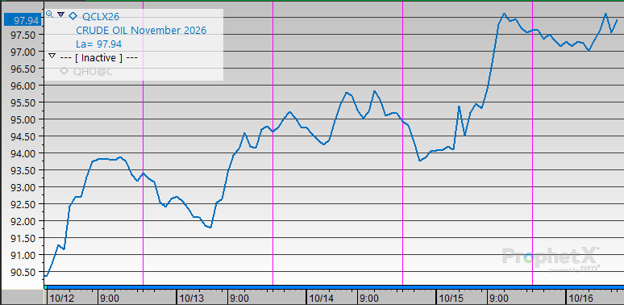
Crude prices trended higher throughout the week, reflecting bullish market conditions driven by tightening U.S. inventories and ongoing Middle East supply concerns. Crude opened the week at $91.83 on Monday before climbing to $93.21 on Tuesday. Prices continued increasing on Wednesday, reaching $94.75, followed by another gain to $95.19 on Thursday. By Friday, crude reached its weekly high of $97.55. Overall, crude prices increased by $5.72 over the course of the week, representing a 6.23% gain.
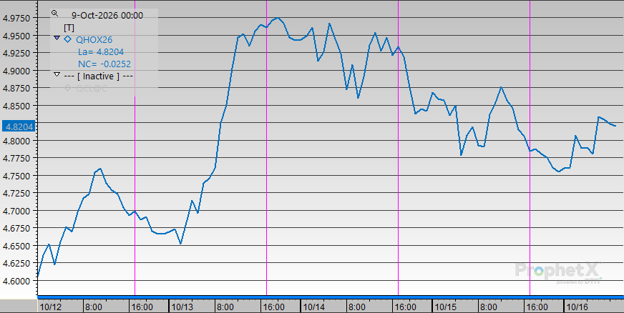
Diesel prices rose early in the week before retreating from their midweek high. Diesel opened at $4.6742 on Monday and increased to $4.7116 on Tuesday. Prices climbed further on Wednesday, reaching the weekly high of $4.9757, before declining to $4.9123 on Thursday. The downward trend continued on Friday, with diesel opening at $4.8157. Despite a pullback in the second half of the week, diesel prices increased by $0.1415, representing a 3.03% gain.
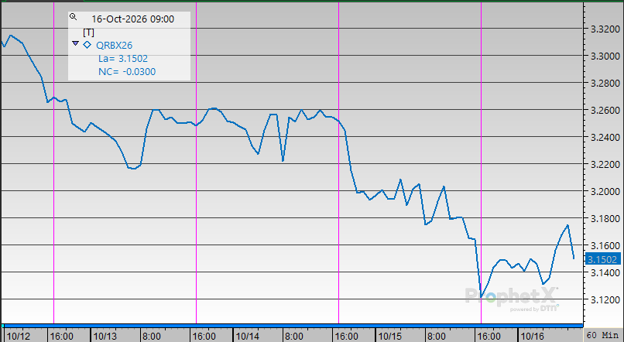
Gasoline prices fluctuated throughout the week before trending lower, reflecting bearish conditions as demand weakened and inventories increased. Gasoline opened at $3.2657 on Monday and edged higher to $3.2798 on Tuesday, marking the weekly high. Prices declined to $3.2480 on Wednesday, then recovered slightly to $3.2649 on Thursday. By Friday, gasoline fell to its weekly low of $3.1665. Overall, gasoline prices declined by $0.0992 over the week, a 3.04% decrease.

This article is part of Daily Market News & Insights


MARKET CONDITION REPORT - DISCLAIMER
The information contained herein is derived from sources believed to be reliable; however, this information is not guaranteed as to its accuracy or completeness. Furthermore, no responsibility is assumed for use of this material and no express or implied warranties or guarantees are made. This material and any view or comment expressed herein are provided for informational purposes only and should not be construed in any way as an inducement or recommendation to buy or sell products, commodity futures or options contracts.