

Week in Review – Hormuz Hopes Lower Crude Prices, but Physical Supply Stays Tight
Oil prices moved lower Friday as the market weighed renewed hopes for a U.S.-Iran agreement against ongoing supply and shipping risks across the Middle East. Prompt WTI futures were down more than $2 per barrel this morning and on track to decline roughly $3 per barrel week over week. Brent was trading near $105 per barrel, while WTI was around $93, leaving the spread between the two benchmarks near its widest level since May.
The biggest source of pressure on crude prices is renewed diplomacy between the U.S. and Iran. Negotiators are discussing a phased agreement that could reopen the Strait of Hormuz while easing the U.S. economic blockade on Iran. The strait has become a central bargaining point in the conflict, with Washington seeking freer passage for energy shipments and Tehran seeking economic relief.
For the energy market, even the possibility of reopening Hormuz is significant. Since the conflict began, around one-fifth of global oil and gas shipments have been curtailed, making any improvement in traffic through the waterway an important potential source of relief for supply. However, negotiations remain complicated because both sides are reluctant to give up leverage until they receive concessions in return.
Oil is still moving through Hormuz but flows remain far from normal conditions. Crude exports through the strait reached 33.7 million barrels so far this week, roughly in line with the previous week’s pace.
Supply concerns also remain elevated elsewhere in the region. Houthi attacks on Saudi Arabia have raised concerns about additional disruptions from one of the world’s largest oil exporters. Saudi Arabia has increased crude movement through its East-West Pipeline toward the Red Sea, although tanker loadings from Yanbu had not yet resumed. At the same time, ship-to-ship transfer capacity in the Gulf of Oman has reached its limits as producers work around disrupted traditional routes.
Shipping costs are adding another layer of pressure. Iraq has been offering last-minute crude cargoes, but freight rates for very large crude carriers traveling from the Gulf of Oman to East Asia are adding roughly $20 per barrel to costs. High freight rates and limited vessel availability are also making it more difficult for U.S. crude to move into international markets. Shipping crude from the U.S. Gulf Coast to Asia now costs around $50 million per VLCC, compared with about $16 million before the Iran conflict began.
That transportation pressure is one reason the gap between Brent and WTI has widened so sharply, but another major factor is uncertainty surrounding U.S. diesel export policy. The Trump administration continues to examine whether a full or partial restriction on diesel exports could help reduce domestic fuel prices. The possibility has already affected expectations for U.S. refining activity, helping push WTI to a much larger discount to Brent.
Restricting diesel exports could leave more fuel in the U.S. initially, but it could also create complications for refiners. Industry analysts suggest that if diesel cannot move overseas, storage could fill quickly, and refiners may have to reduce crude processing. That could lower production of other fuels, including gasoline and jet fuel. For now, the policy remains uncertain, with administration officials still evaluating different options.
The debate is also creating concern in Europe, where diesel supplies remain tight. European diesel inventories are well below both last year’s levels and the five-year seasonal average, while low Rhine River water levels are limiting inland distribution. U.S. barrels have become increasingly important in replacing reduced supply from Russia and the Middle East, so any restriction on U.S. exports could tighten the Atlantic Basin market further.
Russia remains another source of uncertainty. A small refinery in southern Russia was shut down following an overnight drone strike, continuing a pattern of attacks on Russian energy infrastructure. Reduced Russian supply has already contributed to tighter global diesel availability.
For now, progress toward reopening the Strait of Hormuz could remove some of the geopolitical premium from crude prices, but the broader supply picture remains tight. Shipping constraints, attacks on energy infrastructure, low diesel inventories, and uncertainty around U.S. export policy continue to support risk across both crude and refined-product markets.
That tension is helping keep Brent comparatively elevated even as WTI weakens. Much will depend on whether diplomatic progress leads to more consistent energy flows through the Strait of Hormuz. Until then, shipping conditions, supply availability, and refined-product tightness are likely to remain key drivers of oil and fuel prices.
Prices in Review
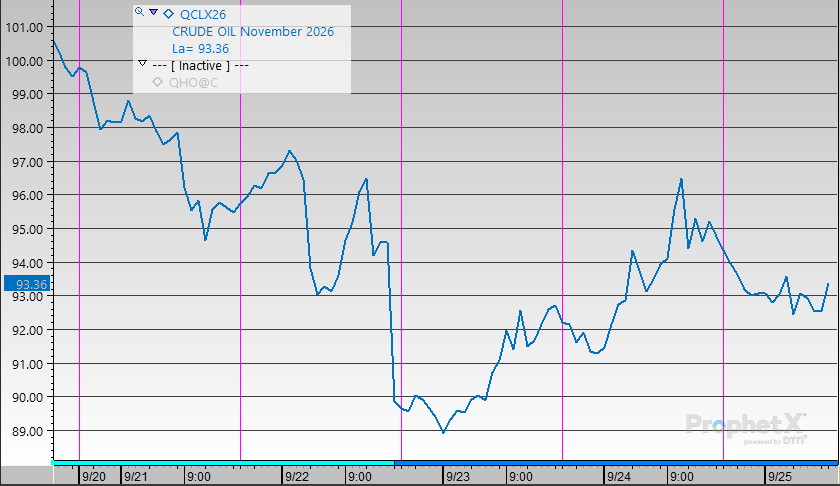
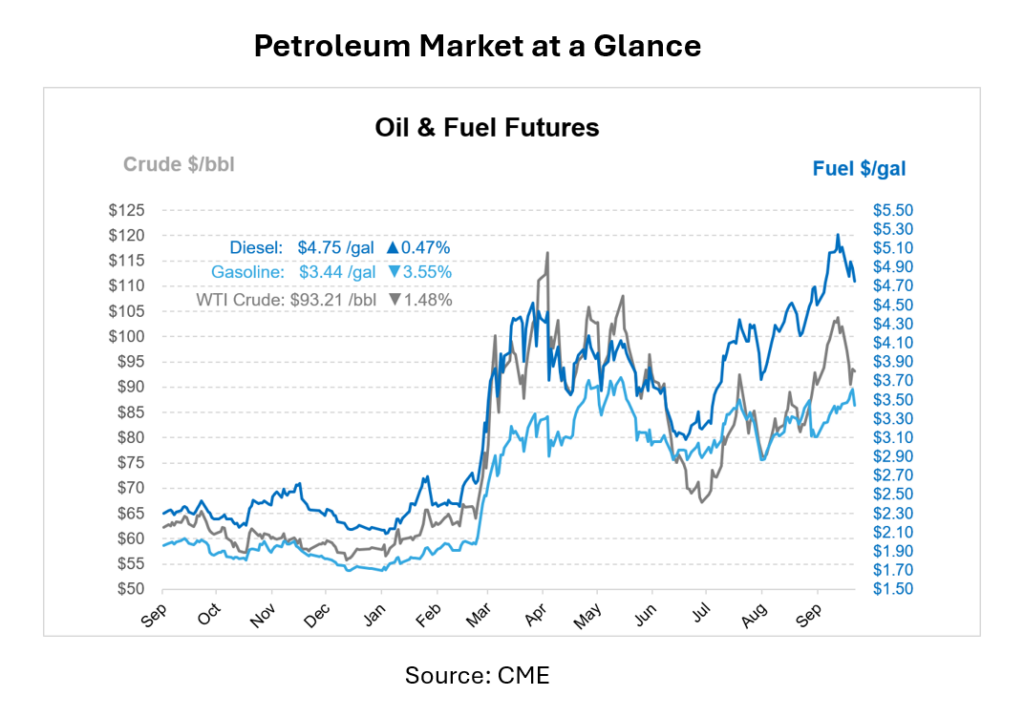
Crude prices came under significant pressure early in the week before staging a partial recovery. Prices opened at $101.00 on Monday and fell to $95.39 on Tuesday, then extended the decline to $89.89 on Wednesday, the lowest opening price of the week. The market regained some ground afterward, with crude opening at $92.72 on Thursday and $94.75 on Friday. From Monday to Friday, crude prices declined by $6.25 per barrel, or approximately 6.2%.
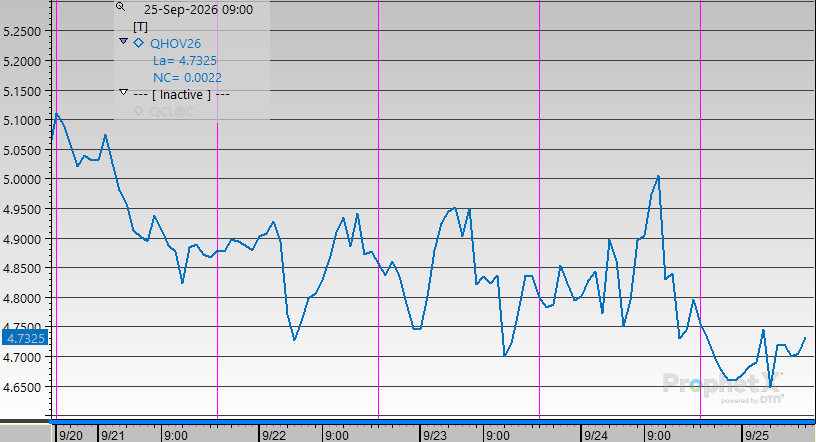
Diesel prices faced downward pressure during the week, with only a brief uptick on Wednesday. Prices opened at $5.1142 on Monday before dropping to $4.8745 on Tuesday. Prices ticked up to $4.8968 on Wednesday, but the decline resumed with openings of $4.8289 on Thursday and $4.7850 on Friday, the lowest level of the period. Throughout the week, diesel fell by $0.3292 per gallon, or approximately 6.4%.
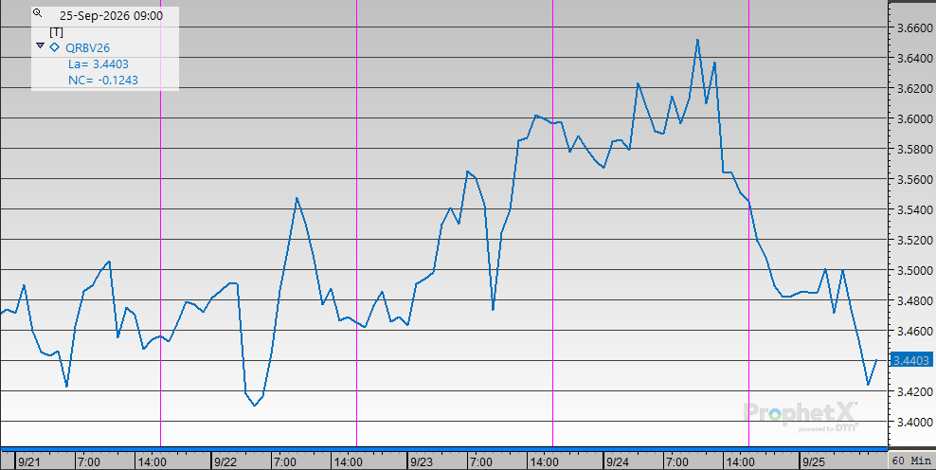
Gasoline prices shifted direction several times during the week, but Friday’s opening remained close to where it started. After opening at $3.5400 on Monday, prices eased to $3.4680 on Tuesday before ticking up to $3.4827 on Wednesday. A stronger move followed on Thursday, when gasoline reached a weekly high of $3.6059, before pulling back to $3.5608 on Friday. Overall, gasoline prices increased by $0.0208 per gallon, representing an approximate 0.6% gain for the week.
This article is part of Daily Market News & Insights


MARKET CONDITION REPORT - DISCLAIMER
The information contained herein is derived from sources believed to be reliable; however, this information is not guaranteed as to its accuracy or completeness. Furthermore, no responsibility is assumed for use of this material and no express or implied warranties or guarantees are made. This material and any view or comment expressed herein are provided for informational purposes only and should not be construed in any way as an inducement or recommendation to buy or sell products, commodity futures or options contracts.