

Diesel Tops $5 With U.S. Inventories and Global Supply Under Pressure
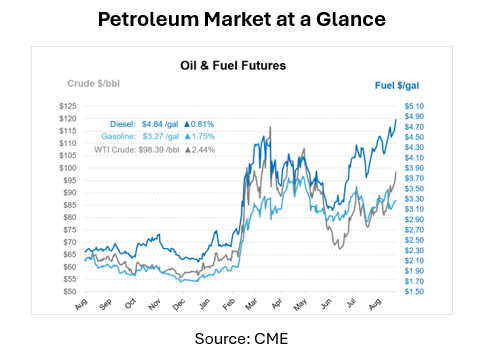
U.S. diesel futures surged above $5 per gallon on Thursday for the first time since April 2022, putting growing strain in global fuel markets back at the center of the energy story. Brent crude remained above $100, while WTI traded above $98 per barrel. At the retail level, the national average diesel price had already climbed to a record $5.98 per gallon as of Wednesday.
Fuel supplies are being squeezed from several directions at once, with Middle East disruptions limiting flows through the Strait of Hormuz, Russian exports restricted following Ukrainian drone attacks, and U.S. inventories entering September at their lowest seasonal levels on record.
The pressure is particularly visible in diesel refining economics. The Nymex heating oil crack climbed $5.32 Wednesday to $104.96 per barrel, its highest close since September 2. The ICE gasoil crack also gained $4.50 to $77.64 per barrel, its highest level since September 1. Gasoline has moved differently, with the Nymex gasoline crack falling to $38.17 per barrel, its weakest level since June 8.
For diesel consumers, the impact is already extending beyond futures markets. Diesel remains a critical input for trucking, agriculture, construction and other heavy-duty operations, meaning higher fuel costs can quickly move through transportation and operating expenses. California retail diesel averaged $7.91 per gallon, while some stations were listing prices at $9.999 per gallon. Other regions face different exposures, including states that rely heavily on heating oil and agricultural markets where diesel powers farm equipment.
Hormuz Traffic Moves Back Into Single Digits
The Strait of Hormuz remains one of the most important constraints on the global energy market. Vessel traffic through the waterway fell to just seven ships Wednesday from 12 the previous day, compared with a 10-day average of 14 vessels. Four ships exited the strait and three entered.
Energy flows were particularly limited. Only one very large crude carrier, Finland Prosperity, exited Hormuz carrying nearly 2 million barrels of crude. No LNG tankers left the strait. The remaining outbound vessels included two dry bulk carriers and a short-range dirty products tanker.
The latest escalation has again increased uncertainty around shipping. Iran said it attacked 10 ships near Hormuz on Wednesday after the U.S. sank five Iranian oil tankers. The exchange was the latest in a series of attacks on vessels and energy infrastructure that have kept the risk of further disruption elevated.
Product exports through Hormuz are recovering slowly but remain well below pre-war levels. That is especially important for the diesel market, where global supply is already tight, and available replacement barrels are becoming more valuable.
Red Sea Risks Complicate the Alternative Route
The challenge for oil markets is no longer limited to the Strait of Hormuz. Risks have also increased around the Red Sea after Houthi forces seized Yemen’s port city of Mocha, strengthening their position near the Bab el-Mandeb Strait.
Bab el-Mandeb connects the Red Sea with the Gulf of Aden and serves as a critical route for crude oil and refined products moving toward the Mediterranean through the Suez Canal and the SUMED pipeline. It is also an important route for commodities moving toward Asia.
That has become particularly important for Saudi Arabia. With normal traffic through Hormuz heavily disrupted, Saudi exporters have increasingly relied on the Red Sea as an alternative outlet for crude.
Saudi crude and condensate loadings from the Red Sea port of Yanbu have rebounded in September after falling to a six-month low in August. Vortexa estimated September loadings at 3.7 million barrels per day, up from 3.2 million bpd in August. Kpler estimated loadings at 2.9 million bpd, compared with just 1.5 million bpd a month earlier.
However, that alternative comes with its own risks. Yanbu loadings had already declined in late July and August amid intensifying Houthi attacks near Bab el-Mandeb. With fighting escalating again, the market is watching whether the Red Sea can continue absorbing barrels diverted away from Hormuz.
For now, overall commodity traffic through Bab el-Mandeb has held relatively steady. Twenty-eight commodity ships passed through the strait on Wednesday, close to the 10-day average of 27. But the latest military developments have increased concern about whether those flows can remain stable.
Russia Adds Another Layer to the Diesel Squeeze
At the same time, diesel markets are dealing with reduced Russian supply. Ukrainian drone attacks have forced Moscow to ban exports through the end of September, removing additional barrels from an already constrained global market.
That has left buyers competing for alternative supplies just as peak demand season approaches. The U.S. is increasingly filling that gap as a supplier of last resort, but higher exports and strong demand are drawing down domestic inventories. U.S. stockpiles entered September at their lowest seasonal levels on record.
The combination helps explain why diesel prices have risen much faster than crude alone would suggest. Diesel futures above $5 per gallon, equivalent to around $210 per barrel, illustrate the premium placed on available refined products relative to the underlying crude market.
Few Signs of a Near-Term Resolution
A senior Iranian official said the country is prepared for a more intense conflict and would escalate its counterstrikes if U.S. attacks on Iranian territory and infrastructure continue. The official also said Tehran does not intend to back down in response to the naval blockade and attacks on its oil tankers.
The conflict is now in its seventh month, and no official peace talks have been held for months. Both sides continue to compete for control over traffic through Hormuz, with Iran maintaining that it has the right to manage shipping through the waterway and targeting vessels that pass without its permission.
Those conditions make the duration of supply disruptions increasingly important for the market. Short-term interruptions can often be managed through inventories, alternative routes, and additional exports from other suppliers. The longer restrictions continue, however, the more pressure they place on those alternatives.
This article is part of Daily Market News & Insights


MARKET CONDITION REPORT - DISCLAIMER
The information contained herein is derived from sources believed to be reliable; however, this information is not guaranteed as to its accuracy or completeness. Furthermore, no responsibility is assumed for use of this material and no express or implied warranties or guarantees are made. This material and any view or comment expressed herein are provided for informational purposes only and should not be construed in any way as an inducement or recommendation to buy or sell products, commodity futures or options contracts.