

Oil Prices Ease as US-Iran Talks Point to Lower Supply Risk
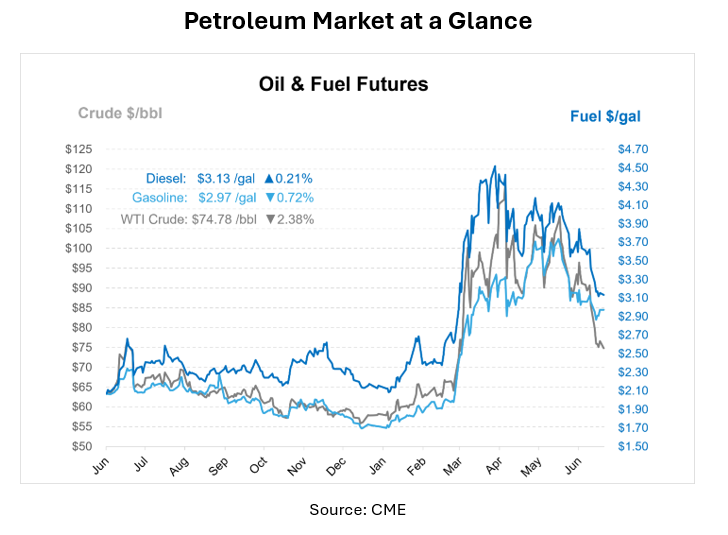
Oil prices are moving lower as the market watches for signs that tensions between the U.S. and Iran may be easing. After rising overnight, prompt WTI prices were relatively flat this morning ahead of the July contract expiration. Brent also moved lower after U.S. and Iranian officials held high-level talks in Switzerland, and comments from U.S. Vice President suggested progress had been made.
Over the weekend, the U.S. and Iran began peace talks aimed at settling issues around Iran’s nuclear program and reopening the Strait of Hormuz. Iranian media reported early Sunday that Iran had halted talks following President Trump’s latest threat of retaliatory strikes, but U.S. officials said discussions were continuing.
That back-and-forth created some uncertainty early in the session. Prices initially moved higher after renewed threats from Washington and reports from Tehran that the Strait had been closed again. However, the market later shifted lower as talks continued and supply risks appeared to ease.
One of the clearest signs of improvement is that oil flows have started to return. Five oil supertankers, with a combined transport capacity of about 8 million barrels, were seen traveling inside the Strait of Hormuz over the weekend along a route close to Oman’s coast. Iranian officials also said more than 25 million barrels of Iranian oil had passed through the virtual blockade line since last Monday.
That matters because a full reopening of the Strait would increase global crude availability and contribute to a more bearish supply outlook. Iranian Foreign Minister Abbas Araghchi said discussions had delivered major progress, with about 80 million barrels of crude expected to hit the market once the Strait of Hormuz fully reopens. Iran has also reportedly secured waivers for oil and petrochemical exports, the release of some frozen assets, and the launch of a reconstruction and development plan.
However, recovery is not expected to be immediate. Iran has resumed exports previously blocked by the U.S. naval blockade, gradually adding supply back to the market. The United Arab Emirates, Kuwait, and Iraq have also offered more oil to customers in the past week. Iraq plans to gradually restore crude production to between 4.2 million and 4.3 Mbpd.
Another factor adding pressure to prices is demand. Chinese oil imports are expected to fall by about 3.3 Mbpd in the second quarter of 2026 compared with the same period last year. That decline is tied to supply disruptions, a halt in stockpiling, refinery run cuts, and a ban on fuel exports. Because China is one of the world’s largest oil consumers, a drop of that size can weigh heavily on market sentiment.
In the long term, the market is also watching electric vehicle adoption. GIR reported that global EV sales as a share of total car sales have accelerated since February, reaching an all-time high of 26.1% last month. GIR estimates that the recent increase in EV sales could reduce global oil demand by 0.13-0.32 Mbpd by December 2027, depending on whether the acceleration is temporary or persistent. While that is a longer-term factor, it adds to the downside risks for oil demand.
Beyond the Middle East, supply concerns remain in other regions. In Russia-occupied Crimea, authorities suspended fuel sales at filling stations and limited supplies to state services amid Ukrainian drone strikes on Russian refineries and oil infrastructure. Ukraine has increased attacks on transport links to Crimea, the Kavkaz port in Russia’s Krasnodar region, an oil terminal in Kerch, and the Tyumen oil refinery. The Moscow refinery was also reportedly hit twice last week.
Meanwhile, North American drilling activity remains mixed. The U.S. crude oil rig count was unchanged at 433 rigs for the week ended June 18. The count is up eight rigs month-over-month but down five rigs from a year ago. In Canada, the crude oil rig count increased by eight rigs to 129, up 42 rigs from last month and 36 rigs from the same period last year.
The market remains focused on the outcome of U.S.-Iran negotiations and the pace of oil flows returning through the Strait of Hormuz. Continued progress could add more crude to the market, while any renewed disruption would quickly reintroduce supply concerns.
This article is part of Daily Market News & Insights
Tagged: Brent Crude, China oil demand, Crude oil prices, Crude Oil Production, electric vehicles and oil demand, fuel market update, global oil supply, Iran nuclear negotiations, Iranian oil exports, Iraq oil production, Mansfield Energy, Middle East oil markets, oil demand outlook, oil market news, oil prices, oil tanker traffic, OPEC supply, petroleum industry news, Strait of Hormuz, U.S.–Iran talks, wti crude


MARKET CONDITION REPORT - DISCLAIMER
The information contained herein is derived from sources believed to be reliable; however, this information is not guaranteed as to its accuracy or completeness. Furthermore, no responsibility is assumed for use of this material and no express or implied warranties or guarantees are made. This material and any view or comment expressed herein are provided for informational purposes only and should not be construed in any way as an inducement or recommendation to buy or sell products, commodity futures or options contracts.