
Oil Hits Three-Month Low as Strait of Hormuz Reopening Moves Closer
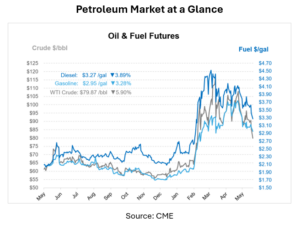
A potential turning point in the U.S.-Iran conflict is putting downward pressure on oil prices this week, with prompt WTI futures trading down by more than $4 per barrel this morning after closing last week down by about $6 per barrel. After more than three months of war and the closure of the Strait of Hormuz, the U.S. and Iran have announced an interim agreement to reopen the waterway, easing some of the supply concerns that have kept energy markets on edge.
The announcement gives the market a reason to price in the possibility of renewed oil and gas flows, but the situation remains far from fully resolved. Officials from both countries are expected to meet in Switzerland on June 19 to formally sign the agreement, and President Trump said the delay is tied to the removal of mines in the Strait. Ship owners are also waiting for more details on security coordination before resuming normal transit through the region.
That uncertainty matters because restarting traffic through the Strait of Hormuz will likely take time. Analysts said a partial recovery could occur within weeks if the deal holds, but broader commercial normalization may take 4 to 6 months. A full return to pre-conflict traffic levels may not happen until 2027, depending on the stability of the agreement and the pace of production recovery.
The market is also watching how quickly Middle Eastern producers can restore production and exports after the damage caused by the war. Since the Strait closed, the world has lost millions of barrels of oil and gas supply. Even if the route reopens, the physical supply recovery may be slower than the price reaction seen in futures markets.
Meanwhile, Kuwait is lowering prices for July crude shipments to Asia, Europe, and the U.S., adding another bearish signal for the market. Kuwait cut the price of its export crude to Asia to a premium of $5.25 per barrel above the regional benchmark for July, down from a $12.75 premium in June. That price cut suggests producers are adjusting to changing market expectations as supply concerns ease.
Financial markets are also responding to the possibility of lower geopolitical risk. S&P 500 futures were trading up 1.2% this morning, while the dollar moved lower as investors waited for the official peace agreement to be signed on Friday.
At the same time, broader economic questions remain in focus. According to GIR, the labor market has strengthened since the last FOMC meeting, with stronger job growth putting the economy on a sturdier path. The key question now is whether inflation concerns could become serious enough to push the Federal Reserve toward a rate hike. GIR still sees rate hikes as unlikely, noting that the Fed has typically not raised rates in response to oil price shocks and that today’s more balanced labor market makes it less likely that higher energy prices would lead to self-sustaining inflation.
Rig count data shows continued activity in North American crude production. In the U.S., the crude oil rig count rose by two rigs to 433 for the week ended June 12. The U.S. oil rig count is up 18 rigs month over month, but still down 6 rigs from a year ago. In Canada, the crude oil rig count increased by six rigs to 121, up 45 rigs month-over-month and 30 rigs year-over-year.
For now, the market is pricing in relief. The U.S.-Iran interim agreement has reduced some of the immediate fear of supply disruptions, which has pulled oil prices lower.
In other words, prices are falling because the market sees a path toward stability. But the pace of recovery will depend on whether the agreement holds, how quickly the Strait can reopen safely, and whether production and shipping activity can resume without further disruptions.
This article is part of Daily Market News & Insights


MARKET CONDITION REPORT - DISCLAIMER
The information contained herein is derived from sources believed to be reliable; however, this information is not guaranteed as to its accuracy or completeness. Furthermore, no responsibility is assumed for use of this material and no express or implied warranties or guarantees are made. This material and any view or comment expressed herein are provided for informational purposes only and should not be construed in any way as an inducement or recommendation to buy or sell products, commodity futures or options contracts.