

Week in Review – Oil Prices Fall to Two-Month Lows as Iran Strike Fears Ease
Oil prices fell to near two-month lows on Friday after President Trump called off threatened strikes on Iran, easing immediate concerns about another escalation in the Gulf. Brent futures dropped more than 3% to around $87 per barrel, while U.S. WTI crude fell to about $84 per barrel. The decline marks a significant shift after weeks of elevated risk tied to the war in Iran and the disruption around the Strait of Hormuz.
The main focus now is the potential agreement between the United States and Iran. President Trump said he currently has a deal to end the war, describing it as “a very strong memorandum of understanding that is a little conceptual.” The agreement could allow ships to begin transiting the Strait of Hormuz as early as next week.
Even if the deal is signed, the market is not assuming that flows will return to normal immediately. Analysts have noted that global and regional oil stocks remain low, and it could take time to restore consistent and uninterrupted vessel traffic through the waterway.
That uncertainty is why downside pressure and upside risk are both present in the market at the same time. On one hand, the possibility of a deal has reduced near-term fears of a broader conflict. On the other hand, if oil flows do not resume quickly, inventories could tighten further as seasonal demand increases. ING analysts noted that late July could become an important inflection point if flows have not recovered by then, with stronger demand and lower inventories potentially pushing prices significantly higher.
Physical crude flows are already showing the impact of the conflict. Iranian crude exports to China fell to 160,000 barrels per day in May, down sharply from 1.8 million barrels per day in February before the start of the war. That decline reflects the effect of the current blockade as well as weaker Asian demand. At the same time, Europe is set to receive additional crude from the UAE and Oman, with at least six supertankers carrying a combined 12 million barrels expected to arrive over the next month. These redirected shipments may help ease some supply concerns, but they also show how trade flows are being reshuffled as the market adapts to disruption.
Goldman Sachs Research now estimates that oil exports from Gulf producers will normalize by late August, compared with its prior expectation of late June. The firm kept its fourth-quarter 2026 Brent forecast at $90 per barrel, noting that weaker demand and pre-war oversupply have helped offset some of the impact from the longer Hormuz disruption. According to Goldman Sachs, the second-quarter deficit is now estimated at 5 to 6 MBPD, which is much smaller than the 14 to 15 MBPD hit to Middle East liquids production. That difference is offset by nearly 5 million barrels per day in estimated demand losses and more than 4 MBP in oversupply that would have existed without the war.
OPEC also adjusted its demand outlook, lowering its 2026 oil demand growth forecast to 970,000 BO from 1.17 MBPD. That marked the group’s second consecutive downward revision. However, OPEC also raised its 2027 demand growth forecast, expecting oil demand to increase by 1.73 million barrels per day that year.
Beyond the Gulf, Russia’s energy infrastructure remains another source of supply risk. Ukraine attacked two oil refineries in Russia last night, causing fires at both facilities. These attacks are part of Ukraine’s continued escalation against Russia’s energy system and add another layer of uncertainty for refined product and crude markets.
Inflation and interest rate expectations are another piece of the puzzle. Federal Reserve officials have generally signaled a wait-and-see approach, with several policymakers indicating that current policy leaves them positioned to respond as conditions evolve. The conflict in Iran, tariffs, and the energy shock have all added uncertainty to the inflation outlook. Goldman estimates that core PCE rose 0.31% in May, which would correspond to a year-over-year rate of 3.38%. That keeps inflation in focus even as some officials expect price pressures to ease later this year.
For now, volatility is likely to remain part of the market until there is more clarity. A signed agreement, improved vessel traffic through the Strait of Hormuz, and evidence that Gulf exports are normalizing would likely ease pressure. But if negotiations stall or physical flows remain restricted into late July, the market could quickly shift back toward tighter supply concerns and higher prices.
Prices in Review
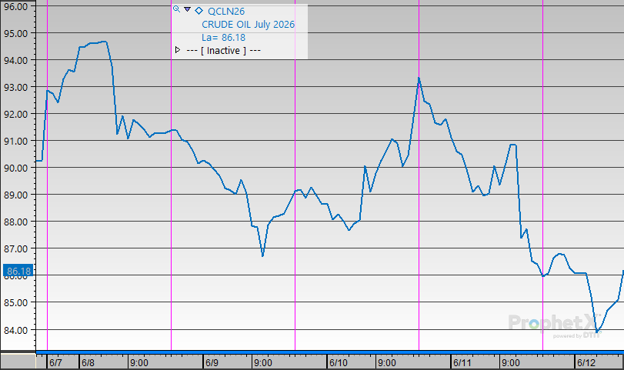
Crude prices trended lower throughout the week, despite a brief rebound on Thursday. Prices opened at $93.00 on Monday and declined to $91.28 on Tuesday, followed by another drop to $89.40 on Wednesday. The market recovered to $92.25 on Thursday, but selling pressure returned on Friday, pushing crude down to $86.64. Overall, crude prices fell by $6.36 per barrel, representing an approximate 6.8% decline during the week.
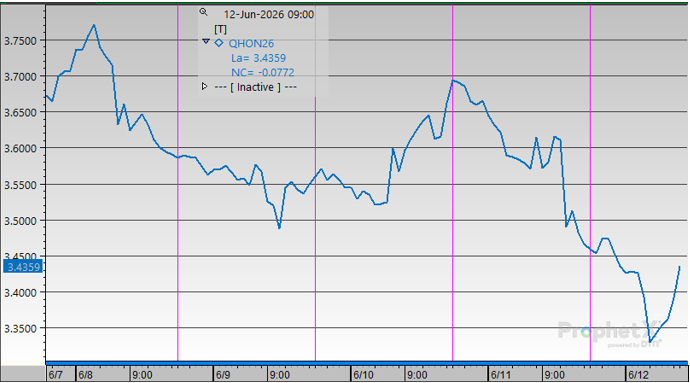
This week, diesel prices stayed within a narrow range through Thursday before dropping sharply on Friday. Prices started at $3.6600 on Monday, eased to $3.5860 on Tuesday, and held nearly flat at $3.5863 on Wednesday. After edging up to $3.6650 on Thursday, diesel fell to $3.4623 on Friday, the lowest level of the week. Overall, diesel prices decreased by $0.1977 per gallon, representing an approximate 5.4% decline.
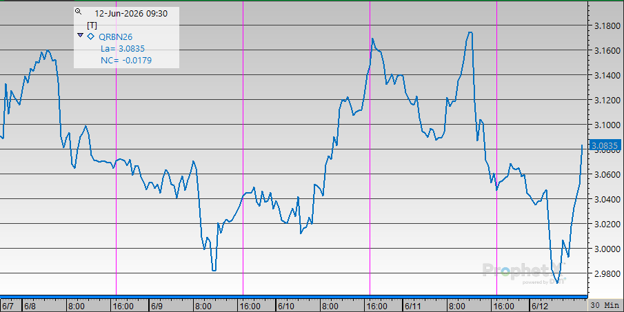
Gasoline prices softened through midweek before briefly rebounding on Thursday. Prices opened at $3.0822 on Monday, slipped to $3.0639 on Tuesday, and then moved lower to $3.0448 on Wednesday. Prices climbed to $3.1425 on Thursday before easing back to $3.0546 on Friday. Overall, gasoline prices decreased by $0.0276 per gallon, representing an approximate 0.9% decline.
This article is part of Daily Market News & Insights


MARKET CONDITION REPORT - DISCLAIMER
The information contained herein is derived from sources believed to be reliable; however, this information is not guaranteed as to its accuracy or completeness. Furthermore, no responsibility is assumed for use of this material and no express or implied warranties or guarantees are made. This material and any view or comment expressed herein are provided for informational purposes only and should not be construed in any way as an inducement or recommendation to buy or sell products, commodity futures or options contracts.