
Paused U.S.-Iran Talks Keep Oil Prices Volatile
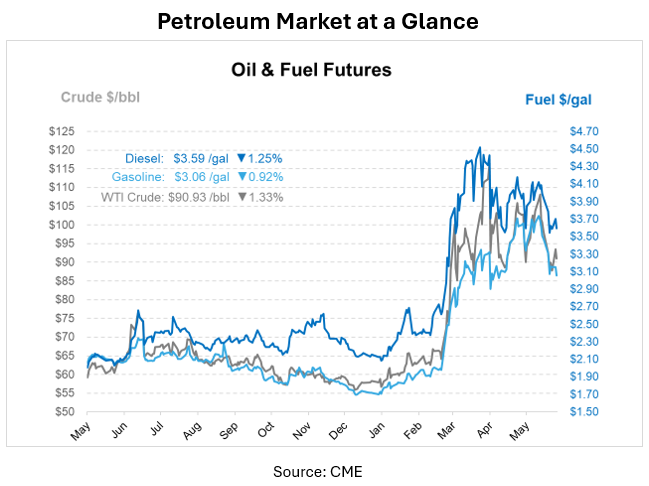
Oil markets are still reacting to the pause in U.S.-Iran agreement talks, with prices moving lower this morning after yesterday’s strong rally. WTI futures were down by about $1 per barrel after closing roughly $5 per barrel higher the day before, showing how quickly the market is responding to changes in the negotiation outlook. The price movement came after Iran pulled back from peace talks in protest of Israel’s expanded attacks in Lebanon, adding more uncertainty to an already tense energy market.
The latest pause does not mean negotiations are over, but it does show how fragile the path to an agreement remains. Iran’s Parliament Speaker and lead negotiator, Mohammad Bagher Ghalibaf, said Israel’s attacks were “clear evidence of U.S. noncompliance with the ceasefire.” That statement raised concerns that the diplomatic process could slow down again, even as President Trump later said talks were continuing at a rapid pace and that Iran’s negotiators were working on the final text to send to the United States.
That mix of messages is one reason prices have been moving sharply. When the market hears that a deal may be moving forward, prices tend to ease because there is hope that the Strait of Hormuz could reopen more fully and supply risks could decline. When talks pause or military activity increases, prices often move higher because the market starts pricing in the risk of longer-lasting disruptions.
The Strait of Hormuz remains central to the issue. The conflict has left the strait largely shut, limiting the flow of oil and liquefied natural gas through one of the world’s most important energy chokepoints. Before the war, the strait carried about one-fifth of global oil and LNG supplies. With flows restricted, global oil markets have had to adjust through a combination of inventory draws, demand losses, and higher prices.
The uncertainty is also showing up in refined products. Product margins, which measure the difference between refined product prices and crude prices, have stayed elevated. Diesel margins reached all-time highs at the end of March as the Middle East conflict reduced refined product exports and created additional pressure on an already stretched global refining system. According to the information provided, global refined product exports declined by 4.0 million barrels per day from a year ago, partly due to lost Persian Gulf product exports and lower output from Asian refineries that rely on Gulf crude.
At the same time, the supply picture remains complicated. Oil refineries and production facilities in Saudi Arabia and the UAE have mostly returned online after war-related damage, but the market is still dealing with estimated outages in the Middle East, continuing attacks on Russian refineries, and changes in trade flows. Venezuela’s crude exports slowed in May after reaching a seven-year high in April, while India’s fuel exports fell to their lowest level in nearly four years as the country focused on maintaining domestic stocks.
U.S. refiners are responding by running near maximum capacity. Bloomberg reported that some refiners have even delayed scheduled maintenance to take advantage of the current price environment. From January through May, an average of 470,000 barrels per day of processing capacity was offline, compared with 700,000 barrels per day during the same period in 2025 and 900,000 barrels per day in 2024.
Still, stronger refinery runs do not fully remove the pressure from the market. Analysts continue to point to low inventories, Middle East supply risk, and strong seasonal fuel demand as reasons prices could remain elevated. One market analyst noted that there is still no clear breakthrough in the U.S.-Iran talks, with Iran seeking broader conditions that include a comprehensive ceasefire, access to frozen funds, waivers on crude exports, and continued leverage over the Strait of Hormuz. The United States, meanwhile, is trying to reopen the strait and reduce fuel price pressure without making major concessions.
The demand side is also sending mixed signals. J.P. Morgan analysts reported growing monthly global oil demand losses, including 2.8 million barrels per day in March, 4.3 million barrels per day in April, and 5.6 million barrels per day in May. Some of that decline appears tied to weaker petrochemical demand, while the rest comes from transportation fuels. However, other high-frequency data show limited evidence of a major drop in end-user demand, with trucking activity in the U.S. and Europe close to seasonal norms and U.S. gasoline demand showing no clear weakness.
That matters because the summer travel season is beginning. If consumer and freight demand hold up while inventories remain low and supply routes stay disrupted, prices may remain supported even if there are short-term pullbacks. On the other hand, any real progress toward a U.S.-Iran agreement could quickly remove some of the risk premium from crude and product markets.
This article is part of Daily Market News & Insights


MARKET CONDITION REPORT - DISCLAIMER
The information contained herein is derived from sources believed to be reliable; however, this information is not guaranteed as to its accuracy or completeness. Furthermore, no responsibility is assumed for use of this material and no express or implied warranties or guarantees are made. This material and any view or comment expressed herein are provided for informational purposes only and should not be construed in any way as an inducement or recommendation to buy or sell products, commodity futures or options contracts.