

2026 Hurricane Season Forecast Signals Lower Storm Counts
It only takes one storm to turn a quiet forecast into a costly and disruptive season. As the Atlantic enters its June 1 through November 30 storm window, forecasters are closely monitoring the growing influence of El Niño, a climate pattern that typically reduces hurricane activity. Still, even with fewer storms expected overall, the risk of major impacts across the United States remains very real.
El Niño Expected to Shape Storm Activity
The El Niño is expected to be one of the most influential drivers of the 2026 hurricane season. It occurs when ocean temperatures in the eastern Pacific rise at least 0.5°C above average, influencing global weather systems and increasing upper-level wind shear across the Atlantic.
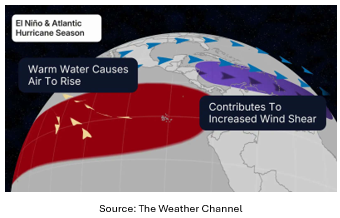
This increase in wind shear typically suppresses storm formation, making it more difficult for tropical systems to strengthen. As a result, forecasters expect fewer storms overall, particularly during the second half of the season, as El Niño conditions intensify through late summer and fall.
Despite this suppressive effect, Atlantic waters are still forecast to remain warm throughout 2026, creating enough underlying energy to support storm development when conditions align.
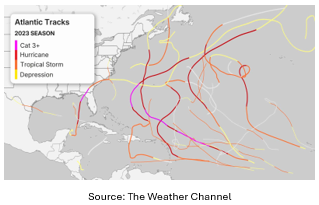
The last time El Niño influenced the Atlantic hurricane season was in 2023, when activity still exceeded historical norms with 20 named storms. Elevated Atlantic sea surface temperatures played a key role in sustaining storm development despite otherwise unfavorable conditions, highlighting how competing climate signals can still drive active seasons.
Forecasts Point to Moderate Activity
Leading forecasters are broadly aligned on a moderate 2026 season:
- AccuWeather projects 11 to 16 named storms, including four to seven hurricanes and two to four major hurricanes (Category 3 or higher).
- The Weather Company expects 12 named storms, with six hurricanes and two reaching major hurricane strength.
- Colorado State University (CSU) forecasts 13 tropical storms, including six hurricanes, of which two are expected to become major hurricanes.
Forecasters also anticipate three to five direct impacts on the United States, reinforcing that lower storm counts do not necessarily translate to lower risk.
Landfall Risk Remains Below Average, But Not Insignificant
CSU projections indicate slightly reduced, but still meaningful, landfall probabilities for major hurricanes:
- 32% chance along the entire U.S. coastline (below the historical average of 43%)
- 15% chance along the East Coast, including Florida (below the 21% average)
- 20% chance along the Gulf Coast (below the 27% average)
Even with probabilities trending lower, a single landfall along key energy corridors, particularly the Gulf Coast, can disrupt refining capacity, fuel production, and logistics.
Lessons from 2025 Highlight Elevated Risk Potential
The outlook follows the 2025 hurricane season that was near average in total storm count but produced outsized impacts. The season featured three Category 5 hurricanes, just one short of the all-time record, and saw the majority of activity occur after the traditional September peak.
This late-season intensity underscores a key risk for fuel markets: even in seasons with moderate totals, storm timing and strength can create concentrated disruptions when demand is elevated or infrastructure is most exposed.
2026 Storm Names Return to Familiar Rotation
The official Atlantic naming list returns in 2026 with 21 pre-designated names, recycled from prior years. Names are reused every six years unless retired due to significant loss of life or economic damage.
This year’s list includes: Arthur, Bertha, Cristobal, Dolly, Eduardo, Fay, Gonzalo, Hanna, Isaias, Josephine, Kyle, Leah, Marco, Nana, Omar, Paulette, Rene, Sally, Teddy, Vicky, and Wilfred.
The reuse of these names is notable, as many were last active during the record-setting 2020 season, which was one of the most disruptive hurricane seasons on record for fuel markets. That year saw so many storms that the naming system was exhausted, prompting a shift away from the Greek alphabet to a supplemental list introduced in 2021.
Storm naming plays an important role in operational response and market communication. In an environment where multiple systems can form simultaneously, naming allows for faster identification, clearer forecasting updates, and more efficient coordination across supply chains.
Preparedness Remains Critical Despite Lower Forecasts
While El Niño may limit the overall number of storms in 2026, the potential for U.S. landfalls and the resulting impact on fuel markets remains.
Storm-related disruptions can shift fuel supply from routine to critical within hours, particularly for businesses dependent on continuous operations and emergency response capabilities. For the fuel industry, the takeaway is that fewer storms do not guarantee reduced risk.
Not sure how to implement your Emergency Plan? Talk to the experts!
Mansfield Energy, North America’s leading fuel distributor, brings a wealth of expertise to the table in creating a robust emergency response program tailored to your company’s needs. With an extensive network serving the US and Canada, Mansfield understands the critical importance of proactive measures to address potential disruptions from hurricanes and other natural disasters.
Leveraging in-depth knowledge, Mansfield has developed a comprehensive Emergency Response Fuel Program that prescribes industry best practices. Mansfield’s program enables a multi-faceted approach, prioritizing essential services and collaborating closely with partners to ensure seamless fuel distribution during emergencies. Contact us today!
This article is part of Daily Market News & Insights


MARKET CONDITION REPORT - DISCLAIMER
The information contained herein is derived from sources believed to be reliable; however, this information is not guaranteed as to its accuracy or completeness. Furthermore, no responsibility is assumed for use of this material and no express or implied warranties or guarantees are made. This material and any view or comment expressed herein are provided for informational purposes only and should not be construed in any way as an inducement or recommendation to buy or sell products, commodity futures or options contracts.