
Oil Markets Remain on Edge After Failed Iran Negotiations
The war between the U.S. and Iran entered another phase this week after diplomatic negotiations over the Strait of Hormuz stalled, pushing energy markets back into risk-off mode. WTI crude prices climbed nearly $3/bbl Monday morning after finishing last week down roughly $6.50/bbl, as the market reacted to signs that the conflict and shipping disruptions may continue longer than expected. Iran rejected key parts of President Trump’s proposed peace framework, calling the plan “unworkable” and demanding that the U.S. immediately lift its naval blockade around Iranian ports. Tehran also refused Washington’s request to fully dismantle its nuclear infrastructure, though Iranian officials signaled willingness to transfer part of their enriched uranium stockpile to a third country as part of a broader agreement.
President Trump quickly dismissed Iran’s counterproposal as “Totally Unacceptable,” reigniting concerns that negotiations could collapse entirely. Iran responded by defending its demands, arguing that ending the war, restoring shipping access, and releasing frozen Iranian assets were necessary conditions for any agreement.
The instability around the Strait of Hormuz is beginning to reshape global trade flows. Around 120 vessels are currently clustered near the Persian Gulf as interference with navigation and geolocation systems continues to rise. Saudi crude exports to China are expected to fall sharply in June compared to pre-war levels, while Chinese crude imports already dropped 20% year-over-year in April. Several countries are now preparing for a longer disruption scenario. More than 40 nations are expected to participate in talks regarding a European-led naval escort mission for commercial vessels once a stable ceasefire can be secured. Turkey and Qatar are also increasing diplomatic involvement as regional powers attempt to prevent the conflict from spreading further across the Gulf and Lebanon.
Military tensions across the region remain elevated despite ongoing diplomatic activity. The United Arab Emirates said it intercepted Iranian drones over the weekend, while Qatar condemned an attack on a cargo vessel in its waters. Kuwait also reported hostile drones entering its airspace. At the same time, clashes between Israel and Hezbollah continue in southern Lebanon despite a U.S.-brokered ceasefire announced in April. Israeli Prime Minister Benjamin Netanyahu said the war is “not over,” emphasizing that Iran’s nuclear facilities and proxy networks still need to be addressed. Iranian President Masoud Pezeshkian responded by saying Tehran would “never bow down to the enemy” and would continue defending its national interests.
The conflict is also starting to influence broader economic expectations. Goldman Sachs Research noted that while the closure of Hormuz has hurt global growth less than initially feared, the market remains fragile. High pre-war inventories, reduced fuel demand in some regions, and strong fiscal conditions have helped cushion the blow so far. However, the firm warned that higher energy costs could keep inflation elevated longer than expected, delaying potential Federal Reserve rate cuts into late 2026 and early 2027. At the same time, recession risks remain above pre-war levels as policymakers continue monitoring the economic impact of prolonged supply disruptions.
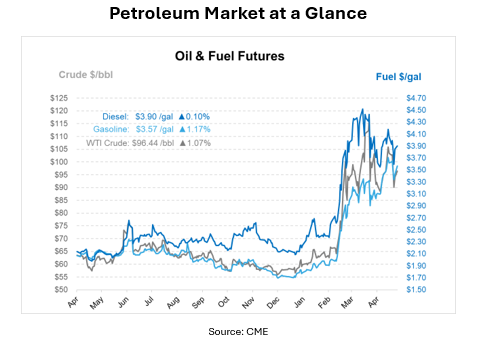
Since the conflict began, Brent crude has seen extreme volatility, climbing above $118/bbl earlier in the war before easing back toward the $100/bbl range. Price swings of 5% or more in a single trading session, typically uncommon in oil markets, have now occurred on 16 out of the past 50 trading days. Instead of preparing for a sustained price rally, the market is adapting to an environment marked by frequent disruptions, rapid price shifts, and ongoing geopolitical uncertainty. The cautious approach signals that volatility, rather than outright supply scarcity, is likely to shape the next chapter of energy markets.
This article is part of Daily Market News & Insights


MARKET CONDITION REPORT - DISCLAIMER
The information contained herein is derived from sources believed to be reliable; however, this information is not guaranteed as to its accuracy or completeness. Furthermore, no responsibility is assumed for use of this material and no express or implied warranties or guarantees are made. This material and any view or comment expressed herein are provided for informational purposes only and should not be construed in any way as an inducement or recommendation to buy or sell products, commodity futures or options contracts.