

Crude Falls Below $100 as Iran Deal Hopes Grow
Energy markets are pulling back as signs of a possible breakthrough between the U.S. and Iran gained traction. After months of conflict, supply disruptions, and fears of a prolonged closure of the Strait of Hormuz, the White House reportedly sent Iran a one-page proposal aimed at ending the war. If accepted, the agreement would gradually reopen the Strait, ease the U.S. blockade on Iranian ports, and potentially remove sanctions on Iran. Iran is expected to respond within the next 24 hours, although President Trump made it clear that if talks fail, military action could escalate quickly.
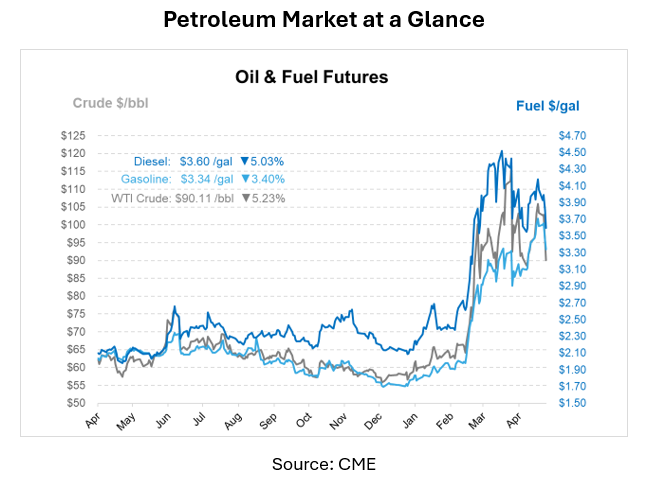
This morning, Brent crude dropped to $90 per barrel, while WTI crude slid to $96, posting some of the largest daily declines since the war began. Traders are pricing in the possibility that some Middle East crude exports could slowly return to the market if shipping lanes reopen and sanctions are eased.
Despite optimism, negotiations remain fragile, and many of the most difficult issues are still unresolved. Reuters reported that the current framework is shaping up as a temporary memorandum rather than a full peace agreement. Key disputes surrounding Iran’s nuclear program, uranium stockpiles, missile development, and support for regional proxy groups remain largely untouched in the current proposal. Iranian officials have publicly expressed skepticism, with some lawmakers dismissing the proposal as an American “wish-list,” while others mocked reports suggesting that a final agreement is close.
The proposed agreement would reportedly unfold in stages. The first phase would formally end the war, followed by efforts to stabilize and reopen the Strait of Hormuz, with a 30-day negotiation period afterward to pursue a broader deal. President Trump has continued to publicly signal optimism, saying that Iran “wants to make a deal very much,” while mediators involved in the talks suggested an agreement could come “sooner rather than later.” At the same time, the White House paused its naval mission designed to escort ships through Hormuz after diplomatic progress accelerated. Reports also indicated Saudi Arabia objected to the U.S. operation and restricted the use of Saudi bases and airspace for military support tied to the mission.
Although oil futures have dropped on peace hopes, the physical oil market remains under significant stress. OPEC crude production fell to a fresh 36-year low of 20.55 million barrels per day last month as the conflict disrupted exports and forced production shut-ins across the region. Global oil inventories have also been falling rapidly as countries rely on emergency reserves, floating storage, and commercial stockpiles to offset lost Middle East supply. Analysts warn the market has not yet fully felt the impact of the disruptions because it will take weeks, and potentially months, for normal shipping patterns and refinery operations to recover, even if the war ends soon.
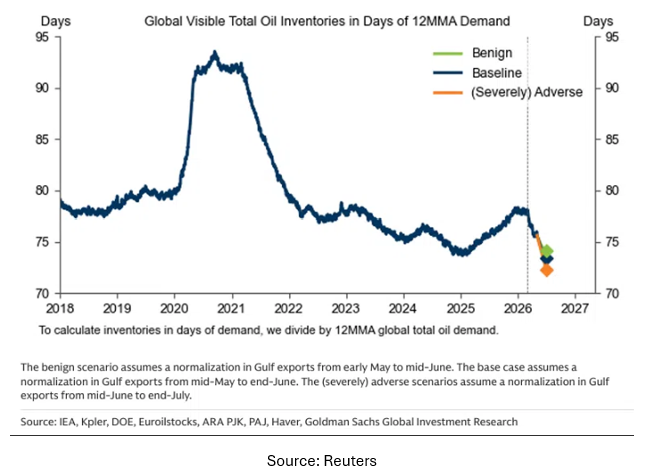
Executives across the energy industry are increasingly warning that supply tightness could persist well beyond the end of active fighting. TotalEnergies estimated that global inventories have already been reduced by at least 500 million barrels since the conflict began, while Rystad Energy estimates total lost supply could eventually reach between 1.2 and 2.0 billion barrels before flows normalize. Equinor said it could take at least six months for energy markets to fully recover. ExxonMobil also warned that the market has not yet experienced the “full impact” of the unprecedented disruption to global oil and natural gas flows.
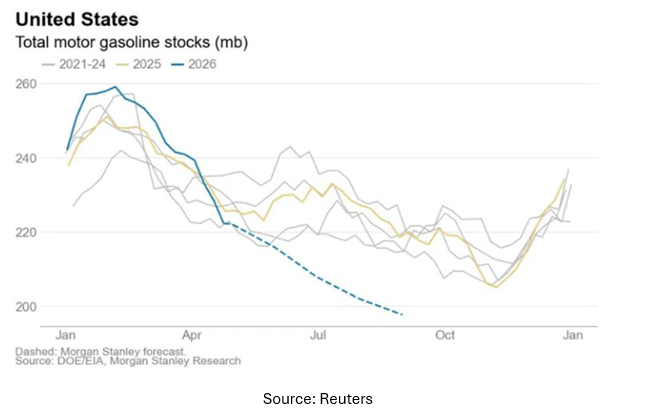
Fuel markets continue to show signs of strain. The EIA reported another round of draws in U.S. crude, gasoline, and distillate inventories last week, with diesel inventories now sitting roughly 11% below the five-year average for this time of year. Gasoline inventories are also below seasonal norms as exports remain elevated. U.S. exports of refined products surged to a record 8.2 million barrels per day as countries facing shortages increased purchases of diesel, jet fuel, and gasoline from the United States.
The supply disruptions are also becoming increasingly visible across Asia. Singapore’s oil product inventories recently fell to their lowest level in more than nine months as Middle East crude and fuel shipments remain heavily constrained. Fuel oil inventories are hovering near one-year lows, while diesel and jet fuel stocks also declined. Traders have increasingly sourced replacement barrels from outside the region, including India, Oman, Egypt, and even Western suppliers, as traditional Middle East flows remain disrupted. Analysts noted that the limited availability of medium sour crude from the Middle East is forcing refiners to adjust operations and reduce fuel oil yields.
For now, markets remain caught between two competing realities. On one side, hopes for a diplomatic breakthrough are driving crude prices sharply lower and lifting broader financial markets. On the other, the global energy system continues operating with historically tight inventories, disrupted shipping lanes, offline refining capacity, and major uncertainty surrounding the durability of any potential agreement. Even if a ceasefire framework is finalized, analysts warn that rebuilding inventories and restoring normal trade flows across the global oil market could take many months.
This article is part of Daily Market News & Insights


MARKET CONDITION REPORT - DISCLAIMER
The information contained herein is derived from sources believed to be reliable; however, this information is not guaranteed as to its accuracy or completeness. Furthermore, no responsibility is assumed for use of this material and no express or implied warranties or guarantees are made. This material and any view or comment expressed herein are provided for informational purposes only and should not be construed in any way as an inducement or recommendation to buy or sell products, commodity futures or options contracts.