

Tight Supply and Limited Progress in Talks Continue to Support Oil Prices
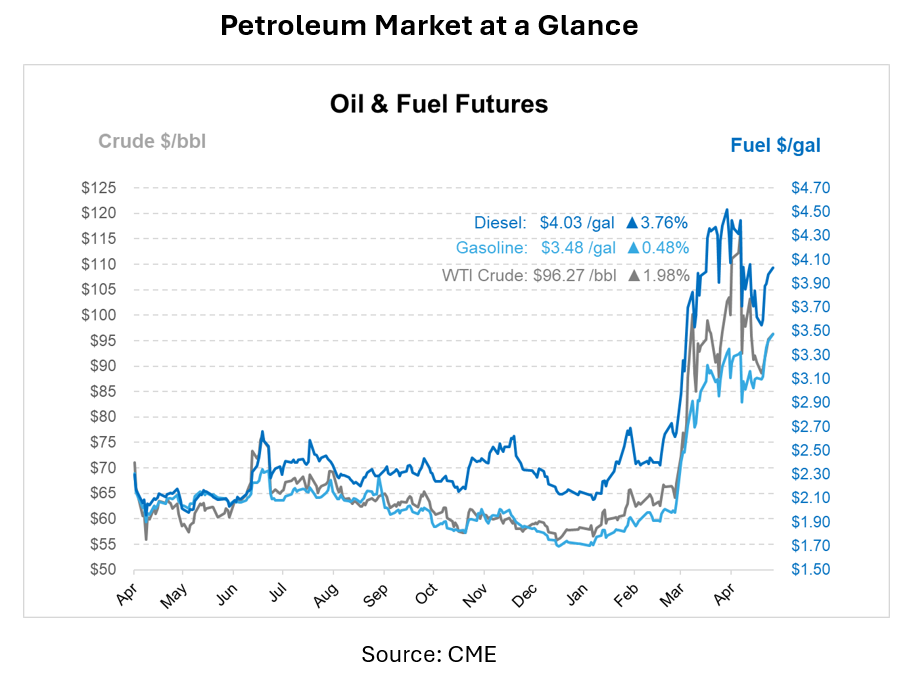
Oil prices are pushing higher again, extending last week’s rally as the market reacts to stalled diplomacy, tighter supply, and mounting pressure across global energy systems. Prompt WTI futures moved higher this morning after climbing nearly $11 per barrel week-over-week, with uncertainty around U.S.–Iran negotiations continuing to drive sentiment.
Diplomatic momentum remains limited. Iran has proposed a phased approach that would extend the ceasefire, reopen trade flows, and delay nuclear discussions, but only if the U.S. lifts its blockade first. That condition remains a major sticking point, and talks are continuing remotely with no clear timeline for progress. At the same time, the broader conflict continues to influence regional stability, reinforcing the risk premium built into oil prices.
On the ground, shipping activity remains disrupted. Traffic through the Strait of Hormuz is still running at a fraction of normal levels, with only a handful of vessels moving through daily compared to roughly 140 transits before the conflict began. In some cases, activity has dropped close to zero, while U.S. forces have redirected vessels and tanker movements remain irregular.
Persian Gulf production remains significantly below pre-conflict levels, contributing to an estimated 14.5 million barrels per day in lost output. That shortfall is driving global inventories to draw at a record pace, tightening the market even as demand expectations begin to soften. In response, Goldman Sachs has raised its longer-term outlook, now expecting Brent to average around $90 and WTI near $83 by late 2026 due to a slower recovery in production and exports.
At the same time, the ripple effects are spreading beyond crude. Refined product prices, especially diesel and jet fuel, are rising quickly, increasing costs across transportation and logistics. Airlines are already feeling the strain, with budget carriers requesting up to $2.5 billion in government relief to offset higher fuel expenses. These rising costs are beginning to weigh on demand, with some forecasts now pointing to a year-over-year decline in global consumption.
Globally, governments are starting to respond to the broader implications of the energy shock. Around 60 countries, including major economies across Europe, Latin America, and Africa, are meeting this week to discuss how to reduce dependence on fossil fuels and improve energy security. While the discussions are not focused on new targets, they highlight how current disruptions are reinforcing long-term concerns around energy resilience.
Operational challenges are also compounding the issue. Crew shortages are emerging as some countries restrict workers from entering the Persian Gulf, making it harder for tanker operators to maintain normal rotations. At the same time, U.S. drilling activity remains subdued, with rig counts trending lower both month-over-month and year-over-year, limiting the ability of domestic production to offset global supply losses in the near term.
This article is part of Daily Market News & Insights


MARKET CONDITION REPORT - DISCLAIMER
The information contained herein is derived from sources believed to be reliable; however, this information is not guaranteed as to its accuracy or completeness. Furthermore, no responsibility is assumed for use of this material and no express or implied warranties or guarantees are made. This material and any view or comment expressed herein are provided for informational purposes only and should not be construed in any way as an inducement or recommendation to buy or sell products, commodity futures or options contracts.