What’s That: Bab el-Mandeb Strait
As geopolitical tensions disrupt global energy flows, attention has centered on the Strait of Hormuz, but the Bab el-Mandeb Strait is emerging as an equally critical chokepoint. Iran-aligned Houthi leaders in Yemen have warned they could close the route, linking the Red Sea to the Gulf of Aden, if U.S. policy does not change, adding that it would be difficult to reopen once shut. Known as the “Gate of Tears,” the strait is critical for global trade, including oil and refined products, so any disruption would have immediate impacts on energy flows between the Middle East, Europe, and North America.
The Bab el-Mandeb is closely linked to the Strait of Hormuz, as both form a continuous maritime corridor for global energy trade. Under normal conditions, Hormuz handles about 20 million barrels of oil per day, while the Bab el-Mandeb carries smaller volumes, around roughly 12% of global oil shipments, but remains critical for moving oil and refined products toward Europe and North America, making it an integral part of the same supply chain rather than a secondary chokepoint.
With tensions around the fragile ceasefire continuing elevated, Iran has warned it has prepared “new cards” to deploy on the battlefield if the agreement, extended by Donald Trump earlier this week, collapses. Tehran’s parliamentary speaker, Mohammad Bagher Ghalibaf, stated that Iran does not accept negotiations under threat and signaled readiness to escalate if conditions deteriorate. Trump has also indicated that U.S. forces are prepared to resume military action if necessary, reinforcing the risk that any breakdown in talks could quickly reignite conflict and further strain already pressured global energy flows.
What is the Bab El‑Mandeb Strait?
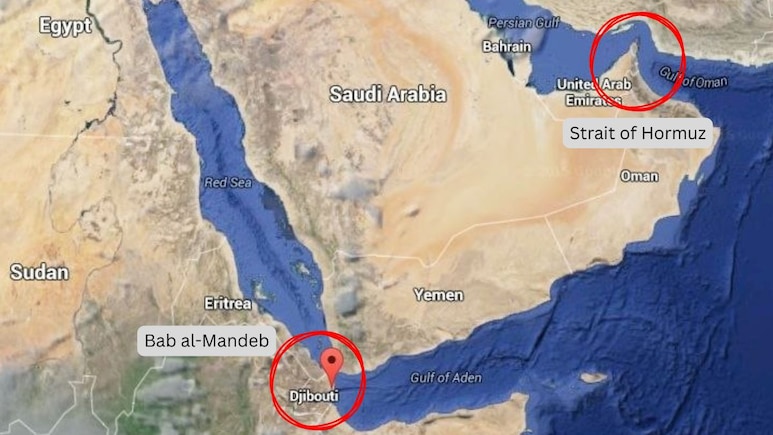
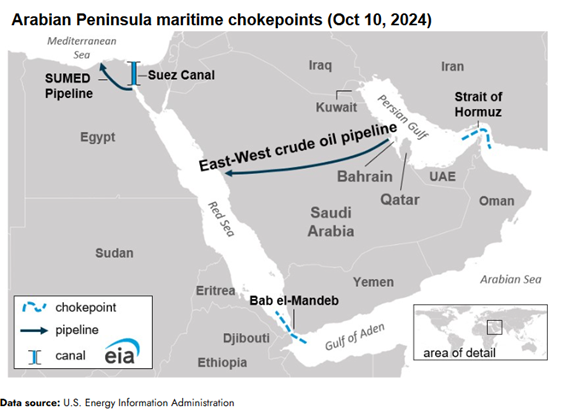
The Bab el-Mandeb Strait is a narrow body of water that connects the Red Sea to the Gulf of Aden, serving as a gateway between the Indian Ocean and the Mediterranean Sea via the Suez Canal.
Geographically, it lies between:
- Yemen – on the northeastern coast of the Arabian Peninsula
- Djibouti and Eritrea along the Horn of Africa to the southwest
At its narrowest point, the strait is just about 26–29 kilometers (16–18 miles) wide, creating a natural bottleneck for global shipping traffic. The Bab el-Mandeb plays a valuable role in the global energy market, as a significant share of the world’s seaborne crude oil, refined fuels, and liquefied natural gas passes through this corridor each day between the Middle East, Europe, and North America. Because there are limited alternative routes, any disruption in the strait can quickly impact shipping costs, transit times, and ultimately fuel prices, making it a key chokepoint to watch in times of geopolitical tension.
Why Is the Bab el‑Mandeb So Important?
The Bab el-Mandeb is a vital route supporting both energy movement and global commerce. Combined with Egypt’s Suez Canal, it enables ships to conveniently travel from Middle East and Asian markets into the Mediterranean Sea for European trade. The alternative is to travel all the way across Africa’s most southern point, the Cape of Good Hope.
According to the U.S. Energy Information Administration (EIA), oil trade flows through the Bab el-Mandeb Strait averaged 4.0 million barrels per day in 2024 through August, down from 8.7 million barrels per day in 2023.
Unlike the Persian Gulf and Strait of Hormuz, which has no other outlet, the Bab el-Mandeb cannot completely trap in supply. Ships can either transit through the Suez Canal or travel around Africa. However, traveling around Africa can add weeks to a journey, causing short-term disruptions and long-term cost increases.
Why Is It Called the “Gate of Tears”?
The name Bab el‑Mandeb comes from Arabic, meaning “Gate of Tears” or “Gate of Grief.” The name is commonly attributed to the historical danger of navigating the narrow strait, where strong currents, unpredictable winds, and heavy traffic made passage hazardous for centuries.
Today, the “tears” refer less to navigation risks and more to the economic consequences that follow when this chokepoint is threatened.
Bab el‑Mandeb vs. Strait of Hormuz: Why Both are Important
The Bab el‑Mandeb is often discussed alongside the Strait of Hormuz, and for good reason. Together, the two straits form a continuous maritime corridor that supports much of the world’s energy trade.
Under normal conditions:
- The Strait of Hormuz carries about 20 million barrels of oil per day, or roughly one‑fifth of global oil consumption
- The Bab el‑Mandeb carries smaller volumes, but remains essential for oil and refined products moving toward Europe and North America
When Hormuz is disrupted, more flows are redirected toward the Red Sea, making the Bab el‑Mandeb a second choke point in the same supply chain.
Impact to Energy Markets
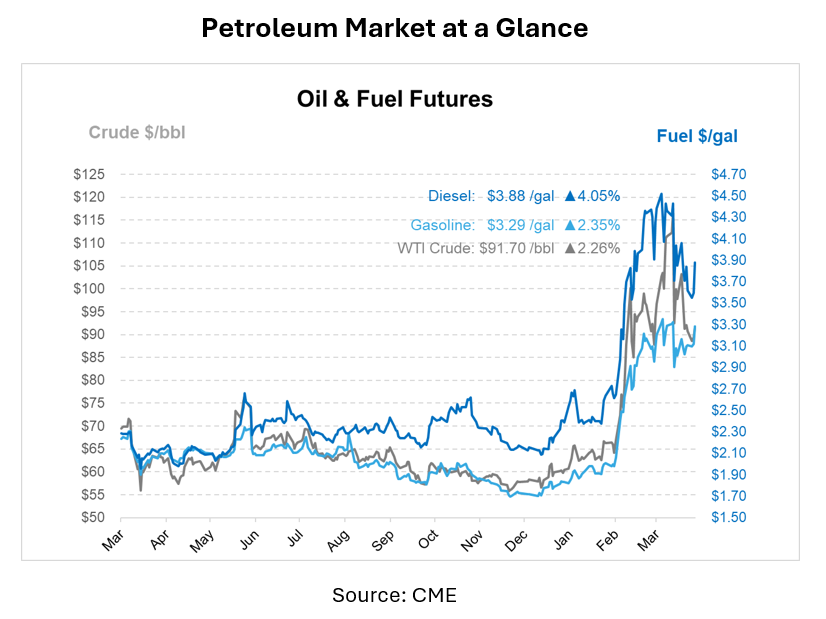
While the Strait of Hormuz often dominates headlines, the Bab el‑Mandeb Strait plays an equally critical role in global energy and trade flows. As supply routes concentrate around fewer, narrower corridors, the importance of each chokepoint grows. Understanding how the Bab el‑Mandeb fits into the global energy picture helps explain why disruptions, whether geopolitical, operational, or logistical, can move fuel markets far beyond the region itself.
Looking to follow the market more closely and stay up to date with daily changes? Visit our Market Update page for insights on current conditions, including developments surrounding the Iran conflict and the global energy market.
This article is part of Daily Market News & Insights


MARKET CONDITION REPORT - DISCLAIMER
The information contained herein is derived from sources believed to be reliable; however, this information is not guaranteed as to its accuracy or completeness. Furthermore, no responsibility is assumed for use of this material and no express or implied warranties or guarantees are made. This material and any view or comment expressed herein are provided for informational purposes only and should not be construed in any way as an inducement or recommendation to buy or sell products, commodity futures or options contracts.