
Gulf Oil Flows Strained After Iranian Strikes on Fujairah
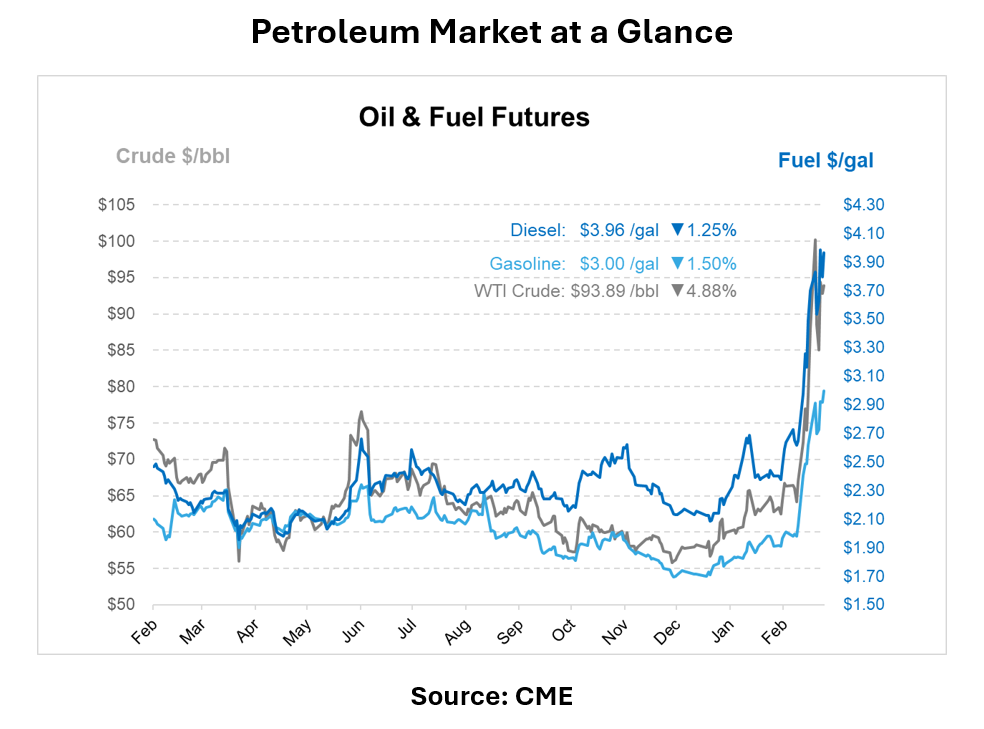
Oil markets began the week focused on escalating disruptions after Iran targeted the Fujairah oil trading hub in the United Arab Emirates. The attacks forced a one-day suspension of shipments and prompted the UAE’s state oil company to impose production shut-ins as flows through the Strait of Hormuz remain constrained. US crude oil prices initially surged above $100/bbl once again but have since retreated. Diesel and gasoline are also seeing moderate losses in early trading today – but the past three weeks have made clear that large up or down movements can be reversed in an instant.
Despite the attacks, oil loading operations have resumed at the Fujairah port, according to sources. The port, located outside the Strait of Hormuz, serves as a key export outlet for about 1 million barrels per day of the UAE’s crude, roughly 1% of global oil demand.
New vessel tracking estimates show that shipping through the Strait of Hormuz has fallen to just 0.5 million barrels per day (MMbpd), down from the normal 20 MMbpd throughput seen before the conflict. After accounting for pipelines that redirect some volumes away from the waterway, the estimated supply disruption from the Persian Gulf stands at 17.2 million bpd.
The IEA continues its plan to release 400 million barrels of emergency crude reserves. Supplies from Asia and Oceania will come to market soonest, with reserves from Europe and the Americas potentially arriving later this month. On Sunday, the United States also reiterated that it is moving forward with a 172 million barrel release from the Strategic Petroleum Reserve, structured as an exchange that will require companies to return the oil later, with interest of approximately 86 million barrels.
President Donald Trump said the United States is asking other countries to help secure the Strait of Hormuz, noting that nations reliant on oil shipments through the corridor should help protect it. However, Japan and Australia said they currently have no plans to deploy naval vessels to escort tankers in the region.
President Trump also said Iran may be open to negotiations to end the conflict, although Iran’s Foreign Minister Abbas Araghchi denied that Tehran is seeking talks with the United States. The White House confirmed that U.S. forces recently targeted military sites on Iran’s Kharg Island while avoiding oil infrastructure, warning that energy facilities could be reconsidered as targets if shipping routes remain threatened. Iranian officials said any attacks on energy infrastructure would trigger retaliation against U.S.-linked facilities in the region.
Market positioning reflects the heightened uncertainty. Managed money increased crude oil net long positions by 64,200 contracts last week, driven by both new long positions and a reduction in short positions across Brent and WTI.
This article is part of Daily Market News & Insights
Tagged: Crude oil prices, diesel prices, gasoline prices, global oil supply disruption, gulf oil flows, Iran, Middle East Geopolitics, oil market volatility, oil shipment delays, opec supply risk, persian gulf oil supply, refinery margins, Strait of Hormuz disruption, strategic petroleum reserve release, uae oil exports


MARKET CONDITION REPORT - DISCLAIMER
The information contained herein is derived from sources believed to be reliable; however, this information is not guaranteed as to its accuracy or completeness. Furthermore, no responsibility is assumed for use of this material and no express or implied warranties or guarantees are made. This material and any view or comment expressed herein are provided for informational purposes only and should not be construed in any way as an inducement or recommendation to buy or sell products, commodity futures or options contracts.