

Winterized Diesel in Canada: What Does It Mean?
Every fall, the same question comes up: What does winterized diesel actually mean? In Canada, it isn’t a single product or a universal blend. It’s a seasonal and regional approach to fuel supply.
There isn’t a switch that flips diesel from “summer” to “winter.” Instead, diesel is adjusted over time to match the colder temperatures expected in a specific region during a specific part of the year. The focus isn’t on the name used on an invoice, but on whether the fuel meets cold-flow performance requirements for local winter conditions.
In practice, winterized diesel reflects how fuel specifications, blending practices, and additives are tailored to align with seasonal weather patterns. When those elements match regional temperature realities, fuel performs as expected. When they don’t, cold-weather issues can surface quickly, regardless of how the fuel is labeled.
What actually happens to diesel in the cold?
As temperatures drop, wax naturally present in diesel fuel begins to crystallize. Long before fuel fully “gels,” those wax crystals can clog filters, restrict flow, and cause hard starts or shutdowns. That’s why cold-weather fuel problems often show up as repeated filter plugging or equipment that simply won’t start on cold mornings.
This is why winter fuel problems often appear well before extreme cold sets in. A tank that works fine at -10°C (14°F) may start having issues at -18°C (-0.4°F), depending on fuel quality, filtration, and storage conditions.
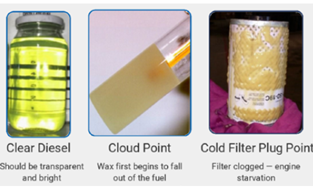
The key takeaway is this: diesel doesn’t have to freeze to cause problems. It just has to stop flowing through filters.
How Canada defines winter diesel performance
Canada’s primary diesel fuel quality standard is CAN/CGSB-3.517, which applies nationwide. Rather than setting one fixed winter temperature for the entire country, the standard allows low-temperature operability to be defined using either cloud point or low-temperature flow testing (LTFT).
In practice, winter diesel in Canada is typically supplied to perform within ranges such as:
- Around -15°C (5°F) in milder winter regions or shoulder seasons
- -20°C (-4°F) to -25°C (-13°F) in much of Southern Canada during core winter months
- -30°C (-22°F) to -35°C (-31F) in Prairie provinces and colder inland regions
- -40°C (-40°F) or lower for northern or remote locations with sustained extreme cold
With traditional summer blends, fuel would typically begin to coagulate and plug filters at those temperatures, though they may not actually “freeze” or turn into a solid.
This approach matters because Canada doesn’t have one winter. Northern Alberta, Southern Ontario, and coastal British Columbia all experience very different cold-weather conditions. The standard is designed so that fuel supplied to each region can be matched to the expected minimum ambient temperatures for that location and season.
In simple terms, winter fuel in Canada is supposed to be suitable for where it’s being used, not just the calendar date.
Federal versus provincial rules: who controls what?
At the federal level, diesel regulations are primarily focused on emissions-related properties, most notably sulfur content (SOR/2002-254). These rules ensure compatibility with modern diesel engines and emissions systems, but they don’t guarantee cold-weather operability on their own.
Cold-flow performance typically comes into play through provincial adoption of fuel quality standards or through commercial supply practices. Several provinces explicitly reference CAN/CGSB-3.517 in their fuel regulations, effectively making that standard enforceable within their jurisdiction. Others rely on the same standard through supplier contracts and terminal specifications.
The result is a layered system:
- Federal rules set the environmental baseline.
- Provincial rules and industry standards address fuel quality and operability.
- Suppliers adjust blending and additives based on regional climate expectations.
Blending, additives, or both?
Most Canadian winter diesel relies on a combination of blending and additives.
Refineries and terminals may blend diesel with lighter components (such as Kerosene) to improve cold flow. This helps lower the temperature at which wax crystals begin causing problems. Additives, specifically cold-flow improvers, are often used alongside blending to further control wax crystal size and shape, improving filterability.
What additives can’t do is fix poor fuel housekeeping. They don’t remove water, and they’re far less effective if added after fuel has already been exposed to very cold temperatures. That’s why timing and storage conditions matter just as much as chemistry.
The missing piece: winter tank management
Even fuel blended to withstand -30°C (-22°F) can struggle if it’s stored improperly. Canadian winters bring constant freeze–thaw cycles, which encourage condensation inside tanks. That water can freeze, block lines, and accelerate corrosion. It also amplifies filter plugging once wax crystals appear.
Winter often exposes weak points in storage systems, undersized filters, unprotected piping, and poor water management that may have gone unnoticed all summer. Many “bad fuel” incidents are actually storage problems revealed by cold weather.
Proper winter tank preparation usually means managing water proactively, protecting exposed piping and filters, treating fuel before extreme cold arrives, and paying attention to fuel turnover during the coldest months.
The most important question to ask about “winterized” diesel
Instead of asking, “Is this winterized?”, a better question is: “What low-temperature operability target is this fuel supplied to for my location and delivery date?”
That question gets past marketing language and focuses on performance. In Canada, winter diesel isn’t about a label; it’s about whether the fuel will still flow when temperatures reach their seasonal lows.
Talk to the Specialist
When winter conditions put pressure on fuel reliability, companies can rely on Mansfield to deliver fuel solutions designed for cold-weather performance. From diesel and gasoline to renewable fuels and winter-specific fuel additives, Mansfield aligns supply, specifications, and treatment strategies with regional temperature demands and on-site storage needs.
The focus stays on keeping equipment running, protecting fuel quality, and minimizing downtime, so your operations remain steady even when winter temperatures are at their most challenging. Contact us today!

This article is part of Daily Market News & Insights
Tagged: Canada diesel fuel, Canadian winter fuel, cold climate fuel, cold weather diesel, cold-flow improvers, Diesel Additives, diesel blending, diesel filter plugging, diesel fuel operability, diesel fuel standards, Diesel Gelling, diesel performance, diesel storage, diesel suppliers Canada, diesel tank management, federal diesel rules, Fuel Quality, fuel reliability, fuel turnover, kerosene blending, low-temperature diesel, provincial fuel regulations, winter fuel problems, winter tank preparation, winterized diesel


MARKET CONDITION REPORT - DISCLAIMER
The information contained herein is derived from sources believed to be reliable; however, this information is not guaranteed as to its accuracy or completeness. Furthermore, no responsibility is assumed for use of this material and no express or implied warranties or guarantees are made. This material and any view or comment expressed herein are provided for informational purposes only and should not be construed in any way as an inducement or recommendation to buy or sell products, commodity futures or options contracts.