

OPEC Increases Output, But Geopolitical Pressures Tighten
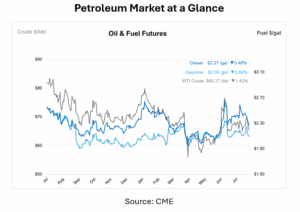
Global oil markets are contending with a wave of geopolitical tensions and shifting supply dynamics, as OPEC+ ramps up production while rising trade disputes and sanctions threaten to upend established crude flows. Crude oil prices continued their downward slide this week, with prompt WTI futures falling another $1 per barrel Tuesday morning, extending Monday’s decline. WTI dipped to $65/bbl after reports confirmed that India, despite U.S. pressure, was continuing to purchase Russian crude. President Trump responded by pledging to “substantially raise” tariffs on Indian imports, a move India called “unjustified and unreasonable,” citing the importance of affordable energy access.
Meanwhile, Russian crude exports dropped 2% in the four weeks ending on August 3, and Chinese imports of Iranian oil fell 30% month-over-month after reports of weak demand from private refiners. Adding to the supply squeeze, two Russian refineries experienced disruptions following attacks during peak seasonal demand.
Despite an uptick in U.S. equity markets, underlying economic signals remain shaky. The S&P 500 and Nasdaq 100 rallied 1.5% and 1.9% respectively on Monday, marking their strongest gains since May. However, labor market data reveals a slow recovery. According to Goldman Sachs, U.S. monthly job growth dropped to just 28,000 in July, well below the 90,000 needed to maintain labor market stability.
Uncertainty is also growing in Eastern Europe. Romania was forced to draw from emergency crude reserves after a major refiner rejected a contaminated shipment of Azerbaijani oil. The shortfall, equal to 184,000 tons, led the government to release both crude and gasoline from national reserves to stabilize local supply.
Looking ahead, Goldman Sachs reaffirmed its Brent price forecast of $64 per barrel for Q4 2025 and $56 in 2026 but warned of mounting risks. Sanctions on Russian and Iranian oil could tighten supply, but demand-side threats, including weak U.S. growth and rising tariffs, pose steep downside risks. The investment bank also flagged a growing likelihood of a U.S. recession within the next 12 months.
On the supply side, OPEC+ announced another production increase of 547,000 bpd for September as part of its ongoing strategy to reclaim global market share. OPEC+ is expected to pause hikes after September but will reassess production levels at its September 7 meeting.
Geopolitical tensions continue to reshape oil trade flows. India has temporarily halted Russian oil purchases following Trump’s warnings and has replaced 7 million barrels of September delivery crude from the U.S., Canada, and the Middle East. However, replacing the heavy grades typical of Russian crude may strain Indian refiners and ripple into Europe’s diesel markets.
If Trump’s threats become policy, Moscow could retaliate by halting oil flows through the CPC pipeline, used by major Western oil firms. This could cause a potential loss of up to 3.5 Mbpd, or 3.5% of global supply. Such a move would likely spike global oil prices and highlight the risk of aggressive energy sanctions in an already fragile market.
This article is part of Daily Market News & Insights


MARKET CONDITION REPORT - DISCLAIMER
The information contained herein is derived from sources believed to be reliable; however, this information is not guaranteed as to its accuracy or completeness. Furthermore, no responsibility is assumed for use of this material and no express or implied warranties or guarantees are made. This material and any view or comment expressed herein are provided for informational purposes only and should not be construed in any way as an inducement or recommendation to buy or sell products, commodity futures or options contracts.