

Oil Prices Slide $3 as Middle East Ceasefire Wavers
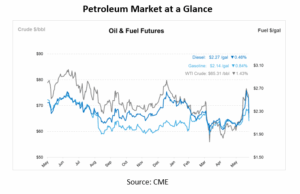
Crude oil prices are continuing to slide this week as geopolitical developments in the Middle East evolve rapidly, leaving markets uncertain but less fearful of immediate supply disruptions. Brent and WTI futures both dropped more than 3% on Tuesday, with WTI falling to a two-week low of $65 per barrel. The downturn follows a ceasefire agreement announced by President Trump between Israel and Iran, which quickly began to unravel. Trump later accused both nations of violating the agreement, expressing frustration with Israel for launching retaliatory strikes on Tehran. Iran denied breaching the ceasefire, calling into question the stability of the deal.
This morning’s drop extended a sharp $5 per barrel drop on Monday, which followed Iran’s limited retaliatory missile strikes on U.S. assets in the region. The attacks were widely seen as symbolic, with the U.S. and Qatar reportedly receiving advance notice, enabling the evacuation of personnel. Trump publicly thanked Iran for the warning, further supporting the perception of a de-escalatory gesture. Nonetheless, the Israeli Defense Minister claimed Iran had launched missiles in a “blatant violation” of the ceasefire and ordered new strikes in response—actions that have further complicated the fragile truce.
Despite the heightened rhetoric, market data suggests traders are adjusting to a lower-risk environment. The prompt month spread between August and September WTI contracts narrowed by nearly 60 cents to $1.24. Oil flows through the Strait of Hormuz—the world’s most crucial chokepoint, responsible for nearly 20% of global oil supply—have remained stable, helping ease concerns of supply disruptions.
Analysts at Goldman Sachs and Barclays are closely watching the potential economic impacts of the conflict. While no major supply shocks have occurred so far, a meaningful reduction in Iranian oil exports could lower global GDP by up to 0.2 percentage points and raise inflation by 0.4 percentage points over the next year. A more severe event, such as a temporary disruption of traffic through the Strait of Hormuz, could shave more than 0.3 percentage points off global growth and increase inflation by 0.7 points. For now, however, these risks remain hypothetical.
The tanker market, by contrast, has already felt the impact. Freight rates surged on Monday, with rates for supertankers moving oil from the Persian Gulf to China jumping 12% to $76,000 per day—the highest since March 2023. Overall shipping costs have risen by approximately $1.40 per barrel since the start of hostilities, reflecting a regional risk premium. While oil prices have deflated from last week’s highs, the underlying geopolitical situation remains fragile. As ceasefire violations persist and regional players reassess their positions, the potential for renewed escalation continues to loom over energy markets.
This article is part of Daily Market News & Insights


MARKET CONDITION REPORT - DISCLAIMER
The information contained herein is derived from sources believed to be reliable; however, this information is not guaranteed as to its accuracy or completeness. Furthermore, no responsibility is assumed for use of this material and no express or implied warranties or guarantees are made. This material and any view or comment expressed herein are provided for informational purposes only and should not be construed in any way as an inducement or recommendation to buy or sell products, commodity futures or options contracts.