

Week in Review – Oil Prices Rise as Israel-Iran Conflict Escalates
Crude prices experienced a notable uptick this week, driven primarily by escalating tensions between Israel and Iran and the uncertainty surrounding potential U.S. involvement in the conflict. Brent crude climbed more than $2 per barrel early in the week and is now up around $8 per barrel since the flare-up began last week. U.S. West Texas Intermediate (WTI) crude also tracked higher week-over-week, despite trading flat this morning as markets reopened following the Juneteenth holiday and ahead of the July 2025 futures contract expiration.
The recent spike in prices reflects what analysts describe as a geopolitical risk premium. Goldman Sachs estimates this premium at approximately $10 per barrel, warning that broader regional disruptions or shipping constraints, particularly through the Strait of Hormuz or Bab-El-Mandeb, could push Brent crude above $90 or even $100 per barrel. Currently, oil exports remain largely undisrupted, but the risk of escalation remains high.
While U.S. President Donald Trump has signaled a delay in any decision to strike Iran, tensions are far from resolved. Iran maintains it will not engage in nuclear talks while under Israeli fire, though it has agreed to limited discussions with European nations. Meanwhile, Israel continues to strike military and nuclear-related sites across Iran, with casualties mounting and civilian areas also affected.
Beyond the Middle East, market fundamentals are also influencing oil prices. On Wednesday, the U.S. Energy Information Administration (EIA) reported a significant crude inventory draw of 11.5 million barrels, well above expectations. With U.S. crude stockpiles sitting roughly 10% below the five-year average, supply tightness is supporting prices. Gasoline and distillate inventories also remain below seasonal norms by 2% and 17%, respectively.
Looking ahead, OPEC+ continues to hold back significant spare production capacity, estimated at 4–5% of global demand. However, whether this capacity can be deployed swiftly in the event of a crisis depends on political will and physical access, particularly in key producers like Saudi Arabia and the UAE.
Economic signals from the U.S. add another layer of complexity. Federal Reserve Chair Jerome Powell indicated that tariffs may push inflation higher, while the Fed’s latest Summary of Economic Projections (SEP) adjusted forecasts for slower GDP growth and elevated inflation through 2026. Rising oil prices could have a further impact on economic growth, especially in energy-importing regions such as Europe and Asia.
Meanwhile, the U.S. dollar has weakened nearly 9% this year, offering limited resistance to oil’s recent gains. A softer dollar can provide some relief for oil-importing countries, mitigating the impact of rising crude costs. Still, with Brent crude nearing $77 per barrel and global inflation expectations climbing, financial markets are keeping a close eye on any potential supply shock or escalation.
The broader market remains cautiously optimistic. Equity indices are near all-time highs, while energy and defense stocks outperform. But should oil breach the $80–$100 range and remain elevated, global growth could face serious headwinds. As one analyst noted, “We’re just below that threshold.”
Prices in Review
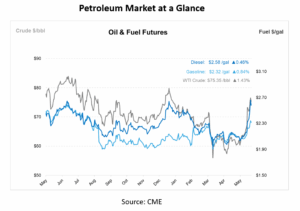
Crude oil prices saw steady gains early in the week, climbing from $71.85 on Monday to a peak of $76.41 on Thursday, marking Wednesday and Thursday as the strongest days for price increases. However, prices slipped slightly on Friday, settling at $75.35. Overall, crude rose by $3.50, a 4.9% increase for the week.
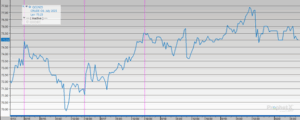
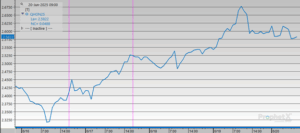
Diesel prices rose over the week, beginning at $2.3172 per gallon on Monday. The strongest daily gain came on Thursday, when diesel hit a high of $2.6630. Although prices pulled back slightly on Friday to $2.5820, diesel still ended the week significantly higher. Prices have increased by $0.2648 per gallon, a weekly gain of 11.4%.
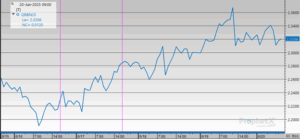
Gasoline prices moved higher through most of the week, starting at $2.1907 per gallon on Monday. The largest daily increase occurred on Tuesday, followed by smaller gains on Wednesday and Thursday, when prices reached a high of $2.3449. On Friday, prices edged down slightly to $2.3211. Overall, gasoline rose by $0.1304 per gallon, marking a 6.0% increase for the week.
This article is part of Daily Market News & Insights


MARKET CONDITION REPORT - DISCLAIMER
The information contained herein is derived from sources believed to be reliable; however, this information is not guaranteed as to its accuracy or completeness. Furthermore, no responsibility is assumed for use of this material and no express or implied warranties or guarantees are made. This material and any view or comment expressed herein are provided for informational purposes only and should not be construed in any way as an inducement or recommendation to buy or sell products, commodity futures or options contracts.