

Crude Climbs Higher as World Events Squeeze Supply and Stoke Uncertainty
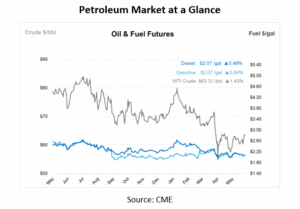
Oil markets have inched up several dollars since opening yesterday morning as traders weighed a mix of global supply risks and escalating geopolitical tensions. Brent crude inched up to $65/bbl this morning, while WTI climbed to $63/bbl. The movement followed a nearly 3% surge on Monday, reflecting rising uncertainty around key global developments that could constrain oil supply in the months ahead.
The intensifying conflict between Russia and Ukraine was one of the major drivers of volatility. Over the weekend, both nations engaged in one of the largest drone battles of their war to date, and infrastructure attacks—including a highway bridge and military installations—further fueled fears of prolonged disruption. While peace talks in Istanbul made little progress, there was some movement toward a new prisoner exchange, though the Kremlin cautioned that no quick resolutions should be expected.
Meanwhile, tensions in the Middle East also weighed on market sentiment. Iran signaled its likely rejection of a U.S.-backed nuclear deal proposal, citing concerns over uranium enrichment restrictions. Should these talks fail, sanctions on Iranian oil exports would likely remain in place, limiting global supply from a major producer and reinforcing upward pressure on crude prices.
Supply-side concerns were compounded by production setbacks in North America. Wildfires in Alberta, Canada, have temporarily shut down an estimated 344,000 to 350,000 bpd of oil sands production—roughly 7% of the country’s output. This comes as seasonal maintenance, combined with lower imports of heavy sour crude from countries like Mexico and Venezuela, has reduced overall supply to U.S. Gulf Coast refiners. Sanctions and policy changes have also contributed to a constrained heavy crude market. U.S. refiners, previously reliant on Venezuelan supply, are increasingly turning to Canadian heavy crude to fill the gap. At the same time, rising domestic refining capacity in Mexico is expected to limit exports to the U.S.
Adding to the complex landscape, OPEC+ reaffirmed its decision to proceed with a relatively modest production hike of 411,000 bpd in July. Some market participants had anticipated a larger increase to offset tightening supply elsewhere, but the cartel’s restraint suggests a cautious approach in balancing market stability with price support.
In the U.S., economic indicators pointed to softening activity. The ISM manufacturing index and construction spending both came in below expectations, and China’s Caixin manufacturing PMI fell to 48.3 in May, signaling contraction and hinting at broader global demand concerns. Still, oil prices faced bullish pressure from a weaker U.S. dollar, which hit six-week lows and made crude more attractive to international buyers.
Domestically, the U.S. Energy Information Administration (EIA) reported a continued shift in oil production toward the Permian Basin, where output jumped 45% from 2020 to 2024. Today, the Permian accounts for over half of the Lower 48’s onshore production, thanks to low-cost drilling, abundant reserves, and proximity to Gulf Coast refineries. In contrast, non-Permian tight oil plays saw a nearly 15% decline over the same period.
This article is part of Daily Market News & Insights


MARKET CONDITION REPORT - DISCLAIMER
The information contained herein is derived from sources believed to be reliable; however, this information is not guaranteed as to its accuracy or completeness. Furthermore, no responsibility is assumed for use of this material and no express or implied warranties or guarantees are made. This material and any view or comment expressed herein are provided for informational purposes only and should not be construed in any way as an inducement or recommendation to buy or sell products, commodity futures or options contracts.