

RIN Generation: What’s Driving the Changes in Renewable Diesel Production?
Every gallon of renewable fuel produced in the U.S. carries a unique code – a Renewable Identification Number (RIN). These codes are essential to the success of the Renewable Fuel Standard (RFS), a key initiative from the U.S. Environmental Protection Agency (EPA) designed to cut greenhouse gas emissions and boost the use of renewable fuels in transportation.
Each RIN represents a specific volume of renewable fuel and acts as a key tool to track and enforce compliance with the RFS mandate, ensuring producers meet the required blending targets set by the U.S. Environmental Protection Agency (EPA).
Early 2025 Production
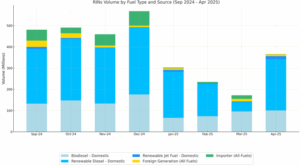
The EPA reported that about 1.5 billion RINs were generated in February 2025, a decrease of more than 25% compared to 2 billion RINs generated in February 2024. This decline continued into March, when 63 million renewable diesel RINs were generated. Domestic producers contributed 36 million of those RINs, with the remainder coming from imports and foreign sources.
In contrast, April saw a remarkable increase in RIN generation. 243 million RD RINs were generated, with 214 million from domestic producers. This increase suggests that production picked up significantly during this month, which might indicate an uptick in demand or production capacity for renewable diesel.
Why Are the RINs Decreasing?
Several factors can contribute to the decrease, including:
- Feedstock Availability – Renewable diesel relies on feedstocks like used cooking oils, animal fats, and plant oils, which can be subject to supply fluctuations. When feedstock availability is limited, it hampers renewable diesel production and RIN generation.
- Economic Factors – The volatility in traditional diesel prices can influence the financial incentives for producing renewable diesel. When diesel prices drop, the economic justification for producing renewable diesel weakens, leading to fewer RINs being generated.
- Policy Adjustments – Changes in renewable fuel mandates and blending requirements can also impact the number of RINs generated. The EPA’s adjustments to the Renewable Fuel Standard can influence production levels and, consequently, RIN generation.
- Market Competition – Renewable fuel market is becoming increasingly competitive, with other biofuels like ethanol and biodiesel vying for production capacity. This competition can limit the growth of renewable diesel production, leading to fewer RINs being issued.
What Does This Mean for Renewable Diesel?
With fewer RINs being generated, producers face reduced financial incentives, which could make renewable diesel production less attractive. This reduction in incentives may slow down the industry’s growth and hinder investment in production capacity. At the same time, the decline in RIN generation creates compliance challenges for obligated parties like refineries, which must meet renewable fuel blending quotas. The resulting scarcity of RINs could lead to higher prices, creating market instability and making it more difficult for companies to meet their obligations.
Additionally, the decrease introduces a level of uncertainty in the renewable diesel market. Producers, investors, and stakeholders may hesitate to make long-term investments in renewable diesel production, which could slow the sector’s ability to scale effectively. This uncertainty complicates the industry’s future prospects, as fluctuations in RIN generation and prices make it harder to predict trends and plan for growth.
Given these challenges, there may be a need for a policy response. Adjusts to blending requirements or new incentives to stimulate renewable diesel production may be necessary. These adjustments could help ensure that RD remains a viable and growing segment of the renewable fuel market, providing the stability needed for long-term success.
Maximize Your Journey Towards Sustainability
Understanding and implementing renewable diesel can seem daunting but Mansfield’s team of sustainability experts makes the transition smooth. With comprehensive support, from quantifying the benefits for your specific fleet through total cost of ownership assessments to integrating renewable diesel into your fueling strategy, Mansfield ensures that every fleet can maximize the advantages of this innovative fuel.
As the demand for sustainable fuel solutions grows, renewable diesel stands out as an easy-to-implement choice that does not compromise performance. For fleet and equipment operators looking to make a change, the path forward with renewable diesel is clear and promising.
Mansfield Energy is at the forefront of this revolution, ready to help fleet and equipment operators understand and harness the benefits of switching to renewable diesel. Contact us today!

This article is part of Daily Market News & Insights
Tagged: Biomass-based diesel, Compliance Challenges, diesel production, Energy Markets, Energy Policy, EPA, feedstock availability, fuel industry, Market stability, market trends, renewable diesel, renewable energy, Renewable fuel policy, Renewable Fuel Standard, Renewable Fuels, renewable jet fuel, RFS, RIN generation, RIN Prices, RINs


MARKET CONDITION REPORT - DISCLAIMER
The information contained herein is derived from sources believed to be reliable; however, this information is not guaranteed as to its accuracy or completeness. Furthermore, no responsibility is assumed for use of this material and no express or implied warranties or guarantees are made. This material and any view or comment expressed herein are provided for informational purposes only and should not be construed in any way as an inducement or recommendation to buy or sell products, commodity futures or options contracts.