

Global Oil Demand Weakens Despite Economic Growth
The global economy is still growing, but oil consumption is not keeping pace. Across several major economies, petroleum demand has declined in 2026 even as businesses continue to invest, consumers continue to spend, and economic activity expands. The disconnect is raising questions about how much oil the world will need in the coming months and whether some of the decline could continue after current supply disruptions ease.
Historically, economic expansion has generally meant higher oil consumption as transportation, manufacturing, and trade activity increased. That connection is becoming less consistent as more economic growth comes from electricity-intensive industries and services rather than activities that depend directly on petroleum.
Lower global oil demand may put downward pressure on crude prices, but that does not guarantee relief at the pump. Refinery disruptions and reduced fuel shipments can still keep diesel prices elevated, even as worldwide consumption falls.
Oil Demand Declines Across Major Economies
South Korea, Taiwan, Japan, and several European countries have reported significant declines in petroleum consumption during 2026. According to J.P. Morgan, fuel demand has weakened as higher prices and supply disruptions affect consumption, even in countries where economic activity remains strong.
In South Korea, oil demand fell 26% year over year in April and remained 13% below the previous year’s level in August. Taiwan experienced similar declines, with consumption falling 20% in April and 16% in August. Japan also recorded seven consecutive months of declining oil consumption.
The pattern extends into Europe. Gasoline and diesel demand in France declined 7% year over year from the beginning of the Middle East conflict through August, while automotive fuel consumption in Germany fell 6%. Both countries recorded an 8% decline in August alone.
These reductions have occurred without a comparable contraction in economic output. J.P. Morgan estimates that global economic growth remained close to 3% during the second and third quarters of 2026.
Part of the explanation is the type of economic activity supporting that growth. Semiconductor manufacturing, data centers, and digital services require substantial electricity but do not necessarily generate the same petroleum demand as transportation or traditional industrial activity.
What the Latest Oil Demand Forecasts Show
Major energy agencies agree that oil demand has weakened, but their forecasts differ on how much consumption will decline in 2026 and recover in 2027.
According to the International Energy Forum’s October comparison, the latest outlooks show:
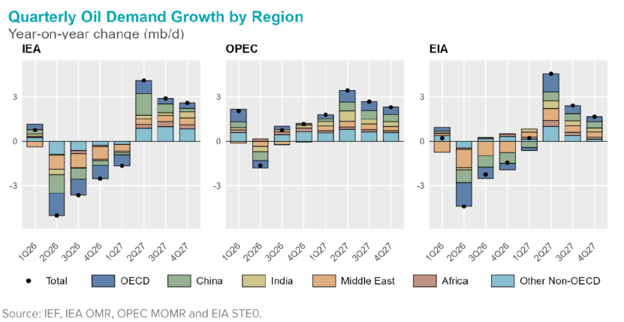
The IEA’s October Oil Market Report projects that global oil demand will average 102.4 million barrels per day in 2026. The agency expects consumption to recover partially in 2027, although demand would remain below 2025 levels.
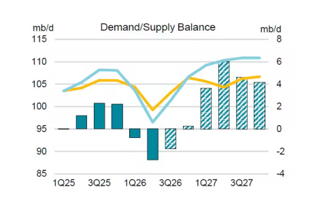
Source: Oil and Gas Journal
The EIA’s October Short-Term Energy Outlook also forecasts global liquid fuels consumption of 102.4 million barrels per day in 2026, followed by an increase to 104.6 million barrels per day in 2027.
OPEC maintains a more optimistic outlook. Its October forecast anticipates modest demand growth in 2026, followed by a stronger recovery in 2027 as previously deferred consumption returns and petroleum inventories are replenished.
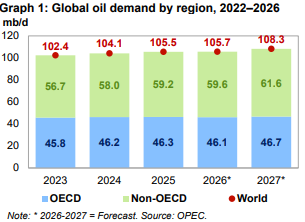
Although the estimates differ, all three organizations expect demand to improve next year. The disagreement centers on how much consumption has been lost and how quickly it will return.
Why Lower Oil Demand Has Not Meant Lower Fuel Prices
Under normal conditions, weaker petroleum demand can reduce pressure on crude oil prices. However, current market conditions are being shaped by supply disruptions as well as consumption trends.
The IEA reported in October that global diesel exports were approximately 700,000 barrels per day lower in September than a year earlier. Reduced shipments from Russia and the Middle East have limited available supplies, particularly as markets prepare for winter heating demand.
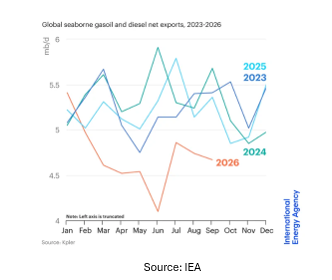
The agency also reported that global observed oil inventories had fallen by approximately 507 million barrels since the start of the Middle East Conflict.
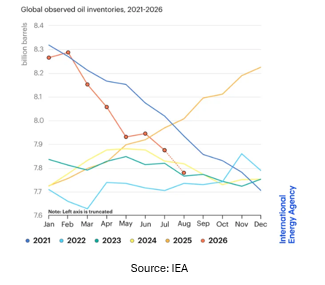
For diesel buyers, these supply constraints can outweigh the effects of weaker global petroleum consumption. Even when less oil is being used worldwide, regional shortages and limited refinery output can keep finished fuel prices elevated.
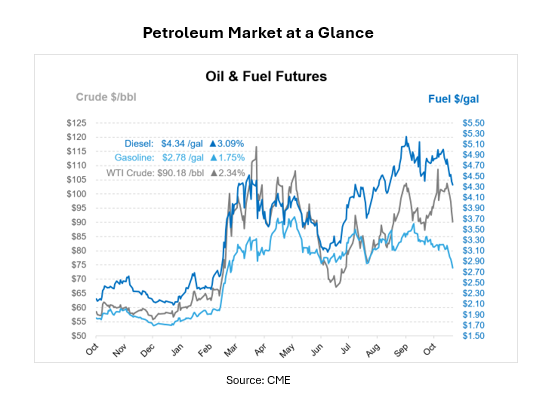
The EIA reported that Brent crude averaged $114 per barrel in September, compared with $91 in August. Its October outlook projects prices will generally decline as Middle Eastern production and exports gradually recover, with Brent averaging $87 per barrel in the second quarter of 2027.
That forecast depends on improvements in supply conditions, which remain uncertain.
What Fuel Buyers Should Watch Next
The next several months will help determine whether the decline in oil demand is primarily a response to unusually high prices and supply disruptions or part of a longer-term shift in energy consumption.
Lower global oil demand may not translate into immediate savings. A refinery outage or reduced fuel deliveries can still tighten supply in certain regions, keeping prices elevated and making it harder to secure fuel when needed. Monitoring regional diesel inventories and working with suppliers ahead of anticipated demand can help businesses plan purchases and avoid unexpected delivery challenges.
The broader question is no longer simply whether the economy will grow. It is how much petroleum that growth will require.
Hear More on the Latest Fuel Market Developments
For a closer look at what could affect fuel prices and supply heading into 2027, listen to the latest episode of FUELSCast. Host Sydney Casey joins Mansfield experts Andy Milton, SVP of Supply, Distribution, and Logistics, and Drew Miller, Manager of Commercial and Industrial Sales, to discuss low diesel inventories, refinery maintenance delays, geopolitical tensions, and the potential impact of the midterm elections. They also cover fuel purchasing strategies, winter preparedness, and steps businesses can take to secure supply and manage costs.
This article is part of Daily Market News & Insights


MARKET CONDITION REPORT - DISCLAIMER
The information contained herein is derived from sources believed to be reliable; however, this information is not guaranteed as to its accuracy or completeness. Furthermore, no responsibility is assumed for use of this material and no express or implied warranties or guarantees are made. This material and any view or comment expressed herein are provided for informational purposes only and should not be construed in any way as an inducement or recommendation to buy or sell products, commodity futures or options contracts.