

Oil Prices Rise as U.S.-Iran Talks Stall and Diesel Export Debate Pressures WTI
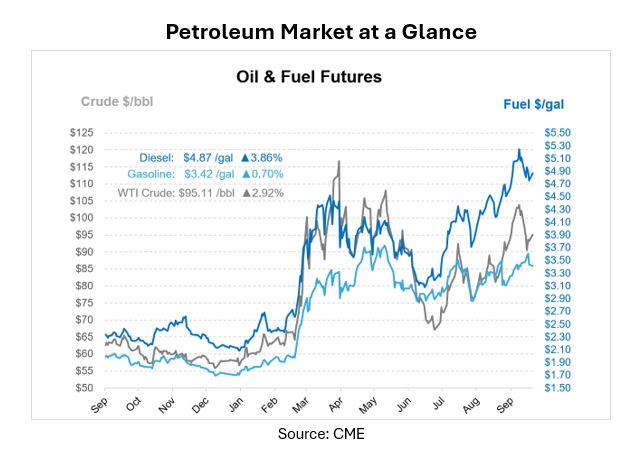
Oil prices moved higher Monday as stalled U.S.-Iran negotiations reduced expectations for a near-term reopening of the Strait of Hormuz. WTI gained nearly $3/bbl to trade around $95/bbl, while Brent climbed to roughly $107/bbl. The geopolitical outlook is bullish for crude as uncertainty surrounding the Strait continues, although recovering Middle East exports are returning barrels to the global market and tempering some of the upward price movement.
President Donald Trump rejected Iran’s latest proposal aimed at ending the conflict and reopening the Strait of Hormuz over the weekend, according to Reuters. Iran has maintained that the U.S. must lift its naval blockade and oil sanctions as part of an agreement to reopen the waterway. Trump said Sunday that he expects negotiations to resume this week, keeping the direction of talks and the timing of a broader recovery in Gulf exports in focus.
Physical crude flows have already improved despite the lack of broader agreement. Preliminary Kpler data shows exports from key Middle East producers reaching 12.8 Mbpd in September, the highest since the conflict began in February. Shipments through the Strait of Hormuz are expected to reach approximately 7.4 Mbpd this month as Saudi Arabia and the United Arab Emirates increase exports. Saudi Arabia has also repaired its East-West Pipeline following drone attacks earlier this month, giving the country additional flexibility to move crude.
Even as geopolitical developments pushed crude higher Monday, the potential for U.S. diesel export restrictions is creating a separate bearish influence on WTI. The WTI-Brent discount widened to as much as $12.02/bbl last week, its widest since early May. Reuters reported that the possibility of lower U.S. refinery runs under a diesel export ban has contributed to the widening spread. Higher freight costs have also made U.S. crude exports less economical, limiting the ability of domestic barrels to move into international markets. Cushing, OK, inventories remain an important factor to watch for WTI as potential changes in refinery demand alter domestic crude balances.
The Trump administration is considering restrictions on U.S. diesel exports as domestic diesel prices remain elevated. The U.S. is the world’s largest diesel exporter, and U.S. diesel prices reached a record $6.528/gallon last week. While an export restriction could initially lower domestic diesel prices by keeping more supply in the U.S., a prolonged restriction could create broader consequences for refining and gasoline markets.
Goldman Sachs Research estimates that while storage remains available, each week of a U.S. diesel export ban could create approximately $0.25/gallon of downward pressure on average U.S. retail diesel prices. As diesel inventories build toward storage capacity, however, lower diesel prices would compress refining margins and could encourage refiners to reduce crude runs.
That reduction would affect more than diesel. Because diesel, gasoline, and jet fuel are largely produced together, lower refinery utilization would also reduce gasoline production. Goldman Sachs estimates that once diesel storage reaches capacity, each week of an export ban could add approximately $0.30/gallon of upward pressure to U.S. retail gasoline prices. Estimates cited by Reuters show U.S. refinery crude processing could fall by more than 2 Mbpd under a prolonged ban scenario.
Restrictions would also shift pressure into international diesel markets. Goldman Sachs estimates each week of a U.S. export ban could raise European wholesale diesel prices by roughly $3/bbl, although releases from European strategic diesel reserves could offset part of that increase. Europe and Latin America are key destinations for U.S. diesel exports, meaning those regions would need to compete more aggressively for supply from alternative sources.
For U.S. fuel buyers, the diesel export debate therefore extends beyond the potential for near-term relief at the pump. Keeping more diesel at home could lower domestic diesel prices initially, but if inventories fill and refiners reduce output, the policy could eventually tighten gasoline supply and reduce domestic crude demand. At the same time, stalled U.S.-Iran negotiations are keeping geopolitical risk elevated, creating a market where international crude remains bullish while domestic refining concerns weigh more heavily on WTI.
This article is part of Daily Market News & Insights


MARKET CONDITION REPORT - DISCLAIMER
The information contained herein is derived from sources believed to be reliable; however, this information is not guaranteed as to its accuracy or completeness. Furthermore, no responsibility is assumed for use of this material and no express or implied warranties or guarantees are made. This material and any view or comment expressed herein are provided for informational purposes only and should not be construed in any way as an inducement or recommendation to buy or sell products, commodity futures or options contracts.