

Week in Review – Oil Prices Ease on Better Supply Flows, but Shipping Disruptions Persist
Oil prices dropped on Friday after climbing to nearly four-month highs earlier in the week, with Brent trading near $104 per barrel and WTI around $102. The pullback came as concerns over immediate Saudi supply disruptions eased, supported by increased crude movements through Oman, higher refined product inventories in the U.S., Singapore, and Europe, and stronger fuel exports from China. However, shipping through the Strait of Hormuz remains severely constrained, Red Sea risks have increased, and refineries in Europe and India continue to face tighter crude availability, keeping supply and transportation concerns firmly in focus.
The market is now paying close attention to whether those physical flows can improve enough to ease some of that pressure. Saudi Arabia is working to restore capacity on its East-West pipeline after last week’s attack, but traffic through Hormuz remains well below recent averages, while rising risks around the Red Sea are creating additional uncertainty for regional exports. With both major routes under pressure, transportation conditions remain a key factor in determining how much crude reaches refiners and, ultimately, how the market responds.
Only four commodity vessels passed through the Strait of Hormuz on Thursday, compared with a 10-day average of roughly 16. Three vessels were entering the Gulf, and only one was exiting. The figures remain especially important because the Strait carried about one-fifth of the world’s oil and gas before the conflict. Three LNG vessels also reappeared outside the Strait on Thursday, highlighting the continued disruption to normal shipping patterns.
The alternative route through the Red Sea is also facing increased pressure. Twenty-three commodity vessels traveled through the Bab el-Mandeb Strait on Thursday, below the recent 10-day average of approximately 26. The expansion of fighting into Yemen and Saudi Arabia has created additional concerns around the Red Sea route, which has become an important alternative for Gulf exports while Hormuz traffic remains constrained.
Those transportation challenges are reshaping global oil flows. Asian and European refiners are having to replace supplies affected by reduced movement through the Strait of Hormuz, increasing the importance of barrels moving from the Atlantic basin. U.S. crude exports have reached record levels, while producers in Brazil, Guyana, and Argentina are expected to contribute to additional export growth. Longer routes between producing and consuming regions are also increasing demand for large oil tankers.
The shipping market is already reflecting that shift. Shipowners have ordered more than twice as many supertankers so far in 2026 as they did during all of 2025. Signal Group data shows 217 Very Large Crude Carriers have been ordered this year compared with 93 last year. At the same time, tanker rates have surged, with VLCC spot prices recently climbing above $500,000 per day, up from about $132,000 in February before the war.
Supply concerns are also showing up at refineries. Indian refiners are facing uncertainty around November crude cargoes after relying heavily on discounted Russian oil and some Middle Eastern barrels in recent months. European refiners are also facing tighter availability, with Saudi Arabia telling at least two customers that they will receive no crude allocation next month. Libya, however, is providing some relief after production returned to normal at two fields that had been temporarily closed.
Geopolitical uncertainty remains another major factor. The Trump administration has decided to allow members of an Iranian delegation to travel to New York for next week’s United Nations General Assembly, even after the recent escalation in the region. President Trump has also said he is approaching a “big decision” regarding whether to re-escalate attacks on Tehran ahead of meetings with Persian Gulf nations next week. The U.S. and Iran have not held peace talks since an interim agreement collapsed in June.
For now, additional exports, higher product inventories and efforts to restore Saudi pipeline capacity are providing some relief. At the same time, limited traffic through Hormuz, growing risks around the Red Sea, tighter refinery access to crude and higher transportation costs continue to keep supply concerns elevated.
The direction of oil prices will depend heavily on whether physical flows through the region can continue to improve. Until shipping through key routes moves closer to normal, the market is likely to remain highly sensitive to changes in supply availability and transportation.
Prices in Review
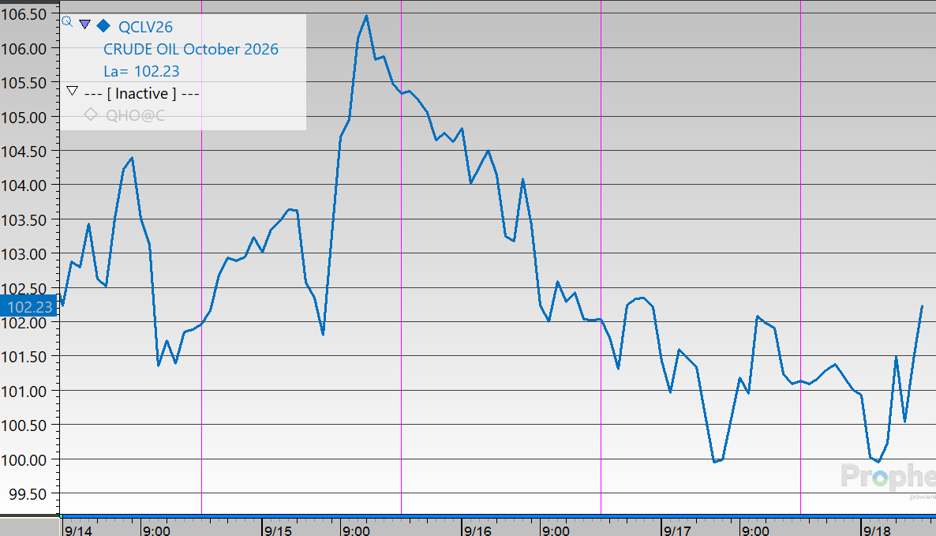
Crude prices were volatile during the week, briefly pushing above $105 before retreating in the final two sessions. Prices opened at $102.25 on Monday, edged down to $102.01 on Tuesday, then jumped to a weekly high of $105.48 on Wednesday. The market reversed course afterward, falling to $102.18 on Thursday and $101.06 on Friday. From Monday to Friday, crude prices declined by $1.19 per barrel, representing an approximate 1.2% decrease.
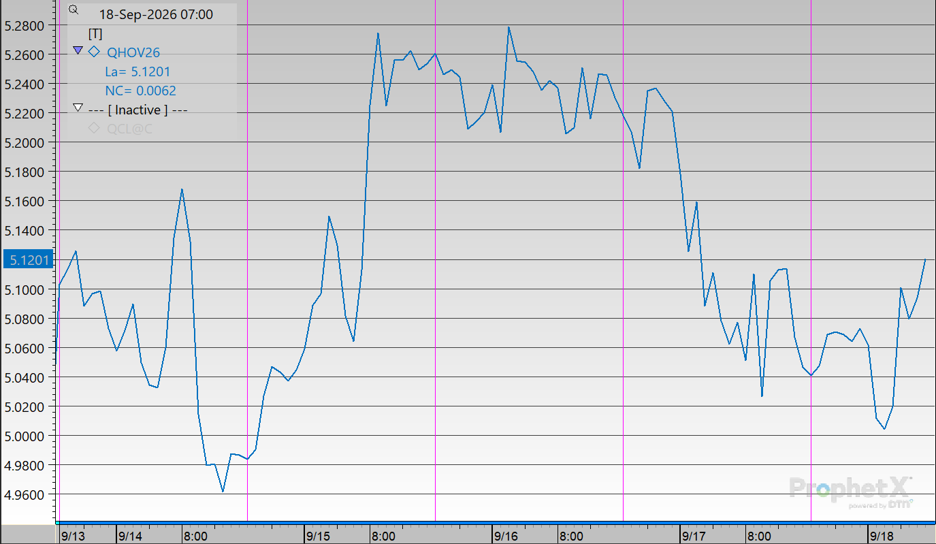
Diesel prices moved sharply higher midweek before giving back most of those gains by Friday. After starting at $5.0200 on Monday, prices eased to $4.9744 on Tuesday before surging to a weekly high of $5.2389 on Wednesday. Diesel remained elevated at $5.2234 on Thursday, then retreated to $5.0470 on Friday. Despite the swings, prices ended the week $0.0270 per gallon above Monday’s level, representing an approximate 0.5% gain.
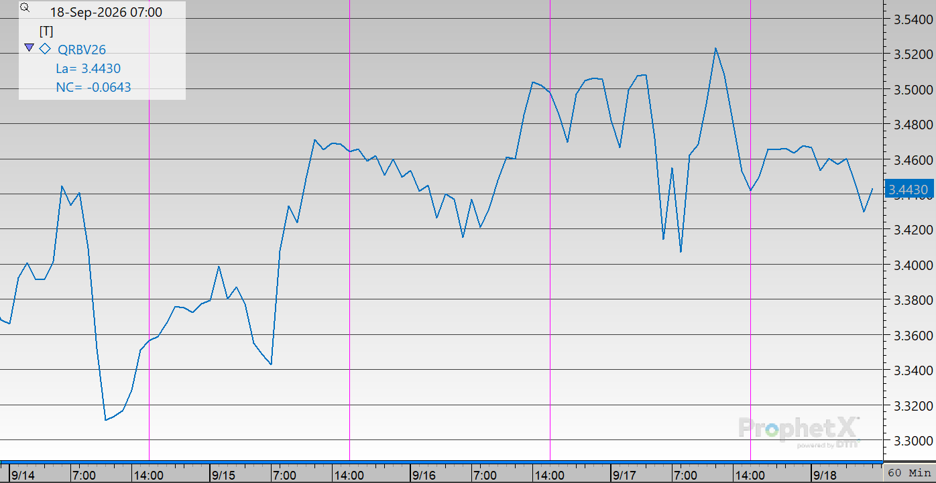
Gasoline prices strengthened through most of the week before easing slightly in the final session. Prices began at $3.3372 on Monday and edged up to $3.3495 on Tuesday, followed by a larger move to $3.4684 on Wednesday. The upward momentum continued Thursday, when prices reached a weekly high of $3.5014, before pulling back to $3.4599 on Friday. Gasoline ended the week $0.1227 per gallon higher, an increase of approximately 3.7%.

This article is part of Daily Market News & Insights


MARKET CONDITION REPORT - DISCLAIMER
The information contained herein is derived from sources believed to be reliable; however, this information is not guaranteed as to its accuracy or completeness. Furthermore, no responsibility is assumed for use of this material and no express or implied warranties or guarantees are made. This material and any view or comment expressed herein are provided for informational purposes only and should not be construed in any way as an inducement or recommendation to buy or sell products, commodity futures or options contracts.