

Oil Prices Rise as Iran Sets Conditions for Strait of Hormuz Reopening
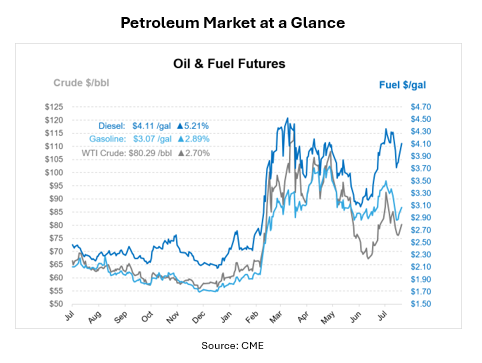
Oil prices moved higher today as Iran tied the reopening of the Strait of Hormuz to a broader set of U.S. concessions, reducing expectations that unrestricted shipping through the waterway will resume quickly. WTI gained roughly $1.50/bbl this morning, trading to near $80/bbl after falling about $6/bbl week-over-week through last Friday. Brent also moved higher, trading near $85/bbl. Uncertainty surrounding the negotiations and Iran’s additional requirements is contributing to higher prices today as attention remains focused on whether the two sides can make progress toward restoring commercial shipping.
Crude prices fell more than 7% last week as negotiations between Iran and Oman raised expectations that the Strait of Hormuz could reopen. The waterway carried roughly one-fifth of global oil and liquefied natural gas flows before the conflict began in February, and its effective closure has disrupted shipping and increased transportation risks throughout the region. Approximately 17 Mbpd of crude oil normally transits the strait, while more than 50 million metric tons of liquefied natural gas move through the waterway annually. With a large portion of these flows currently delayed, rerouted or suspended, the disruption continues to affect global supply chains and freight costs.
Iran said today that negotiations with Oman are nearing completion, with the two countries agreeing on a map for new shipping routes through the strait. Remaining discussions include safe navigation procedures, environmental protections, maritime services and other technical details. An agreement between Iran and Oman, however, would not by itself restore unrestricted commercial traffic.
Tehran has linked a full reopening to several U.S. actions, including compensation for damage from attacks on Iran, an end to military threats, removal of the U.S. naval blockade, sanctions relief and the release of frozen Iranian assets. President Donald Trump described discussions with Iran as only “semi-negotiating,” while Iran maintains that direct negotiations will not resume while the U.S. is violating the interim agreement reached in June.
Iran’s additional conditions have shifted crude pricing back toward a more bullish direction today. A clear agreement to restore commercial shipping would reduce some of the geopolitical risk reflected in crude prices, while extended talks would keep physical supply routes constrained. The timing is particularly important for fuel buyers after expectations of a reopening contributed to last week’s price decline.
Supply risks also extend beyond the Strait of Hormuz. Iran-aligned Houthis attacked Saudi Arabia’s Jazan refinery over the weekend, causing a fire that affected one crude storage tank before Saudi authorities extinguished it. The attack followed increased Houthi activity around the Red Sea, adding another source of disruption near a key global shipping corridor.
Separately, a Ukrainian drone attack caused a fire at Russia’s Ilsky refinery. The facility has been targeted repeatedly during Ukraine’s campaign against Russian energy infrastructure. Ukraine has agreed not to target certain non-Russian oil tankers and Black Sea infrastructure used to export Kazakhstan’s crude, limiting some of the risk to non-Russian supply flows.
For fuel buyers, crude prices remain closely tied to whether negotiations lead to the operational reopening of the Strait of Hormuz. Iran and Oman are moving closer to an agreement on shipping arrangements, but Tehran’s broader demands on Washington create additional hurdles before unrestricted oil traffic can resume. A deal that restores crude flows would create a more bearish pricing environment, while prolonged negotiations or additional regional disruptions would keep conditions more bullish.
This article is part of Daily Market News & Insights


MARKET CONDITION REPORT - DISCLAIMER
The information contained herein is derived from sources believed to be reliable; however, this information is not guaranteed as to its accuracy or completeness. Furthermore, no responsibility is assumed for use of this material and no express or implied warranties or guarantees are made. This material and any view or comment expressed herein are provided for informational purposes only and should not be construed in any way as an inducement or recommendation to buy or sell products, commodity futures or options contracts.