

Week in Review – Hormuz Talks Push Prices Lower, but Oil Markets Stay Tight
Oil prices continued to move lower Friday as markets focused on the possibility of progress toward reopening the Strait of Hormuz. Prompt WTI futures were down about $0.60 per barrel this morning and were on track to finish the week roughly $7.50 per barrel lower. The decline reflects growing expectations that negotiations involving Iran and Oman could restore at least some oil traffic through the critical waterway. However, the broader supply picture remains tight, with continued disruptions in the Middle East, pressure on global diesel supplies, and new risks emerging around the Red Sea.
President Donald Trump said negotiations between Iran and Oman over reopening the Strait are “moving along.” The potential agreement is expected to involve designated shipping lanes that could allow more vessels to move through Hormuz, which carried roughly one-fifth of global oil and liquefied natural gas supplies before the conflict.
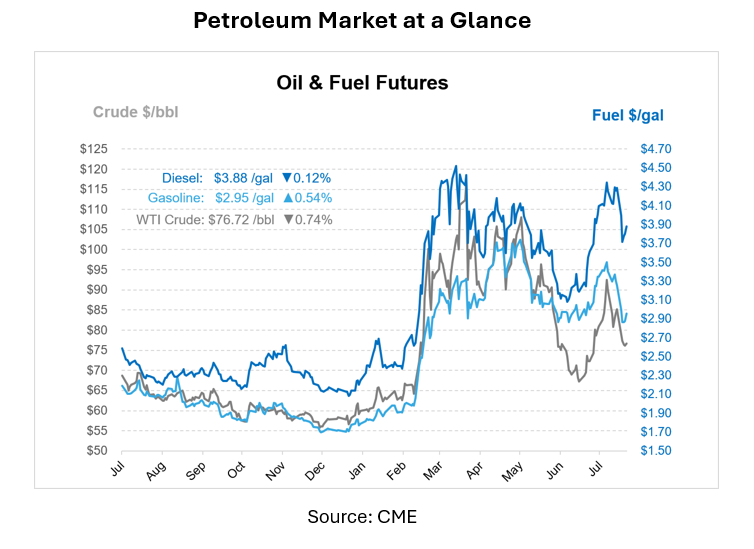
That possibility has helped push crude prices substantially lower. Brent has fallen from approximately $100 per barrel on July 23 to around $80 as expectations of an agreement have increased.
But reopening the Strait and restoring normal energy flows are two different things. Arab mediators remain concerned that Iranian diplomats may not be able to guarantee compliance with any agreement. Even if a deal is reached, unrestricted movement through Hormuz is far from certain, particularly if Iran retains some influence over how vessels move through the waterway.
The market also has a much smaller supply cushion than it did during the previous ceasefire attempt in June. At that time, nearly 150 million barrels of oil had accumulated on tankers inside the Gulf. Around 70 million barrels of crude and refined products moved out during the month following the June agreement, providing additional supply to the global market.
Today, only around 80 million barrels remain stored inside the Gulf. That means even a successful reopening would likely release considerably less oil into the market than it did following the June agreement.
The difference is particularly important for diesel. Fuel inventories have been drawn down during the Northern Hemisphere’s peak summer demand season while Middle Eastern supply disruptions have continued. At the same time, Russian diesel availability has declined after Russia banned exports in July following months of Ukrainian attacks that damaged refining facilities.
Those pressures pushed diesel refining margins to an all-time high of $75 per barrel on July 31. Margins have since fallen to approximately $63 per barrel, but they remain more than 50% above mid-June levels. That creates an important distinction between the crude and refined-product markets. More crude moving through Hormuz could improve feedstock availability, but it would not immediately restore damaged refining capacity or replace lost diesel exports.
The Red Sea became an important alternative for Saudi Arabian exports after the conflict began. Saudi Arabia was able to continue moving more than 4 million barrels per day through alternative routes, representing roughly 60% of its pre-war flows, even while traffic through Hormuz was severely restricted.
That route is now facing its own challenges. Tankers traveling into the Red Sea to load Saudi crude are increasingly signaling the Suez Canal and Egypt as their destinations as vessels seek to reduce the risk of attacks following the Houthi blockade of Saudi ports. On Thursday, the Houthis also conducted what was described as a “large-scale” attack against forces from Yemen’s Saudi-backed government, striking the southwestern Saudi region of Najran.
Whether the blockade would be lifted as part of a wider agreement involving Iran remains uncertain. Until there is greater clarity, the Red Sea represents another potential constraint on Middle Eastern energy exports.
Prices in Review
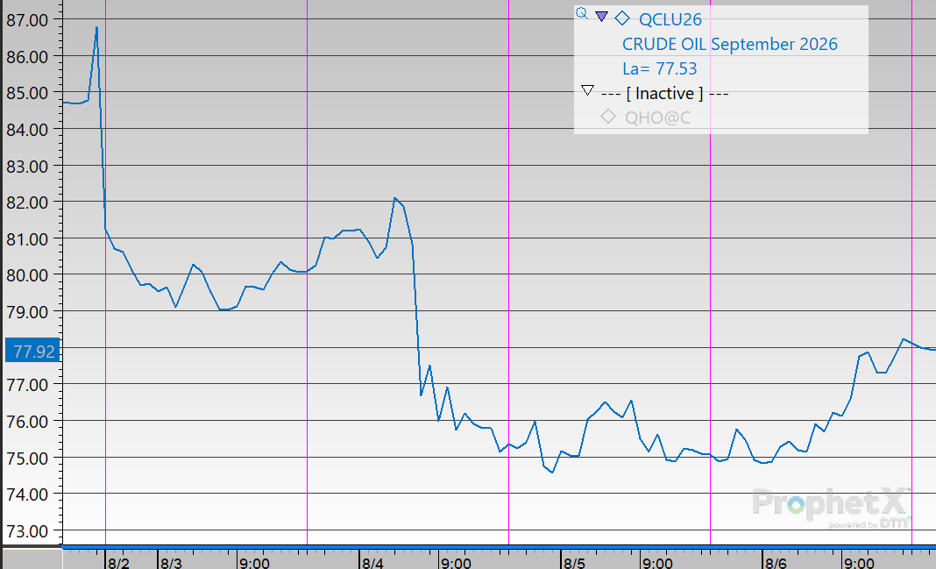
Crude prices trended lower through most of the week before rebounding on Friday. Prices opened at $80.10 on Monday, then fell sharply to $75.17 on Wednesday. The market held relatively steady at $75.14 on Thursday, before recovering to $78.17 on Friday. Overall, crude prices decreased by $1.93 per barrel, representing an approximate 2.4% decline during the week.
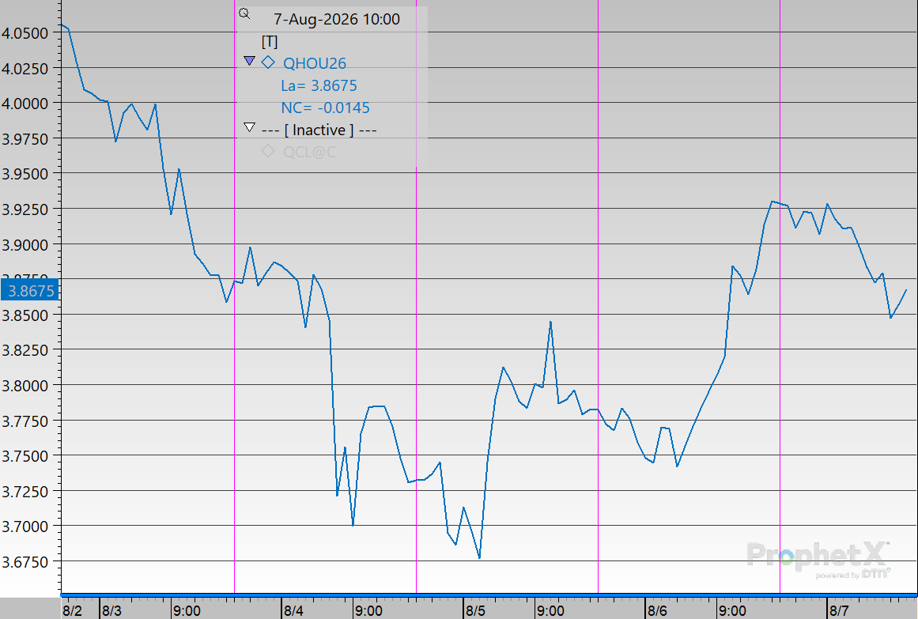
Diesel prices moved lower early in the week before recovering most of the losses by Friday. Prices opened at $3.9780 on Monday, declined to $3.8696 on Tuesday, and then dropped to $3.7221 on Wednesday. Prices then turned higher, reaching $3.7924 on Thursday and $3.9409 on Friday. Overall, diesel prices dropped by $0.0371 throughout the week, representing an approximate 0.9% decline.
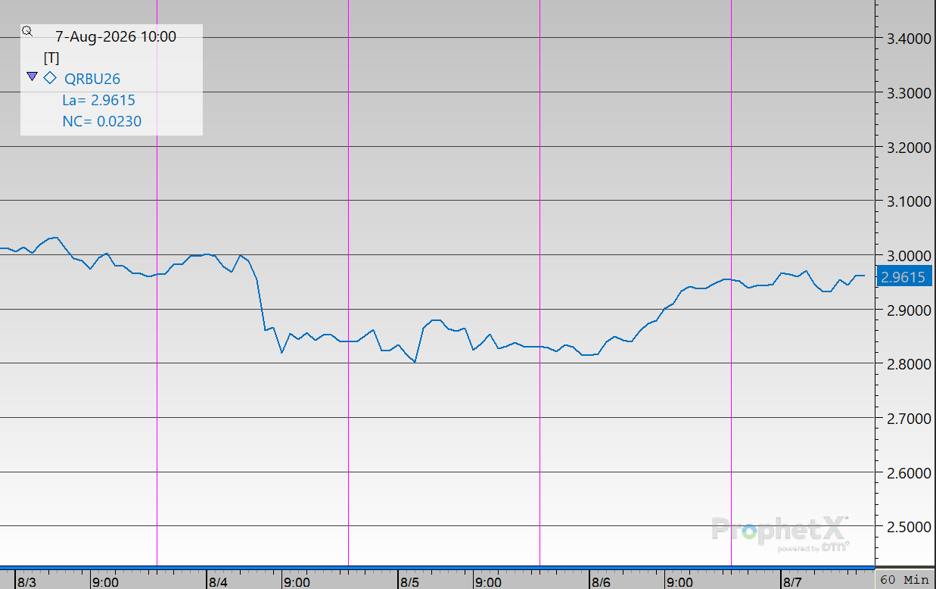
Gasoline prices opened at $3.0500 on Monday, fell to $2.9727 on Tuesday, then declined further to $2.8422 on Wednesday and $2.8338 on Thursday, the lowest level of the week. Prices recovered to $2.9580 on Friday, but remained below the week’s opening level. Overall, gasoline prices decreased by $0.0920 per gallon, representing an approximate 3.0% decline during the week.
This article is part of Daily Market News & Insights


MARKET CONDITION REPORT - DISCLAIMER
The information contained herein is derived from sources believed to be reliable; however, this information is not guaranteed as to its accuracy or completeness. Furthermore, no responsibility is assumed for use of this material and no express or implied warranties or guarantees are made. This material and any view or comment expressed herein are provided for informational purposes only and should not be construed in any way as an inducement or recommendation to buy or sell products, commodity futures or options contracts.