

Oil Prices Under Pressure as OPEC+ Adds Supply and Gulf Exports Recover
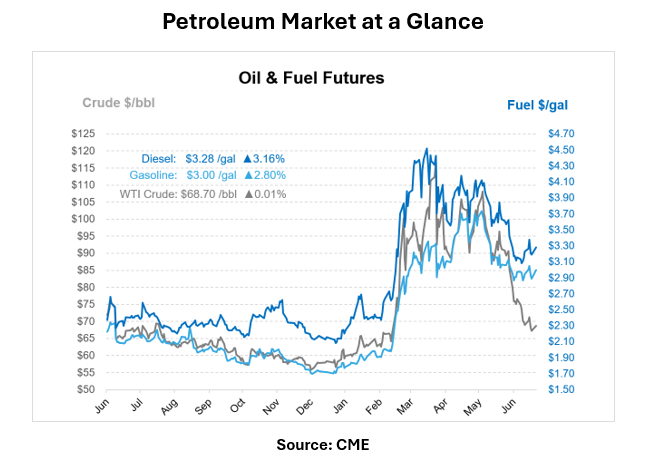
Oil markets are starting the week under pressure as OPEC+ is preparing to increase production quotas in August and tanker traffic through the Strait of Hormuz shows signs of recovery. This morning, Brent was trading around $72 per barrel, while WTI was around $69 per barrel. WTI also finished last week about 50 cents lower, as the market weighed the return of more Gulf barrels against softer demand signals and ongoing uncertainty around whether regional exports can fully return to pre-conflict levels.
Over the weekend, OPEC+ members agreed to raise their oil production quotas by 188,000 barrels per day, beginning in August. The move follows similar increases for June and July and brings the total increase from April to nearly 800,000 barrels per day. On paper, that adds more supply to a market already facing questions about demand. However, the bigger question is whether producers can actually deliver those additional barrels while Middle East exports continue recovering from the disruptions caused by the Iran war.
That recovery appears to be improving, but it is not complete. Tanker traffic through the Strait of Hormuz showed signs of picking up on Sunday, with ships using a U.S.-protected corridor. At least eight Japan-linked tankers were moving through the strait as part of a convoy near the coast of Iran after earlier failed attempts to transit the waterway. Two supertankers carrying Saudi crude are also heading to the U.S. for the first time since February, after being loaded in early March and stuck in the Persian Gulf until recently.
The return of stranded tankers has helped ease supply concerns. As more barrels leave the Gulf, the market is shifting away from the fear of a prolonged supply disruption and back toward concerns about oversupply. Still, the picture remains complicated. Middle East exports have improved since the U.S. and Iran agreed to a 60-day ceasefire on June 17, but volumes remain well below pre-war levels. Kpler data showed June exports at 9.62 million barrels per day, roughly half of the 18.4 million barrels per day average seen in the three months before the Iran conflict. July shipments are tracking slightly higher at 9.99 million barrels per day, though that number could be revised upward as more cargoes are assessed.
The UAE is also adding to the supply story. The country raised crude output to more than 3.8 million barrels per day in June, near record highs and the second-highest level on record, after leaving OPEC and OPEC+ on May 1 to move away from quota restrictions. Abu Dhabi National Oil Company (ADNOC) has also sold large volumes of Emirati crude through spot tenders, with recent sales bringing total tender volumes to more than 70 million barrels. The increase in available UAE barrels is adding pressure to prices, especially as cargoes are being offered at wider discounts.
China remains another important factor. During the Iran war, China cut back sharply on crude purchases, helping ease pressure on global supply. Kpler data showed China’s seaborne imports dropped to 5.84 million barrels per day in June, about half of pre-war levels and the lowest in more than a decade. July imports are currently tracking even lower at 5.31 million barrels per day, although that figure may be revised higher. If prices remain weak, Chinese refiners may return to the market, but the timing will depend on whether crude prices fall far enough to make purchases attractive.
At the same time, U.S. crude drilling activity increased. The U.S. crude oil net rig count rose by five rigs to 445 for the week ended July 2. The count is up 14 rigs month-over-month and 20 rigs year-over-year. Canadian crude rigs moved in the opposite direction for the week, falling by seven rigs to 130, though they remain higher by 15 rigs month-over-month and 28 rigs year-over-year.
Market positioning also points to a more cautious view. Managed money participants reduced their Brent net length by 37,500 lots, driven by a decline in long positions and a small increase in short positions. That suggests some investors are stepping back from bets on higher prices as supply concerns ease and the market weighs whether additional OPEC+ and UAE barrels can be absorbed.
For now, oil prices are being shaped by expectations of more supply from OPEC+, improved tanker traffic through the Strait of Hormuz, stronger UAE output, and softer demand signals. While those factors have helped push prices lower, the market is still dealing with a fragile recovery in Gulf exports, depleted inventories, and unresolved geopolitical risks that could bring renewed volatility if supply flows are disrupted again.
This article is part of Daily Market News & Insights


MARKET CONDITION REPORT - DISCLAIMER
The information contained herein is derived from sources believed to be reliable; however, this information is not guaranteed as to its accuracy or completeness. Furthermore, no responsibility is assumed for use of this material and no express or implied warranties or guarantees are made. This material and any view or comment expressed herein are provided for informational purposes only and should not be construed in any way as an inducement or recommendation to buy or sell products, commodity futures or options contracts.