

Oil Supply Cushions Thin as U.S. and Iran Continue Deal Negotiations
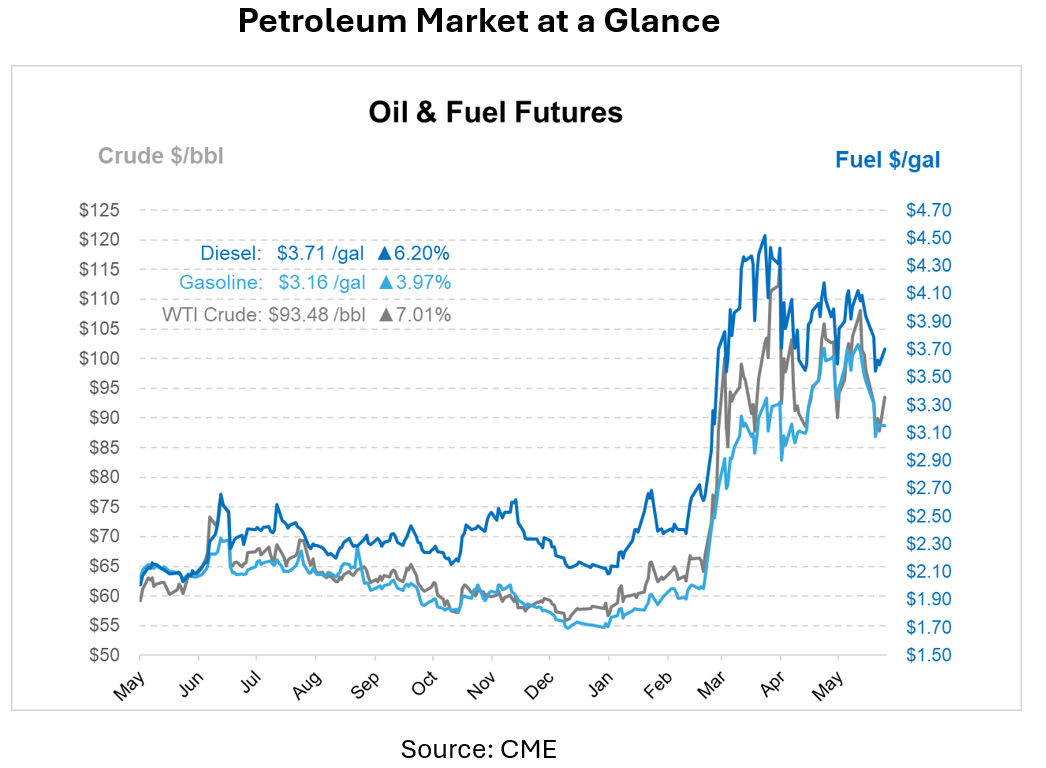
The Iran war is still keeping energy markets on edge, with prices reacting to every signal from the negotiating table and every new military exchange in the region. This morning, WTI futures were trading up by about $3 per barrel after closing down roughly $9 per barrel week over week.
Over the weekend, President Trump said talks with Iran over an interim peace deal “will work out well.” He also said his proposed deal clearly states that Iran will not have a nuclear weapon and that Iran must fully restore the Strait of Hormuz to its previous status as a free, international waterway. For energy markets, that point remains critical because Hormuz is one of the world’s most important routes for oil and liquefied natural gas.
Iran has been more cautious about the direction of talks. Iranian officials have accused the U.S. of sending conflicting signals and slowing the process. Iranian Foreign Minister Abbas Araghchi said both sides are still exchanging messages and proposing amendments to the draft agreement, adding that it is not possible to judge the outcome until there is a definite result.
That delay matters because global oil inventories are being used to fill part of the supply gap. The Strait of Hormuz closure has created the biggest oil supply disruption on record, with Persian Gulf oil production down by more than 50%. Goldman Sachs estimated that the world is drawing from global stockpiles at a record pace of 8.7 million barrels per day, while the total supply loss since the war began has exceeded 1 billion barrels.
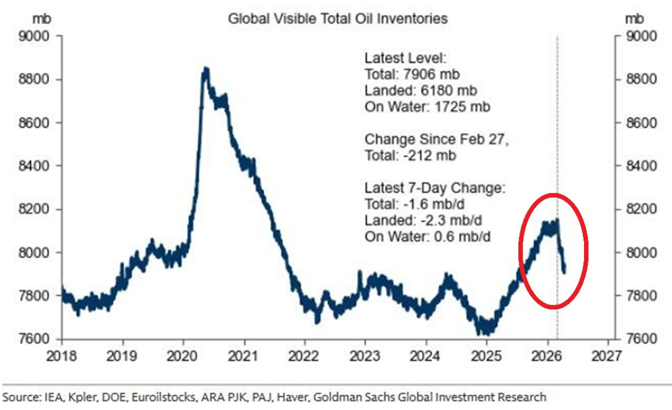
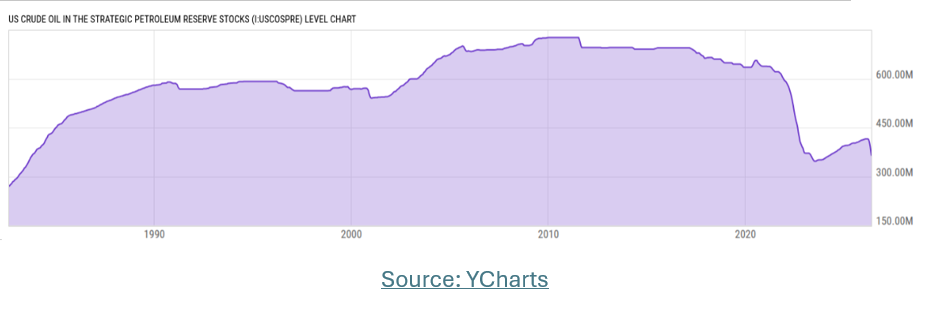
The market had some cushion going into the conflict because inventories were relatively high. However, that buffer is shrinking. U.S. commercial crude inventories ended last week at 441.7 million barrels, about 2% below the five-year average for this time of year. The U.S. Strategic Petroleum Reserve has also fallen to 365.1 million barrels, down from 415.4 million barrels before the war began and well below its 714 million barrel capacity.
Executives from ExxonMobil and Chevron warned that these inventory draws could become a bigger issue over the next several weeks. Chevron CEO Mike Wirth said the market’s “buffers and shock absorbers” are being steadily drawn down, reducing its ability to absorb the imbalance. ExxonMobil senior vice president Neil Chapman also warned that the market is approaching unusually low inventory levels, which could create stronger upward pressure on prices if supply does not improve soon.
That is why the Strait of Hormuz remains the center of the energy market story. Brent crude has cooled from more than $110 per barrel in mid-May to around $90 per barrel, partly because of optimism that the U.S. and Iran may be moving closer to a deal. But if Hormuz flows do not recover soon, some analysts and executives warned that prices could move sharply higher again, especially as inventories continue to drain.
Military activity is keeping that risk alive. The U.S. said it struck Iranian air defenses, a ground control station, and two drones that were threatening ships after what it described as aggressive Iranian actions. Iran’s Revolutionary Guard said it targeted a U.S.-used air base in response to an attack on southern Iran. Kuwait also activated air defenses and condemned Iranian missile and drone attacks, adding to concerns that the security risk could spread further across the region.
The conflict is also still tied to fighting beyond Iran. Israel ordered troops to move further into Lebanon against Hezbollah, a Tehran-backed group, while the U.S. has proposed a gradual de-escalation plan between Israel and Lebanon. For oil markets, each additional front makes diplomacy more complicated and keeps attention on supply routes, tanker security, and the possibility of further disruptions.
U.S. fuel markets are already showing the strain. Gasoline inventories have fallen for 15 straight weeks, matching the longest run of stock draws on record. Stocks are now around 211.5 million barrels, down from more than 253 million barrels before the Iran conflict began and about 5.5% below the five-year average for this time of year. With summer driving demand rising, that leaves the gasoline market with less room to absorb another disruption.
Refiners are trying to increase supply. U.S. refiners processed 16.9 million barrels per day last week, the highest weekly volume since November. However, that does not guarantee immediate relief for domestic inventories, especially because some U.S. refineries serve export markets where gasoline and diesel prices may be stronger than domestic prices.
For fuel buyers, the next few weeks may be less about whether the market has enough oil today and more about how long it can keep drawing from its backup supply. A signed agreement that brings reliable movement back through the Strait of Hormuz would help reduce some of that pressure. Without it, shrinking inventories, stronger summer fuel demand, and continued regional fighting could leave crude, gasoline, diesel, and jet fuel prices exposed to another round of sharp moves.
This article is part of Daily Market News & Insights


MARKET CONDITION REPORT - DISCLAIMER
The information contained herein is derived from sources believed to be reliable; however, this information is not guaranteed as to its accuracy or completeness. Furthermore, no responsibility is assumed for use of this material and no express or implied warranties or guarantees are made. This material and any view or comment expressed herein are provided for informational purposes only and should not be construed in any way as an inducement or recommendation to buy or sell products, commodity futures or options contracts.