
Oil Holds Above $100 as Strait of Hormuz Disruptions Persist
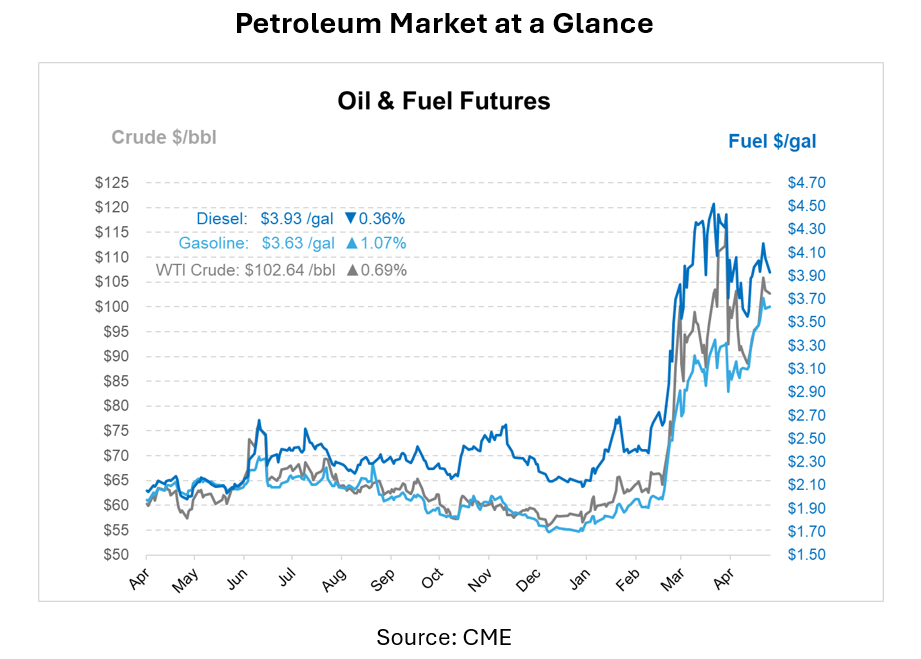
Energy markets are starting the week with renewed upward pressure, and the driver remains the same: escalating tensions around the Strait of Hormuz. Prompt WTI is trading above $105 per barrel, up more than $3/bbl on the day and extending last week’s ~$7.50/bbl gain, while Brent is holding above $111 per barrel. The move comes as Iran claimed it struck a U.S. warship and forced it to turn back, an assertion denied by U.S. officials, but the headline alone reinforced how quickly risk premiums are being added back into the market. At the same time, the U.S. launched “Project Freedom,” deploying naval and air assets to support vessels attempting to transit the Strait, drawing immediate warnings from Iran that any military presence would be met with retaliation.
Despite these efforts, shipping conditions show little improvement. Vessel traffic through the Strait remains near a standstill, with only a small number of ships successfully transiting. Many major shipping companies continue to hold back due to the lack of clear security protocols and the elevated threat level. Hundreds of vessels and thousands of seafarers remain effectively stranded, while alternative routing options are limited and inefficient. Even reports of tankers being hit by projectiles near key regional hubs, such as Fujairah, are reinforcing concerns that the disruption is not isolated but part of a broader regional risk environment.
This disruption is tightening global supply at a time when flexibility is already limited. With flows restricted, refiners, especially in import-dependent regions, are facing increased competition for available barrels. That dynamic is helping sustain crude prices above $100 per barrel, even as some financial indicators show mixed sentiment. Analysts continue to note that as long as flows remain constrained, the risk balance for prices remains skewed to the upside.
On the supply response side, OPEC+ has agreed to raise production targets by 188,000 barrels per day in June, marking the third consecutive monthly increase. However, the market is treating this move as largely symbolic. Much of the additional supply cannot reach global markets if export routes remain blocked. At the same time, the recent exit of the UAE from OPEC adds longer-term uncertainty, raising questions about how cohesive the group will be moving forward and whether a future increase in production could lead to a volume-driven price reset once the Strait reopens.
Geopolitical risks are extending beyond the Middle East as well. Ukraine has continued its campaign against Russian energy infrastructure, including drone strikes on the Baltic port of Primorsk and attacks on vessels. These developments add another layer of supply risk, particularly for European markets, and reinforce the broader theme that energy infrastructure is increasingly becoming a target in global conflicts.
Market positioning and macro signals are also reflecting the uncertainty. Managed money participants have reduced net long exposure in WTI, driven by both an increase in short positions and a pullback in longs, while Brent positioning has shifted higher. In refined products, gasoline length has increased while heating oil positioning has softened, pointing to uneven demand expectations across the barrel. Meanwhile, U.S. rig counts have seen only modest increases and remain below year-ago levels, suggesting that domestic production growth may not accelerate quickly enough to offset global disruptions.
At the same time, inflation dynamics are beginning to come into focus. Recent analysis shows that energy price spikes are being partially filtered out of certain inflation measures, but there is growing concern that if elevated oil prices persist, the impact could broaden across the economy. That raises the stakes for policymakers, particularly as energy costs begin to feed into transportation, manufacturing, and consumer prices more broadly.
As long as the Strait of Hormuz remains constrained and military tensions continue to escalate, supply risks will stay elevated, and prices will remain sensitive to headlines. Until there is a clear path to restoring stable flows, volatility is likely to persist.
This article is part of Daily Market News & Insights


MARKET CONDITION REPORT - DISCLAIMER
The information contained herein is derived from sources believed to be reliable; however, this information is not guaranteed as to its accuracy or completeness. Furthermore, no responsibility is assumed for use of this material and no express or implied warranties or guarantees are made. This material and any view or comment expressed herein are provided for informational purposes only and should not be construed in any way as an inducement or recommendation to buy or sell products, commodity futures or options contracts.