
Did You Miss the Boat on Better Fuel Prices?
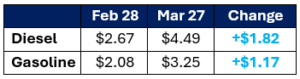
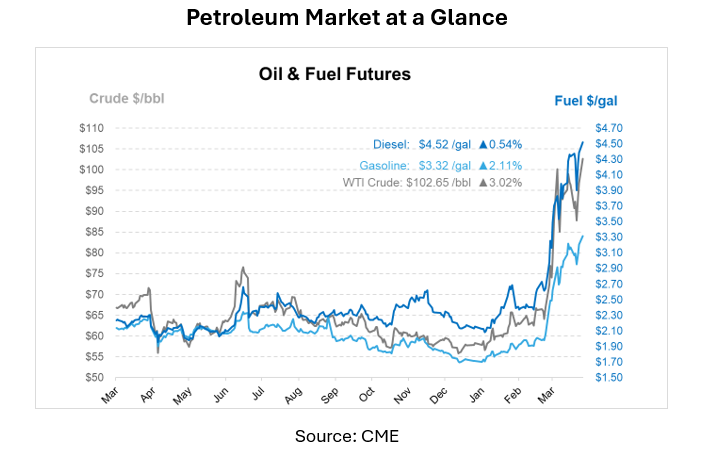
Since the beginning of the US-Israel-Iran conflict, fuel markets have risen significantly. At the Nymex futures level, gasoline is up $1.17 per gallon from Feb, and diesel is up $1.82 per gallon. At gas stations and truck stops across the country, prices are even higher. Economists expect sustained higher prices to reduce demand and economic activity.
Rapid increases in fuel costs can wreak havoc on budgets. Commercial and industrial fuel buyers, who were considering a fixed price, may look at current rates and feel they missed the boat on low prices. But did they? Turns out, there are still ways to use fixed fuel contracts to secure your supply at a rate well below current market prices.
Lowering Your Fuel Price
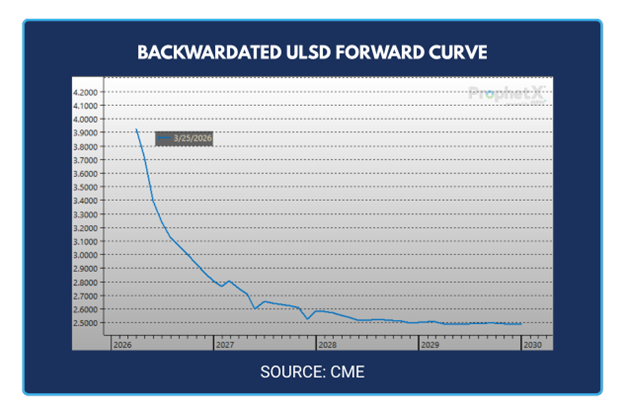
The secret that fuel buyers must consider is the forward curve. While today’s prices are excessive, future-dated contracts are much less dire. Recall that futures prices are the price of fuel for some future delivery – so there’s a contract for April 2026, and a different one for October 2026, December 2026, and January 2027. When you average the full curve – as you would when locking in a fixed price – you can bring your price much lower.
Consider the spread (or difference) between April and December – current diesel future trades in December are $1.50/gal less than current fuel prices. By blending the full 2026 ULSD strip, you can lower your price today by nearly $1/gal and lock in that price for the rest of the year – so even if the market remains above $4-$5/gal all year, you’re locked in below $4.
How Does This Work?
The current geopolitical environment is reinforcing a backwardated market, where prices today are higher than those further out. While this creates near-term pressure, it also opens up opportunities, especially for those considering fixed price strategies.
In this type of market, future pricing is often more attractive than today’s pricing. Locking in now doesn’t mean committing to the highest levels; instead, it allows you to secure a price below current spot levels and smooth out your overall cost. If prices move higher in the coming months, as they often do when supply is tight, you’ve already protected a portion of your volume at a better rate, turning market uncertainty into a cost advantage. Check out the example below.
With a layered strategy, you can gain immediate protection from high fuel costs while maintaining optionality to move with the market in the future. Instead of locking in 100% at a single point in time, you can hedge volumes incrementally. For example, you might secure a portion of your near-term needs today to protect against immediate price spikes, then add additional hedges over time as you move further out on the curve. This approach reduces the risk of locking everything in at a high point while still capturing opportunities as they develop. It also offers the advantage of lower prices further out, gradually blending those positions into an overall portfolio and improving average cost.
Lower Fuel Costs: Still Possible
So, did you miss the boat? Not necessarily. While prices have already moved higher, hedging still offers a path to control costs and reduce risk moving forward. The opportunity may look different than it did a few weeks ago, but for those taking a structured approach, there’s still time to act and secure better outcomes.
Fuel price volatility is a fact of life in the energy industry. With Mansfield Fuel Price Risk Management services, you can plan for the unexpected and mitigate the impact of these events on your bottom line. Protect your business against fuel price fluctuations and ensure cost stability.
Our Price Risk Management experts will analyze your buying history and organizational goals to provide an assessment of your current fuel spending, a forecasted outlook, and recommendations. Contact us today!
This article is part of Daily Market News & Insights
Tagged: backwardation fuel market, commercial fuel buyers, diesel futures spread, diesel price increase, Energy Market Outlook, fixed fuel pricing strategy, fuel cost management, fuel hedging strategies, fuel market analysis, fuel price risk management, fuel prices 2026, fuel procurement strategy, gasoline price trends, geopolitical impact on oil prices, layered hedging strategy, lower fuel costs strategy, oil price volatility, ULSD futures curve, US Israel Iran conflict oil


MARKET CONDITION REPORT - DISCLAIMER
The information contained herein is derived from sources believed to be reliable; however, this information is not guaranteed as to its accuracy or completeness. Furthermore, no responsibility is assumed for use of this material and no express or implied warranties or guarantees are made. This material and any view or comment expressed herein are provided for informational purposes only and should not be construed in any way as an inducement or recommendation to buy or sell products, commodity futures or options contracts.