

Week in Review – Winter Weather Adds Noise to Markets, Crude Pushes Back to $60s
Oil prices moved back into the low-$60 per barrel range this week after a brief uptick driven by geopolitics and weather-related concerns. However, the move higher appears driven more by short-term risk factors than a meaningful shift in underlying market fundamentals. The broader backdrop still points to ample supply and continued bearish pressure once temporary disruptions ease.
Early in the week, crude prices drifted lower as markets shed geopolitical risk premiums tied to U.S. rhetoric on Greenland and trade policy. President Trump’s decision to step back from tariff threats against Europe and rule out military action related to Greenland allowed markets to refocus on supply fundamentals, which remain well supplied. That shift was reinforced by U.S. inventory data, with the EIA reporting a larger-than-expected 3.6 million barrel crude build for the week ending January 16, along with significant builds in gasoline and distillate stocks. Gasoline inventories are now running about 5% above the five-year average, signaling continued softness in demand.
Later in the week, prices began increasing when geopolitical news again influenced the market. Renewed warnings toward Iran, including comments referencing U.S. naval deployments to the Middle East, raised concerns about potential supply disruptions from a key exporting region. Iran remains an important crude supplier to China, and any escalation carries headline risk even if no barrels are immediately removed from the market. These developments reintroduced a layer of caution, lifting crude prices back above $60 per barrel after Thursday’s pullback.
Additional bullish pressure came from supply interruptions in Kazakhstan, where production at the large Tengiz oilfield remains offline following a fire earlier in the week. While the outage has tightened near-term availability, it is viewed as a temporary disruption rather than a structural change to global supply. Meanwhile, the International Energy Agency slightly raised its 2026 global oil demand growth forecast, narrowing the expected surplus, but inventories remain elevated, and oversupply concerns persist.
Weather is now the primary near-term variable for U.S. fuel markets. Winter Storm Fern is expected to bring extreme cold across much of the country this weekend and into early next week, increasing the risk of refinery slowdowns, reduced crude production, and logistical disruptions. Some refiners have already taken precautionary measures, and extreme cold can temporarily limit operations when temperatures fall outside normal design ranges.
Refined product markets, particularly diesel, have already reacted to the weather outlook. Diesel futures jumped midweek alongside a sharp rise in natural gas prices as heating demand surged. In parts of the Southeast, diesel demand is running well above normal due to a combination of cold-weather power generation and precautionary buying. Even so, overall diesel inventories remain adequate on a days-of-supply basis, suggesting that weather-driven price spikes may prove short-lived once conditions normalize.
Prices in Review
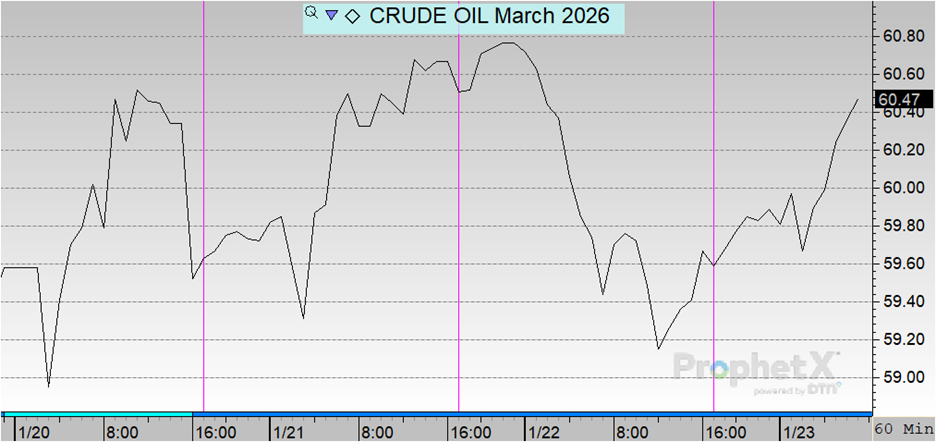
Crude prices ultimately edged higher this week as markets reacted to short-term geopolitical and weather-related risks. Crude opened the week at $59.01 on Tuesday following the holiday weekend and moved modestly higher to $59.57 on Wednesday. Prices climbed further on Thursday, reaching a weekly high of $60.68, before pulling back slightly to $59.66 on Friday. Overall, crude prices increased by $0.65 over the course of the week, representing a 1.10% gain.
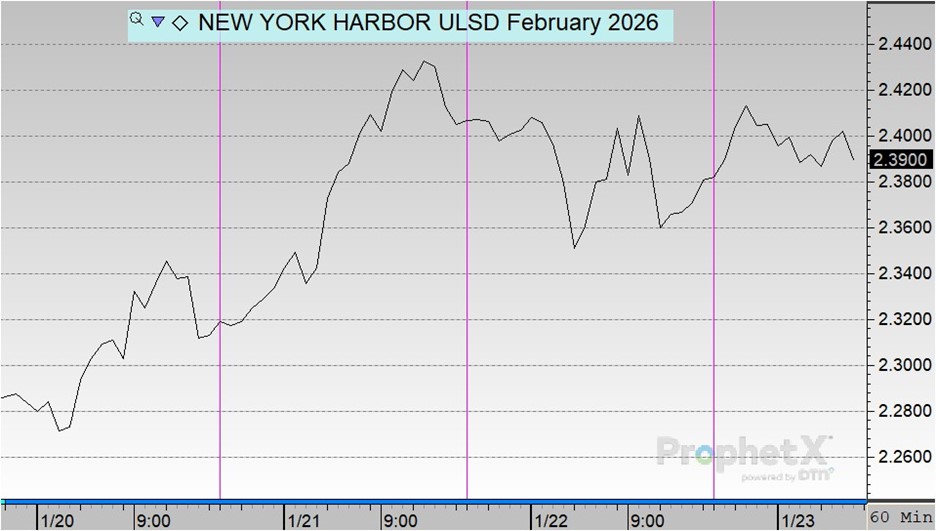
Diesel prices moved higher this week, driven by weather-related concerns and tightening short-term risk sentiment. Diesel opened the week at $2.2319 on Tuesday before rising to $2.3147 on Wednesday. Prices surged on Thursday, reaching a weekly high of $2.4059, before easing slightly to settle at $2.3798 on Friday. Overall, diesel prices increased by $0.1479 over the course of the week, representing a 6.63% gain.
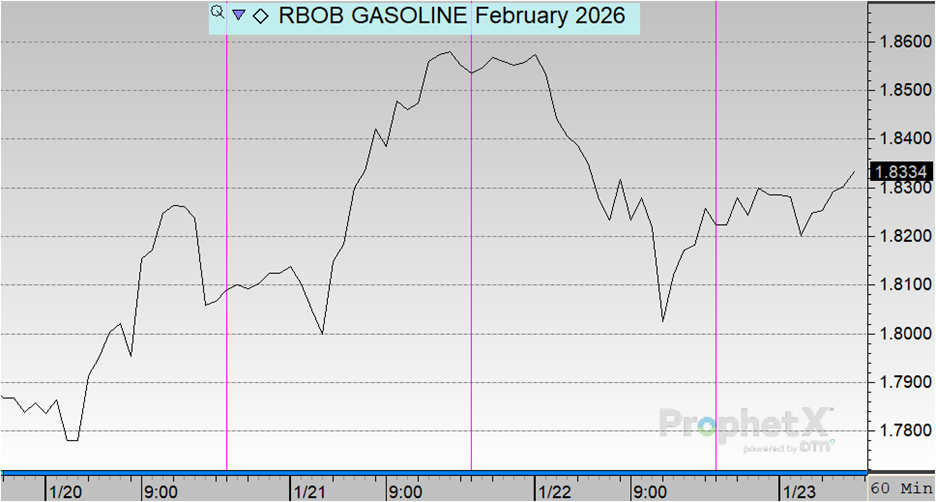
Gasoline prices moved higher this week, opening at $1.7800 on Tuesday and rising to $1.8124 on Wednesday. Prices continued to climb on Thursday, reaching a weekly high of $1.8574, before pulling back to $1.8180 on Friday. Overall, gasoline prices increased by $0.0380 over the course of the week, representing a 2.13% gain.
This article is part of Daily Market News & Insights
Tagged:


MARKET CONDITION REPORT - DISCLAIMER
The information contained herein is derived from sources believed to be reliable; however, this information is not guaranteed as to its accuracy or completeness. Furthermore, no responsibility is assumed for use of this material and no express or implied warranties or guarantees are made. This material and any view or comment expressed herein are provided for informational purposes only and should not be construed in any way as an inducement or recommendation to buy or sell products, commodity futures or options contracts.