

Week in Review – Venezuela Holds Center Stage as Markets Balance Politics & Oversupply
Venezuela was the focal point of energy markets throughout the week. In the span of just days, the U.S. has seized multiple Venezuelan tankers, announced plans to market tens of millions of barrels of sanctioned crude, and signaled intent to exert long-term control over the country’s oil sector following the capture of President Maduro. The question is no longer whether Venezuelan barrels will return to the market, but how quickly, in what volume, and at whose expense.
Washington confirmed a deal with Caracas that would redirect between 30 million and 50 million barrels of sanctioned Venezuelan crude to the United States, equivalent to roughly four months of China’s historical imports from Venezuela. The U.S. Department of Energy indicated that sales would begin immediately, with proceeds controlled by the U.S. government and earmarked for the benefit of both the American and Venezuelan people. The move effectively diverts barrels previously bound for China and signals a broader effort to assert long-term influence over Venezuela’s oil sector.
While the volumes involved are modest in a global context, the implications for heavy crude markets are more pronounced. Venezuela accounts for roughly 1% of global crude production but nearly 9% of global heavy crude output, according to S&P Global Energy.
China, meanwhile, has pushed back against the U.S. actions, denouncing them as economic coercion. With Venezuelan supply curtailed, Chinese refiners are reportedly exploring alternative sources, including Canadian crude, despite higher costs. This reconfiguration of trade flows underscores the broader geopolitical undercurrent driving oil markets, as energy increasingly becomes a tool of foreign policy rather than a purely functional aspect of supply and demand.
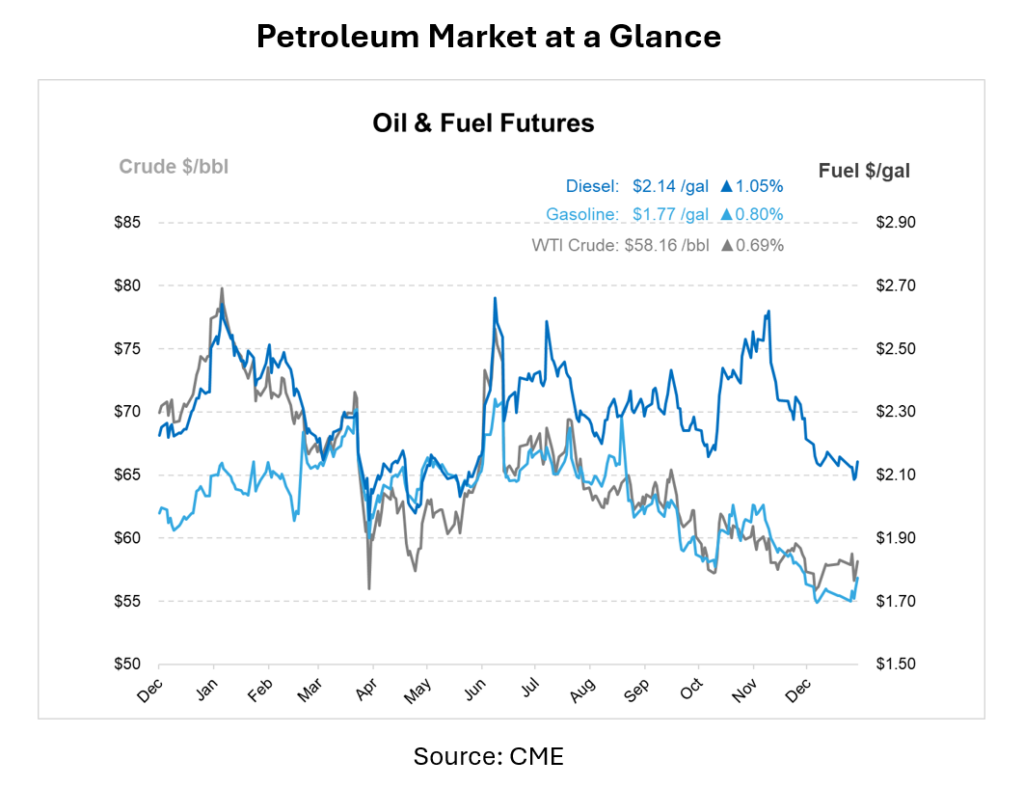
On the domestic front, inventory data reinforced the market’s bearish undertone. The U.S. Energy Information Administration reported a larger-than-expected 3.8 million barrel draw in U.S. crude inventories for the week ending January 2, while gasoline and distillate stocks posted sizeable builds of 7.7 million barrels and 5.6 million barrels, respectively. Gasoline inventories now sit roughly 3% above the five-year average, while distillate inventories remain slightly below seasonal norms. Product builds during the typically lighter holiday demand period have improved near-term fuel supply conditions and weighed on refined product futures, particularly diesel, which is approaching the $2 per gallon level.
Prices in Review
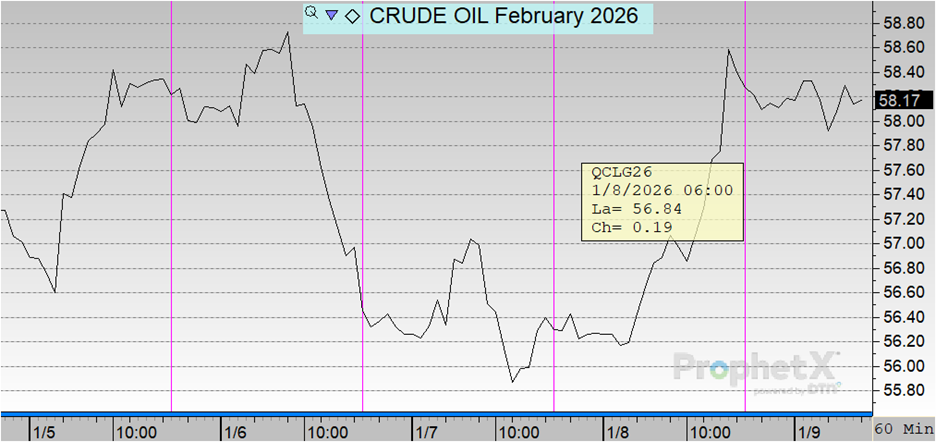
Oil prices finished the week higher as markets reacted to uncertainty alongside renewed geopolitical tension in the Middle East. WTI is just above $58, capping a volatile week that saw prices swing sharply in response to shifting headlines. While geopolitical risk briefly lifted prices, the broader market remains anchored by expectations of rising global inventories and a looming supply surplus.
Crude opened the week at $57.47 on Monday and climbed to $58.34 on Tuesday before reversing course on Wednesday, when prices slipped to $57.00. The downward momentum continued into Thursday, with crude reaching the weekly low of $56.42. Prices rebounded sharply on Friday, settling at $58.40 to end the week on a stronger note. Overall, crude prices increased by $0.93 over the course of the week, representing a 1.62% gain.
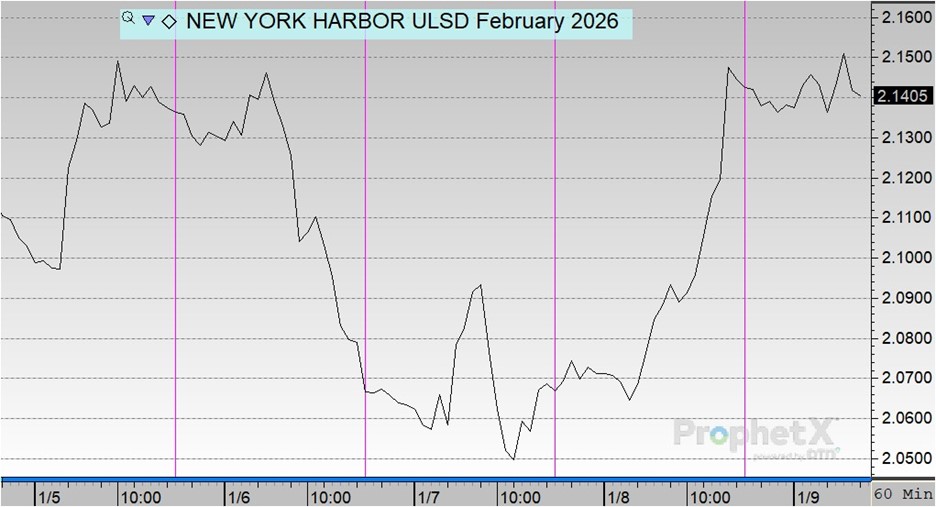
Diesel opened the week at $2.1216 on Monday and edged up to $2.1377 on Tuesday. On Wednesday, prices dropped sharply to $2.0797 and continued lower on Thursday, reaching the weekly low of $2.0662. Prices jumped on Friday, opening at $2.1450. Overall, diesel prices increased by $0.0234 over the course of the week, representing a 1.10% gain.
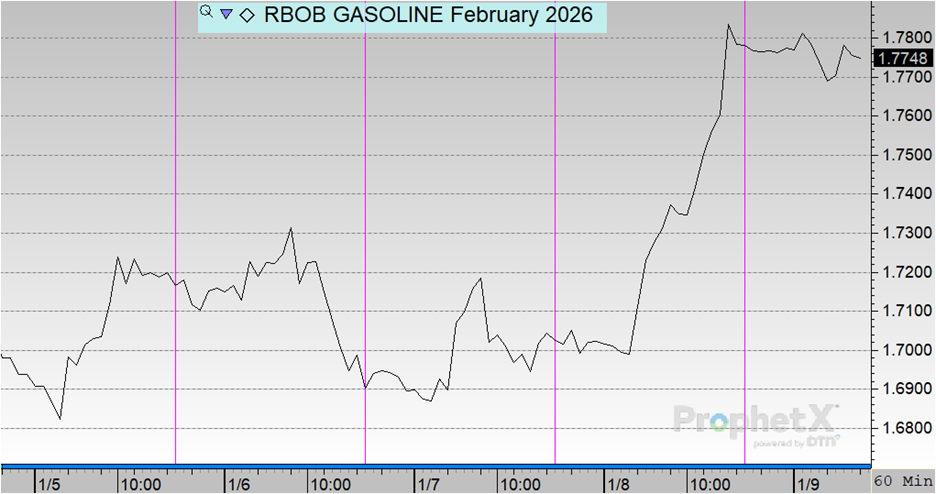
Gasoline opened the week at $1.7034 on Monday and rose to $1.7187 on Tuesday before easing lower on Wednesday, when prices reached the weekly low of $1.6981. Prices increased slightly on Thursday at $1.7016 before surging on Friday, settling at $1.7749 to close out the week. Overall, gasoline prices increased by $0.0715 over the course of the week, representing a 4.20% gain.
This article is part of Daily Market News & Insights
Tagged:


MARKET CONDITION REPORT - DISCLAIMER
The information contained herein is derived from sources believed to be reliable; however, this information is not guaranteed as to its accuracy or completeness. Furthermore, no responsibility is assumed for use of this material and no express or implied warranties or guarantees are made. This material and any view or comment expressed herein are provided for informational purposes only and should not be construed in any way as an inducement or recommendation to buy or sell products, commodity futures or options contracts.