
Diesel Inventories Are Headed for Multiyear Lows. Is Your Business Ready?
What if the price of diesel suddenly spiked – would your business be ready?
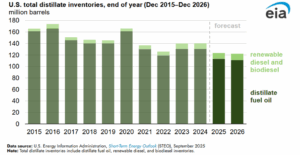
According to the U.S. Energy Information Administration (EIA), diesel inventories are forecasted to end both 2025 and 2026 at multiyear lows. That’s not just a number, it’s a warning. Lower inventories mean a higher risk of price volatility, especially during peak demand seasons like the autumn harvest and winter heating months.
What’s driving the forecast?
The EIA’s September Short-Term Energy Outlook paints the picture. Several factors are converging to push diesel inventories to historic lows:
- Sharp inventory draws down in early 2025 – down 17%, or 22 million barrels, compared to the average 10% drop in previous years.
- Reduced supply of renewable diesel and biodiesel, which led to increased demand for petroleum-based distillate.
- Strong export demand, especially from European countries, replacing Russian fuel.
- Refinery closures in Houston and California, cutting domestic production capacity.
Even though inventories have ticked up slightly since the forecast was published, they remain relatively low, keeping the risk of price spikes very real.
What Does This Mean for Your Business?
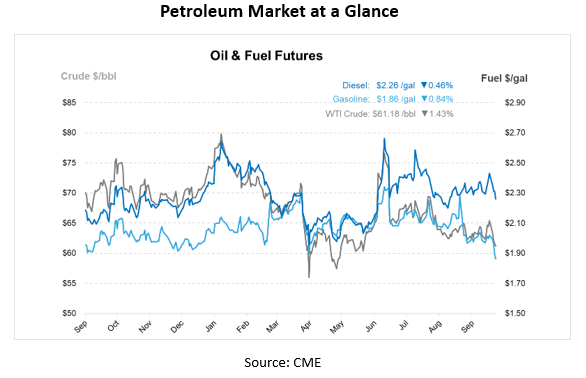
If your company relies on diesel, whether for transportation, backup power for generators, heating, or operations, you’re exposed to market volatility. Fuel costs are one of the most volatile line items in many operational budgets, and when prices swing, the impact on the bottom line can be immediate and severe. The question isn’t whether diesel prices will rise, but when – and by how much.
At this point, you should ask yourself:
- Can you afford to gamble at fuel prices?
- What happens if diesel jumps $1 per gallon next quarter?
- Are you budgeting based on hope or strategy?
Protecting Your Bottom Line
Here’s where Mansfield comes in. Mansfield manages fixed price fuel contracts for customers across the country, helping them eliminate risk and stabilize fuel budgets. A fuel price risk management program allows businesses to lock in a fuel price for a set volume over a defined period. That means no surprises, no budget blowouts, and no scrambling when the market shifts. Whether you’re a fleet operator, waste services provider, or logistics company, Mansfield’s program offers a way to mitigate market volatility, customize contracts to your risk profile, and gain transparency and control over fuel costs.
As Mac Cullens, Director of Pricing at Mansfield, puts it: “You should consider protecting yourself from the known unknowns.” It’s a powerful reminder that while we can’t predict every market disruption, we already know the risks are real and rising. The EIA’s forecast isn’t just a possibility; it’s a reality unfolding in real time.
Are You Ready for What’s Coming?
With diesel inventories forecasted to remain tight and global demand showing no signs of slowing, now is the time to act. Don’t wait for the next price spike to rethink your fuel strategy. Let Mansfield help you protect your bottom line and turn uncertainty into opportunity. Contact us today to learn more about Mansfield’s fixed price program and how we can help you protect your bottom line.
This article is part of Daily Market News & Insights
Tagged: backup power, Biodiesel, business strategy, Diesel Inventories, EIA forecast, Energy Markets, energy outlook, Fixed-Price Fuel Contracts, Fuel Cost Control, Fuel Price Volatility, fuel supply, Oil futures, petroleum market, Price Risk Management, Refinery closures, renewable diesel, risk mitigation, transportation


MARKET CONDITION REPORT - DISCLAIMER
The information contained herein is derived from sources believed to be reliable; however, this information is not guaranteed as to its accuracy or completeness. Furthermore, no responsibility is assumed for use of this material and no express or implied warranties or guarantees are made. This material and any view or comment expressed herein are provided for informational purposes only and should not be construed in any way as an inducement or recommendation to buy or sell products, commodity futures or options contracts.