

California Pushes Long-Term Climate Policy and Short-Term Supply Relief
California has taken two major legislative steps that will shape its energy landscape for decades to come. Governor Gavin Newsom signed AB 1207 and SB 840, extending the state’s carbon market, which has now been rebranded as Cap-and-Invest, through 2045. The bills strengthen environmental safeguards, maintain the offset cap, expand consumer protections through larger California Climate Credits, and ensure continued progress reporting from regulators. The extension provides long-term certainty for the state’s carbon allowance market and supports future linkage with Quebec and Washington programs.
At the same time, Newsom signed SB 237, designed to stabilize California’s petroleum market by allowing up to 2,000 new drilling permits. The law also streamlines environmental reviews, enhances pipeline safety standards, and gives the governor authority to temporarily suspend CARBOB gasoline blend requirements during periods of sharp retail price increases. This move comes as California faces declining oil output, heavy reliance on imports, and the upcoming closure of two major refineries representing over 17% of the state’s refining capacity. Collectively, these policies support California’s dual strategy of increasing oil supply to maintain short-term market stability, while simultaneously strengthening long-term objectives for carbon reduction.
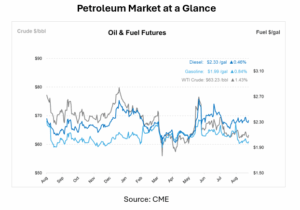
In petroleum markets, oil prices are experiencing bullish pressure this week, with Brent and WTI both on the rise after multiple sessions of declines. Bullish sentiment is coming from delays in the restart of Kurdish crude exports and disruptions to Russian refining caused by drone strikes. WTI crude oil has increased by approximately $1 per barrel today to reach $63. Futures for diesel and gasoline have also shown upward movement.
Gasoline prices remain volatile, particularly in California, where supply challenges loom. The scheduled closure of the Phillips 66 Los Angeles refinery and Valero’s Benicia plant next spring will remove significant refining capacity, keeping retail prices elevated relative to the national average. Seasonal demand patterns and blend requirements continue to play a role, with any temporary waivers of CARBOB standards likely to offer only short-term relief.
This article is part of Daily Market News & Insights
Tagged:


MARKET CONDITION REPORT - DISCLAIMER
The information contained herein is derived from sources believed to be reliable; however, this information is not guaranteed as to its accuracy or completeness. Furthermore, no responsibility is assumed for use of this material and no express or implied warranties or guarantees are made. This material and any view or comment expressed herein are provided for informational purposes only and should not be construed in any way as an inducement or recommendation to buy or sell products, commodity futures or options contracts.